hejenemy's Notes
2026
The Cabin at the End of the World
By Paul TremblayAlso - and this isn't Tremblay's fault but, sorry pal - one of the all time horrible narrations I've heard. I wonder how much of my feeling like all the characters were acting irrationally had to do with the narrator seemingly trying as hard as possible to make them all sub-50 IQ point slurring idiots.
Whatever. Get this away from me.
On the Calculation of Volume (Book II)
By Solvej BalleAgainst my better judgement I read Volume II. I love the cover. I love the concept. I love the translation. On paper I love everything about this. But the execution just isn't there. This is so boring, and so frustrating. A women stuck in time, driven mad by a constantly recurring Nov 18, unable to pregress through life. Unable to build relationships, feeling herself gradually hollow out. She moves through the world an empty shell, a ghost, consumed with guilt, with doubt. What is she? Is she even alive at this point? Is anyone else alive?
Am I a stupid person? I just don't get it. There must be more to it that this. Is this book actually about something else entirely? Is this all metaphor and philosophy wrapped in a veneer that everyone can see but me? I am desperate for her to take a critical look at what is actually happening. To try to understand it, or to come to terms with it with any kind of real reckoning. Instead we just get endless paragraphs like this: When I sit in my backyard I can tell that my time is a container. That is how it is. It is a day one can step into. Again and again. Not a stream which one can only dip into once. Time doesn't fly anywhere, it stays still, it is a vessel. Every day I lower my body into the eighteenth of November. I move around but nothing runs over the edge. Time is a space. Time is a room. Time is my backyard in afternoon sunshine, with the sound of cars, with trams in the distance. My day is a container filled with a mild breeze and sunshine every day around three. The night is a container with a medlar tree that rustles in the breeze, and the night says danke when the fruit falls. What is the point of all this? This paragraph very neatly sums up both the style but also the substance of the entire novel.
And yet, despite having not liked this book, and having not liked its predecessor, and being quite sure that Volume III will be almost identical in tone and substance, I am still strangely drawn to it? Will I continue this series? I hope not! I shouldn't! But I feel like I see it there in the distance, coming closer.
Yesteryear
By Caro Claire BurkeThe ending wasn't very satisfying, but it never really could have been. Better than it had to be, but still squarely in the category of 'airport bookstore classics'.
The Sentence
By Louise Erdrich
Pretend I'm Dead
By Jen Beagin
On the Calculation of Volume (Book I)
Shortlisted for the 2025 International Booker Prize
By Solvej BalleThe book centers around a classic 'Groundhog Day' style time loop trope, which is such an easy hit for me. My issue is that the style of the narrative is just too... floaty and internal, maybe. We sit alongside the main character, reading her journal entries as she keep experiencing the same day over and over. The language and style in the book is very artsy, focused on her internal state of mind. Lots of abstract language about the loneliness of being stuck in time, and of the estrangement from her husband and other humans as she becomes more and more trapped in whats happened to her. She feels like a monster, consuming time, sucking resources out of the world. That's all fine, and it's good. But what kills me is the lack of pragmatism and precision. This is just the most deeply incurious person you could imagine. She doesn't think critically, she doesn't explore what is or isn't affected by her time loop. She makes terribly flacid attempts at it, tiny references to how some things (food) seem to regenerate daily, or move themselves back to their original position, and others don't -- others seem permanently consumed, or don't reset their position/condition daily. And she just, doesn't care? Of the year she spends in the time loop, she spends about 300 of the days in the same place. Often literally without leaving the room, spiraling into a malaise about the passage of time. There is no philosophical inquiry into the experiences of others. Are these forked dimensions? Do other people go on to have "next" days? Do her actions and interactions with them disappear each night, or do they live on in separate lifetimes, separate timelines, forever?
This is somewhat infuriating to read. I'm desperately curious about what's happened, how to get out of it, how to take advantage of it, etc, and she just, isn't. It's really awful. Imagine Palm Springs but where Andy Samberg is depressed and just never leaves his hotel room.
I genuinely don't understand the praise. Did I not get it? Did I miss something obvious? Is the point that there is no point?
Amazing cover, though.
Crux
By Gabriel TallentThis was spectacular. I loved it. I love his characters, they'll stick with me for a while.
Moonbound
By Robin Sloan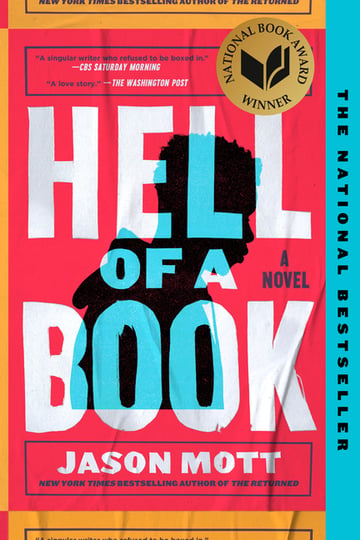
Hell of a Book
National Book Award Winner
By Jason MottThat said, I found the title distracting, and didn't love the cover.
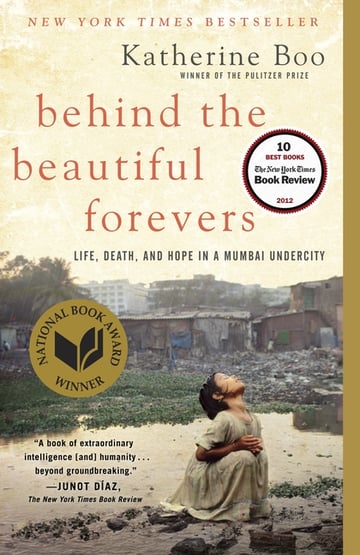
Behind the Beautiful Forevers
By Katherine Boo
Abdul had been aiming for a future like the past, but with more money. The rage of a neighbor with less money had played no part in his calculations. He didn't know if his mother was right about an earlier, peaceful age in which poor people had accepted the fates that their respective gods had written on their foreheads, and in turn treated one another more kindly. He just knew that she didn't really long for companionable misery. She'd known abjectness, loathed its recollection, and raised her son for a modern age of ruthless competition. In this age, some people rose, and some people fell. And ever since he was little, she'd made him understand that he had to rise.
2025
Exercised
Why Something We Never Evolved to Do Is Healthy and Rewarding
By Daniel E LiebermanNot great, honestly. Not bad, either, but mainly not memerable. The book explores how odd the idea of exercise is; why is it good for us? Is it even good for us? Did we evolve for this? If not, why is it still good? Etc.
The Stand
By Stephen King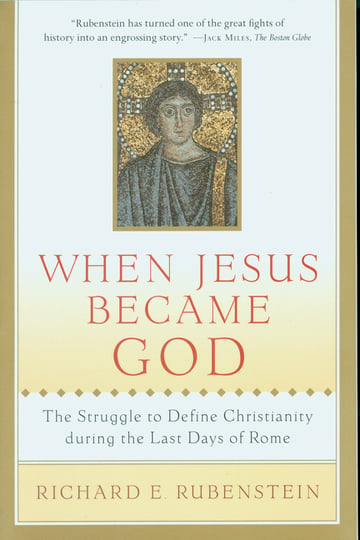
When Jesus Became God
The Struggle to Define Christianity During the Last Days of Rome
By Richard E Rubenstein
The heart of Arianism was the idea that radical improvements in human behavior need not await the apocalypse or be limited in this world to a cadre of religious specialists. With its popular base among city artisans and workers, sailors and merchants, monks, sodalities of virgins, and young people, it represented a radical impulse in Christianity: the drive to infuse worldly existence with the spirit of Christ, and so renew human society.
Arius’s Jesus: a beacon of moral progress sent not so much to rescue helpless humans as to inspire them to develop their own potential for divinity
Was the Arian controversy resolved? Roman Catholic and Orthodox Christians who today recite the Nicene Creed (as amended at Constantinople) would doubtless answer, “Of course.” With the adoption of the Cappadocian Fathers’ theology, the Catholic Church recognized Jesus as God incarnate, the Second Person of the Holy Trinity. Arianism in its original form disappeared rapidly as a living force within the Roman Empire, and by the seventh century the last of the Arian tribes in Western Europe had been converted to Catholicism. About one thousand years later, Arian beliefs would be espoused by a number of well-known English Protestants, some of whom would go on to create Unitarianism. But for most Christians the question of Jesus Christ’s divinity was settled at Constantinople in 381
2024
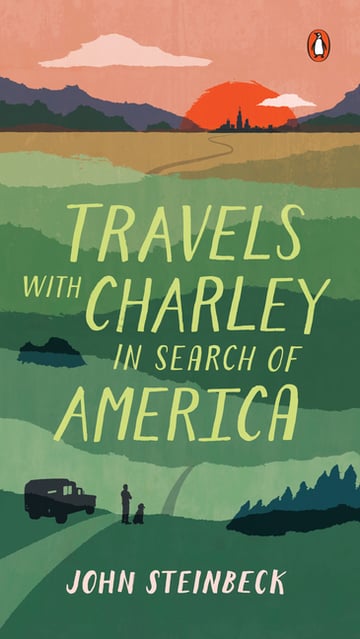
Travels with Charley
In Search of America
By John Steinbeck2023
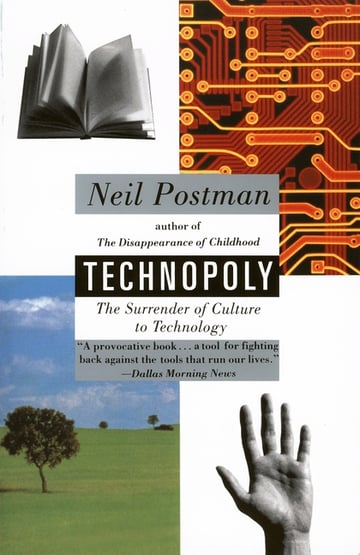
Technopoly
The Surrender of Culture to Technology
By Neil PostmanAbsolute barnburning noodle cooker. Incredibly prescient. Terrifying.
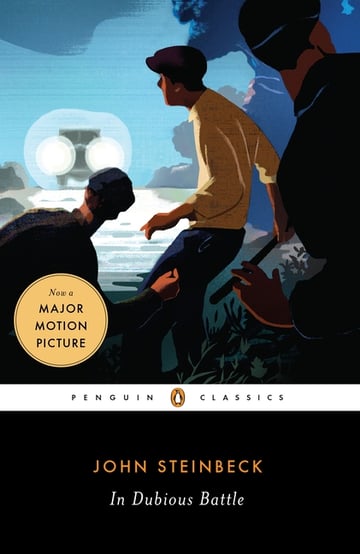
In Dubious Battle
By John Steinbeckinteresting how uncommitted Mac and Jim are to the single strike they are pushing in the novel - they have an interesting long term view.
Shift
Book Two of the Silo Series
By Hugh HoweyThere is a lot to like in this book. For starters, it addresses my main complaint about Wool, being that Howey was a terrible coward and stuffed that book into a 'good guys versus bad guys' trope where love and truth conquers all. This followup clarifies the position of the 'bad' guys from Wool, and introduces a lot of ambiguity and complexity about their intentions and moral standing.
Unfortunately, this is just not a good novel. It's boring at times, it bounces around times/settings/characters far too much, rehashes details from the first novel, and ultimately just isn't compelling to read at all. It's better thought of as an interesting appendix to Wool.
The good news, maybe, is that by the ending the timeline is back aligned with the ending of Wool, only now with the much broader perspective on the motivations of the designers of the silos. So at the very least the stage is set for an interesting book 3 - but to be honest I don't think I have the stomach for more.
God, Human, Animal, Machine
Technology, Metaphor, and the Search for Meaning
By Meghan O'GieblynVery good, but not really a page turner. I actually found myself more interested in O'Gieblyn's personal theological journey than I did in the AI/tech story. Still though, very interesting conversation about all the rhymes between religion and tech.
11/22/63
By Stephen KingThis was fine. It was fun to listen to, but missed on a few areas.
It was great to run into Bev and Richie in Derry, and intersect with elements from It. What I liked most about that book had been the haunting pallor given to the town Derry as an entity, and that still carried through here.
King had a lot of opportunities to get into some philosophic weeds on time travel, but chose to skip it entirely. I'm fine with him not taking a swing at explaining the unexplainable, but not okay with the characters not thinking about it. The entire point of this novel was to change the past in an effort to reduce global misery - but Jake never gave a thought to what happened to the worlds he transitioned out of. Either they keep on existing in some kind of multiverse thread, in which case he really isn't changing anything, just traveling to new worlds, or he is in fact killing everyone in the entire world when he leaves it. I feel like Jake would have struggled with this, but never did.
The Children Money Can Buy
Stories from the Frontlines of Foster Care and Adoption
By Anne MoodyBroad overview of foster and adoption practices in the US, primarily in the 80s/90s though. Not as much contemporary info as I'd've liked.
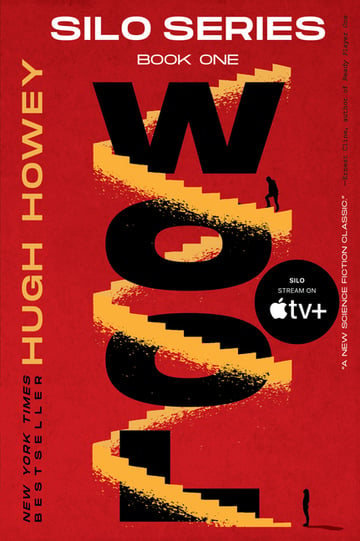
Wool
Book One of the Silo Series
By Hugh HoweyGod damn it this was close to being a good book. Somewhat similar to The Hunger Games series (and in fact quite similar to the district 13 portions of the final book), this was a fun take on socio-dystopic post-apocalypse sci-fi. And, exactly like the final Hunger Games book, Howey lacked the courage to write a proper ending.
The premise here is that humanity lives in a silo because the outside is uninhabitable. It's been so long that no one knows what's outside the silo, or why they're inside, or frankly what the distinction even means. Their entire universe is a 146-floor spiral silo, with thousands of people living and dying, with no one the wiser. There is a single door at the top, and everyone who's ever gone outside of it has died because of the poison air. There are some other details but that's the jist.
Only one man knows the truth of the silo, which is that at some point in the past there was a calamity, causing the outdoors to be uninhabitable. To survive as a species, humans needed to go underground. Much like grain, they built 50 such silo's to house human beings (seeds) until some indeterminable point in the future when humans would be able to survive outside again.
The clever piece of the book is the problem the original silo planners faced. The single goal of the silo project was to allow humanity to survive. Human beings will need to survive inside for many hundreds, and maybe thousands of years. How then could you maximize odds of long term survival? How would you physically design the silo to prevent disease? To prevent social strife? To prevent war? Rebellion? How do you minimize the odds of failure, given everything we know about human behavior?
Making things durable for the very long term is in fact an interesting problem (e.g., the 10,000 year clock project). Introducing a human component is a very rich vein of behavioral and ethical complexity. Howey skims this vein. He brushes up against it, and then quickly backs off into more tried-and-true pop sci-fi fiction tropes.
Ultimately and inexcusably, Howey ends the book with a childish and sophomoric appeal to truth, love, and freedom. A feel-good ending where the protagonist wins because she fought hard for these ideals. Left unsaid is that she has in fact doomed the entire silo, now burdened with the truth of their situation. They will now know that they are not alone, that an outside exists, that they are meant to be seeds. They will question authority, they will fight for new and disparate preferences, for enlightened 'rights', and someday there will be a war. People will die, and in their desperation, they will doom the silo. With enough time, it is now inevitable.
Howey built an incredible allegory illustrating that in fact sometimes truth, love, and freedom are not nearly enough. It's sad. It's awful. It feels horrible to learn that and then sit with it, to really understand what it means. And then right at the end, when it was time to twist the dagger and make the audience come to terms with this loss, he lost his nerve. He betrayed the entire book that he had written and entirely capitulated to his better angels.
So much promise, dashed. Such a shame.
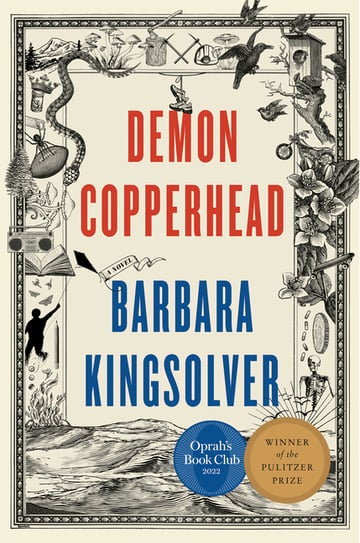
Demon Copperhead
By Barbara Kingsolver- Novel of Appalachia. Goes a long way in explaining the feeling of having been both disdained and forgotten, as well as exploited, for hundreds of years.
- land economy vs money economy people and lifestyles. (being poor is worse in the city, when money is all you have).
- a picture of addiction as desease. why do we put addicts in prison? (crossover w/ the pretenders)
- saving your juice
Lucy by the Sea
By Elizabeth StroutEveryone needs to feel important.
This is a fabulous book. I really loved it. It's just a joy to read, and effortless to do so, it went by very quickly. Things I liked:
- Strout nails empathy. The book is written entirely from Lucy's internal perspective, but even so, Strout does an incredible job of having Lucy recognize and attempt to empathize with people and 'think how they think'. She is very kind, and shows incredible grace, even (and especially) when dealing with people much different from herself.
- She perfectly captured the feeling of the early pandemic. The entitlement that came with thinking "this might be a big deal to other people, but will never affect me". The general disbelief, once it did. The awkward interactions with other people. The terrible sense of no one knowing what is right, but everyone generally trying there best.
- I'm sure I must be wrong, but I can't think of another book I've read from the perspective of an old women and I really loved it. I think Strout did a good job balancing out the wisdom of age along with a brutally honest indifference towards life, a not knowing what the hell the point was or if it had even gone well. She also illustrates a general anxiety about being old, about just knowing that you don't have much time left - that the things you're doing now will be the last things you do, that you're no longer building towards something... you just, are.
I am delighted to learn that there are at least three other books in the universe of these characters, and I'm excited to read them.
The Great Pretender
The Undercover Mission That Changed Our Understanding of Madness
By Susannah CahalanI loved Cahalan's Brain on Fire from a few years ago, and was excited to read this followup. This book is in some ways a natural consequence of her first. In Brain on Fire, Cahalan wrote about her experience with autoimmune encephalitis, which can be summed up as 'no one knew what was wrong with her, they pretty much decided she was just going crazy, and then one doctor got lucky and realized finally what the physical problem was with her brain'. Cahalan is very aware, in retrospect, how close she was to never receiving a correct diagnosis and just being written off as having gone crazy. How is it that we know so much about neuroscience these days, and yet so little about mental disease? And why is the standard of care for someone with well understood physical problems so different than a patient with poorly understood mental ones?
I had seen how doctors’ labels altered the way they saw me: During my hospitalization, one psychiatrist described my plain white shirt and black leggings as “revealing,” for instance, and used it as proof that I was hypersexual, a symptom that supported her bipolar diagnosis. It’s hard to ignore the judgment that comes with those kinds of labels. Yet the minute the doctors discovered my issues were neurological—after I had spent weeks living with a psychiatric diagnosis—the quality of care improved. Sympathy and understanding replaced the largely distant attitude that had defined my treatment, as if a mental illness were my fault, whereas a physical illness was something unearned, something “real.”
Cahalan wants to understand this entire system better, and so does a deep dive into the history of psychiatry, which turns out is really just a dumpster fire. 100 years ago we had literally no idea what we were doing. And somewhere along the way we made the DSM to at least try to start a system for classifying these issues, and the DSM is just continually revised as we learn more (e.g., homosexuality was classified as mental illness in DSM-I). But really, we're still making it up as we go along.
The book becomes anchored by David Rosenhan, a Stanford phycologist who became famous for his study "Being Sane in Insane Places", which tracked a handful of pseudonymous volunteers, all of them sane, who submitted themselves into psychiatric institutions with fake symptoms. Once inside, they'd act perfectly normal and see if they could 'earn' a positive diagnosis and be released from the hospital/ward. In the study, basically every patient fails this, and even after acting normally for a week or so can't convince the hospital that they are mentally healthy. The paper lit a firestorm around the industry, obviously suggesting that the entire field of psychiatry was bogus pseudoscience at best. It continues to be heavily cited.
Cahalan was deeply interested in the study as it really drives home her concerns on psychiatry in the US, so she started to dig into the details. The book sort of went off the rails at that point, because Cahalan did some fantastic journalism and turns out that Rosenhan essentially fabricated the entire thing. What begins as a book about psychiatry really transitions into a mystery around Rosenhan's study. It's a fantastic unravelling and a wonderful example of how a single person who refuses to settle can uncover what has been missed by an entire generation of people... but from a narrative perspective it doesn't do the book's original focus any favors.
Overall still very strong, and really excellent journalism. Just, a bit odd.
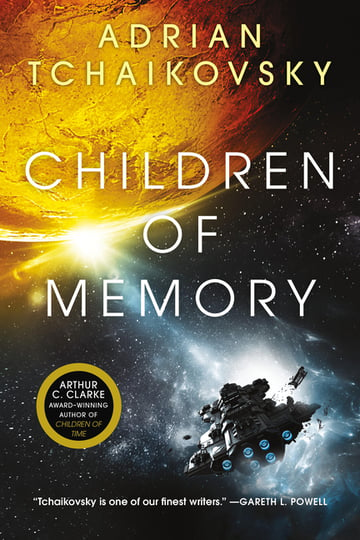
Children of Memory
By Adrian TchaikovskyI wrote a lot about this, not sure what happened to it.
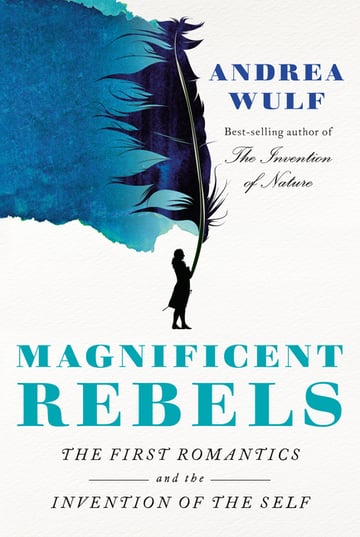
Magnificent Rebels
The First Romantics and the Invention of the Self
By Andrea WulfI know a fair amount about the history of science, but far, far less on the history of either art or philosophy. That is a somewhat fitting position to be in when beginning this book, which chronicles the Jena Set, a small group of academics, writers, philosophers, and general thinkers in Jena, Germany, in the 1790s, who gave birth to Romanticism. From ChatGPT:
Romanticism was a philosophical and artistic movement that originated in the late 18th century as a reaction against the Industrial Revolution and the Enlightenment's emphasis on reason. It emphasized individualism, emotion, intuition, and the beauty and spirituality of nature. Romantic thinkers rejected the mechanistic view of the universe, instead asserting that the world was alive, interconnected, and full of inherent meaning. They also stressed the importance of imagination and creativity, viewing art as a means of transcending everyday reality.
It's very interesting how quickly the Enlightenment shifted consensus thought on science/nature to being entirely deterministic. Romanticism was a rejection of that materialism, and broadly seemed to be an exploration of the self as a necessary participant in nature, the self almost as a precondition for nature to exist at all.
Some thoughts:
- I loved the sense of urgency throughout the book. The Jena Set lived during an incredible time, one where it was possible for a person with money (such that one doesn't need to labor to survive) could learn everything there was to know, at that point. A moderately intelligent person could study for 10ish years and just literally know everything there was about science, nature, most of math, medicine, etc. There just hadn't been enough time and specialization yet. So it was a period of incredible, intense discovery. Wulf captured that very well. These people knew that they could actually figure this stuff out, that they were capable of finding the right answers about anything, because such answers were being found all the time. That, paired with people knowing how especially fragile life was, and how they could literally catch a cold and be dead in a week. It created this incredible opportunity, an acknowledgment that they only had this very small window to figure out how the world works, and they needed to take it.
- I'll admit I did not follow along well for most of the first half of the book. Way too many characters with similar names. Names that were only different by one letter, identical first names, etc etc. I just had a lot of trouble differentiating people, which meant I sort of tracked 7ish identical characters in my head, since I couldn't track who was who. It made for a much less engaging story.
- This book simply wasn't as good as The Invention of Nature. I found that one compelling all the way through, and Alexander von Humbolt was an incredible character. No one here got anywhere close to the motivations and development, and so there wasn't much driving me to turn the page.
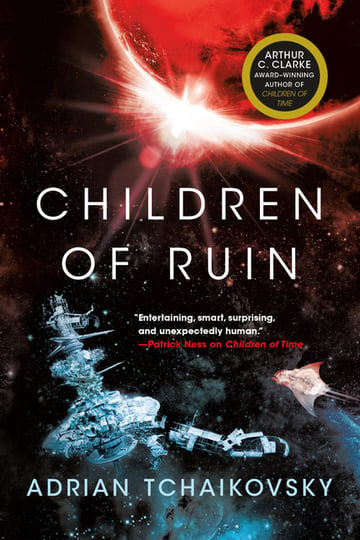
Children of Ruin
By Adrian TchaikovskyGreat book. Really ambitious, creative. I had more to say, but haven't said it yet. check two.
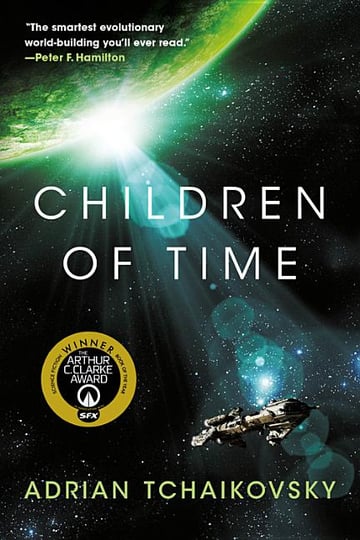
Children of Time
By Adrian TchaikovskyGreat sci fi. Really good at explaining perspective from non-human beings, and imagining how that world develops from a non-anthropocentric point of view.
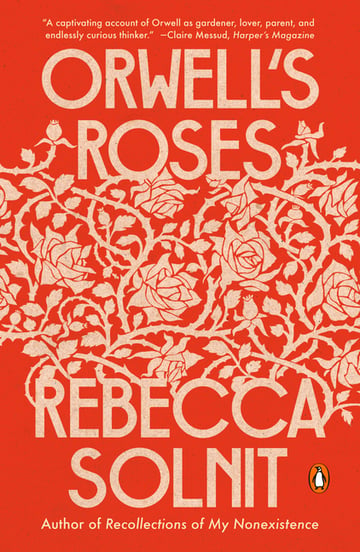
Orwell's Roses
By Rebecca Solnit
The people of 1936 had a confidence so deep it was like an unexcavated strata in their consciousness: that the world was big enough to resilient enough to absorb our harm, that the damage was always going to be local, that whatever we did to the parts would not undermine the whole, that there would always be more. Human beings behaved like a child who believes his mother is immortal no matter what, but the child had grown huge and powerful with powers beyond the human in his tools, machines, and chemical inventions, and he was striking blows that were damaging and changing the system itself.
The writer and actor Peter Coyote once remarked that no one cries over artificial flowers, and there's a particular kind of disappointment when you begin to admire a bouquet or a blossom at a distance and find out closer up that it's fake. The disappointment arises in part from having been deceived, but also from encountering an object that is static, that will never die because it never lived, that didn't form itself out of the earth, and that has a texture coarser, dryer, less inviting to the touch than a mortal flower.
She reminded me what my Black neighbors had taught me earlier that decade, that the yearning to be more rugged, more rustic, more rough, more scruffy, is often a white and a white-collar yearning, and that those who have only recently escaped agricultural work, maybe sharecropping or slavery or migrant labor, who have survived being treated as dirty or backward, are often glad to be polished and elegant. You have to feel securely high to want to go low, urban to yearn for the rural, smooth to desire roughness, anxious about artificiality to seek this version of authenticity. And if you see the countryside as a place of rest and respite you're probably not a farmworker.
2022
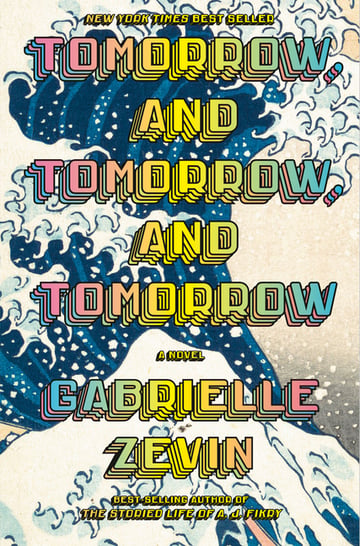
Tomorrow, and Tomorrow, and Tomorrow
By Gabrielle ZevinLoved it. Videogames, work, love, hate, loss, acceptance.
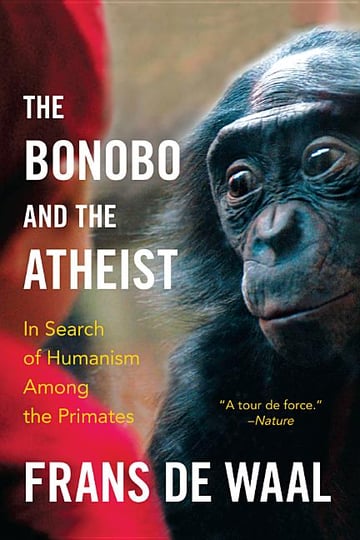
The Bonobo and the Atheist
In Search of Humanism Among the Primates
By Frans de WaalA decent book I bailed on. It had interesting ideas for sure, but the author just couldn't get over himself and I found myself not reading any at all for months because I didn't want to pick this back up.
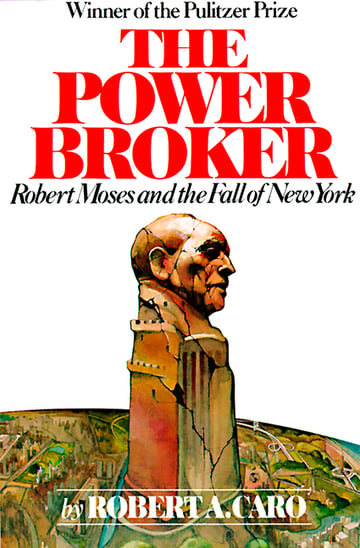
The Power Broker
Robert Moses and the Fall of New York
By Robert A CaroThis was an absolutely epic biography of Robert Moses that I unfortunately didn't write about in real time. And, having listened to the book on Audible, I'd need to spend hours going through bookmarks in order to really capture the good stuff. So instead of not doing that and having this sit in my drafts folder for another 8 months, I'm going to say this about it.
One, it was an absolutely killer description of someone who sought and wielded power for its own sake. A maestro of having everything he actually needed, but just wanting more power. More flex. Not more money, not more influence. More power.
Second, it was an incredible story of how power corrupts. Moses didn't come from much money and started out as an earnest reformer, someone who legit wanted to improve the lives of the everyman. And as he accumulated power his goals strayed, bit by bit, to where they became entirely, irrevocably exclusive of what originally motivated him.
Anyway, the book is long, but never feels too long. It's probably the best biography I've read. Caro goes deep.
True Biz
Reese's Book Club
By Sara NovicNovic's followup to Girl At War is no disappointment. I'd been looking forward to her next work literally since finishing that last book, and was delighted to see it finally released. This book challenged me to consider two main things.
First, the book does an incredible job (I think, I mean, I can't exactly verify this) at describing the lived experience of being deaf. What I mean by that is that Novice peppers the text with little actions the characters do that I absolutely never would have thought about as a hearing person. For example, there is a scene where three deaf children are driving a car in the dark, and Novic mentions, somewhat in passing, that they have the console lights on in the car. They need the light on in order to be able to sign to each other. The book is just littered with little things like that, little "huh" moments that really help empathize with the experience of being deaf. But it's deftly handled and never made super explicit, it's just very good writing.
Second, the main theme of the book is that deaf people are full humans, not to be marginalized. There is a very rich culture, and full and vibrant lived experience, of being deaf. Novic really highlights this, in a way that suggests that if there were some magical way to make all people going forward fully hearing, that it would actually be a terrible net loss for humanity. Obviously we don't live in that magic world, and instead live in one where deaf people are indeed heavily marginalized and despite the very little effort it would take to very enormously ease their burden of integration, the hearing really make no such effort and instead just consider the deaf similar to mentally disabled people. I think True Biz is powerful in driving home that we do not need to live in such a world. But I never cross all the way into thinking that such a better world would in fact be preferable over the magical one. Deaf people are people - and we absolutely must do better with accessibility, etc, not only because it would be so easy to do so, but also because accessibility affordances almost always improve the experience of a thing for all people, including the fully abled -- but overall I do think that the work being done to try to end deafness is good work.
Tombstone
The Great Chinese Famine, 1958-1962
By Yang JishengThirty six million people, conservatively, starved to death in China between 1958 and 1962. The Great Chinese Famine is unique in world history both in the terrible magnitude of death and suffering, but also insofar as it was an entirely political event; the famine was not preceded by war, nor by natural disaster or abnormal climate. Additionally, it happened in secret. The rest of the world, and even most of China itself, had no idea the famine was severe as it was until long after the fact. This book works to understand how that all happened. Most of this was entirely new to me, which was especially difficult. This book assumes that the reader is already very familiar with Chinese history and politics, which I am absolutely not, and so I felt like I missed a lot here due to that lack of foundational knowledge. Here's what I got:
- Mao/CCP came to power and believed that communism was a borderline-magical power that would fundamentally transform China, and the world, for the better.
- From this core belief, Mao pushed the Great Leap Forward, preaching that China would surpass UK and USA as economic and cultural powers within 10 years. (At the time, China was like, 1% of those powers).
- These ridiculous goals were pushed down a chain of sycophants, each of whom wanted to outperform the goal in order to show his devotion to the cause. So a 2x yearly production goal at the state level became a 4x goal at the county level, then a 6x goal at the commune level, etc.
- All party officials lied and said that they were surpassing their goals, increasing pressure on the others and fueling a false belief that the goals were feasible.
- Commune leaders then assumed that if they were coming up short it was due to hoarding, and so directed their cadres (local military) to terrorize, beat, and murder, anyone suspected of not giving their grain/food/goods to the party.
- Communal kitchens destroyed the local family unit. All stoves and cooking gear was confiscated from homes, so eating was only possible at the communal kitchen, controlled by the state.
- All internal/external communication was heavily monitored. Citizens did not have free mobility within China. All mail was screened and any reference to hardship was censored, with dire consequences to the sender. The only news one would receive was from the party.
All combined, this made everyone in China think that they were achieving the Great Leap Forward, and that any personal hardship was hyper local and unusual, likely due to anti-communist local actors. It was a terrible feedback loop. People were literally starving to death and often unaware of the crisis.
I ended up not finishing the book because it was simply too dense and often over my head due to lack of context. There were three key pieces that I left wanting to understand much more clearly:
- How did Mao/CCP come into power?
- What was Mao's true intention? While his sycophants only lied to him about production, certainly he must have known that things weren't going spectacularly, and that people were suffering. Did he really think that his actions were helping China, or was he a selfish, evil authoritarian exploiting his people?
- How did it end? To what extent is today's CCP the same as Mao's party? Were there no political consequences?
These are all obviously quite knowable, and I hope to learn more in the future. In the meantime, I'll leave things with this single, depressingly Trumpy quote:
Mao spoke four times at the congress. In his first speech on May 8, he described how young people surpassed the old and how those with little education excelled over the educated: “The lowly are the cleverest and the noble are the stupidest.” During the meeting, he wrote in a directive, “Dispelling feelings of inferiority … and stimulating a dauntless creative spirit of daring to think, daring to speak, and daring to act will definitely be an enormous help in achieving our goal of surpassing England in seven years and overtaking the United States in another eight or ten years.”47 Through his praise of the uneducated, Mao encouraged the public’s rejection of science and its attacks on experts and scholars.
Like a Mother
A Feminist Journey Through the Science and Culture of Pregnancy
By Angela Garbes
Regretting Motherhood
A Study
By Orna DonathThis was a Kindle sale and I wanted to read some viewpoints from people who regretted becoming mothers/parents.
I think I'm particularly interested in what it is that makes life worth living. Back when I read A Short Stay In Hell, I more or less determined that a feeling of progress was essential - one must be moving forward, towards something, in order to make life have meaning. I found a lot of that validated here, though rarely as explicitly as below.
These accounts indicate that it is not necessarily motherhood that is perceived as natural, but rather moving forward along life’s course. The idea that women have a “natural” and “normal” life trajectory does draw some of its power from the cultural idea of biological determinism, which naturally leads to motherhood. But it also relies heavily on heteronormative cultural logics that instill in both women and men that life is fundamentally a series of progressive stages—that is, a roadmap every person must follow, with milestones such as school, work, coupledom, marriage, and parenthood. This canonical narrative of a natural and normal progression specifically details what the “right” life course is and the actions required to meet each phase at the “right” time, at the “right” pace, along the “right” linear track.
The book is also largely a meta commentary on our social institutions, and the expectations that all women have children, and that they be happy in doing so. The mothers who do not find happiness in motherhood are additionally penalized by not having anyone they are able to share those feelings with. It is so deeply taboo for a mother to regret having children that these mothers feel entirely alone, unable to speak to spouses, friends, or even therapists about it.
For many women, motherhood marks the death of what I think of as the "rock star" dream. For much of life, you think that many doors remain open, and that life can still take you in new, incredible directions. Even though most people end up living mundane lives, there is a feeling that it won't happen to you, that your moment is still ahead, that you can still reinvent yourself, etc. Even now, I still hang on to a little of this feeling. Once you have children, that's it.
After giving birth to my daughters, I felt that I was not realizing myself at all. In fact, I was faced with limits … once I had children. That’s it. I can’t do it anymore … nothing … the world is not my oyster anymore. There is a certain space in my life that is very important to me; I have a yearning for spaces. And I never felt trapped before, that I couldn’t get to these spaces. Even with one child, I could still do what I wanted, but with two girls—no. That closed up my spaces, my horizons, and my progress.
Worth noting that most, (though certainly not all), of the women in this study were alone, with partners/fathers that left them. Obviously the experience of single motherhood must be entirely different than that in a supportive and economically secure family.
Interestingly, none of it was about regretting pregnancy or birth itself.
I did appreciate the discussion around the concept of regret itself as something to be ashamed of generally.
Yet on the other hand, regret can be considered “derailing” in a neoliberal, capitalist society that is founded on an ethos of progress. In this context, wherein all of one’s actions are directed toward mastering life’s challenges, regret is a defiant breach of values. Common sayings like “Don’t cry over spilled milk” (which is at once a comforting message and a command) show us that this sort of regret is seen as an emotional stance one must overcome. Self-help books abound with titles like Overcoming Regret, Letting Go of Regret, and even Regret-Free Living. To admit regret is to allegedly admit the failure of pragmatism and optimism; regret is seen as a torturous self-flagellation and a paralyzing helplessness that might lead individuals or society at large to fixate on a past that has (supposedly) ended and a (supposedly) inflexible current reality.
Not covered exactly in the quote above, but I enjoyed the nuance of mothers who regretting having children, but still genuinely loved the children themselves. This seems quite straightforward to me, but the book had many quotes from other women who found it abominable.
The last one that hit the most for me
The problematic thing for me is this responsibility for raising a person. Not the responsibility of worrying, “Oh no, he is going to …”. It’s something that sits here [gestures toward the back of the head]—you are done with your freedom forever. It’s not the freedom … I don’t know if I am explaining myself enough. It’s kind of … [before motherhood] you were only responsible for yourself; you are not responsible for your partner, because he or she is grown up; you are somehow connected to him—but [when you are a mother] it’s as though you are never alone anymore. That’s it—no more being alone, no more freedom in your head.
The Great Betrayal
The Great Siege of Constantinople
By Ernle BradfordEver since reading Venice and Istanbul by Thomas Madden, I've been fascinated by Constantinople. For reasons I really don't understand, for me it stands out even more than Rome as having such an incredible lived history. Walking through Istanbul to me feels very directly connected with the city and events of the past in a way that doesn't quite hit me the same way walking through other historical places.
This book was fine. The bullet points it hits are:
- The 4th crusade took place in 1204. The intent was to eradicate muslims from the Christian holy lands (Outermer)
- The crusaders commissioned ships from Venice. Fewer crusaders than expected showed up, and so they couldn't pay.
- The Venetians basically said 'fine you can take the ships but first you gotta do some dirty work for us against our trading competitors'. Crusaders were in a bind and so agreed.
- One thing led to another and the crusaders were outside Constantinople trying to re-install their ousted emperor (who promised to pay them handsomely for doing so). They were out of supplies and essentially had no choice, otherwise they'd never be able to get on with their crusade.
- Constantinople had stood for almost a thousand years at that point, but had been terribly mismanaged by a series of bad emperors, and their luck ran out. The crusaders took the city within days.
- Sidenote: There had once been an enormous chain linking Constantinople to the Galata tower, cutting off ships from entering the Golden Horn. Amazing.
- Anyway, crusaders took the city easy peasy. They started a fire that burned for three days. They destroyed countless churches, homes, etc. They looted everything, and generally they laid waste to a thousand years of history and culture. Which again, wasn't even their stated intent of the crusade. They only did this in order to get supplies and to pay off the Venetians.
- The Venetians didn't care at all about the crusaders. They were just trying to get paid, and took advantage of the opportunity in order to coerce the crusaders into destroying their main rival.
- The Pope was so mad at the crusaders for destroying Constantinople (a Christian city. The Christian city), that he excommunicated all the crusaders.
- The Greeks took control of the city again a few years later, but the die had been cast. The city teetered for a few hundred years and then fell permanently to the Muslims in 1453.
Interestingly, much of our knowledge of the 4th crusade comes directly from a primary source, Geoffrey de Villehardouin, who participated in it and wrote about it.
My only complaint is I wish the book covered much more about how and why the city was unable to defend itself against the crusaders. It was clear that by 1200 Constantinople had been led for several generations by inept leaders. The government and army weren't functional. I'd love to know more about the years leading up to that point, and the causes of that decline. The 4th crusade was the nail in the coffin, but it the city was in some ways already dead.
How to Do Nothing
Resisting the Attention Economy
By Jenny OdellI really expected to enjoy this. The first chapter was fantastic, about the importance of focus and resisting the constant demands for attention that are put on us. Then it sort of meandered from place to place, talking about other ways that 'doing nothing', accepting defaults, not acting, etc, can lead to productive results. It really stopped resonating pretty quickly and I got incredibly bored reading it so I just stopped.
Parts of the book were very good, which made the rest all that much more disappointing. These sections from the beginning were particularly meaningful:
Nothing is harder to do than nothing. In a world where our value is determined by our productivity, many of us find our every last minute captured, optimized, or appropriated as a financial resource by the technologies we use daily. We submit our free time to numerical evaluation, interact with algorithmic versions of each other, and build and maintain personal brands. For some, there may be a kind of engineer’s satisfaction in the streamlining and networking of our entire lived experience. And yet a certain nervous feeling, of being overstimulated and unable to sustain a train of thought, lingers. Though it can be hard to grasp before it disappears behind the screen of distraction, this feeling is in fact urgent. We still recognize that much of what gives one’s life meaning stems from accidents, interruptions, and serendipitous encounters: the “off time” that a mechanistic view of experience seeks to eliminate.
This has been on my mind for the last few years and I'm getting more and more concerned about it. I often find myself reaching for my phone even while doing other engaging, enjoyable things. Literally, I'll be playing a video game and if a cutscene or brief interaction or whatever comes up, I find myself reaching for my pocket. It's disturbing. It's been surprisingly difficult to write out this paragraph without switching tabs to see what else is 'happening' on the internet. It's scary.
Also:
A simple refusal motivates my argument: refusal to believe that the present time and place, and the people who are here with us, are somehow not enough.
I really loved this, and do also try to think about this same thing frequently. (E.g., not watching Tom Cruise movies).
War and Remembrance
By Herman Wouk
The Passage
By Justin CroninYou know, this was really a missed opportunity. Parts of it were really good. I thought the world building was great, and I'm a sucker for post-apocalyptic stories. This book opens like a solid Michael Crichton book would, science heavy. The first hundred or so pages are spent on characters you pretty much don't meet again. But things veer off towards the end, and it loses a lot of the composure that the story carried in the first half.
Also, kind of ruined by the epilogue where Cronin admits the whole thing was something he and his teenage daughter did for fun. Like they would spitball crazy ideas just for shits and giggles, and then she wanted to turn one of them into a book, and so here we are I just spent 30 hours reading it. Good for you, buddy.
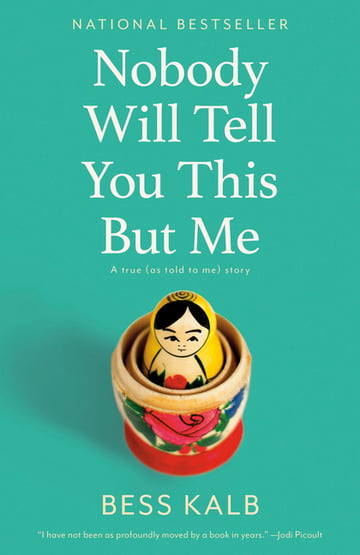
Nobody Will Tell You This But Me
A True (as Told to Me) Story
By Bess KalbEqually hilarious and sad at times, made me miss family. This book is a primarily a biography of the author's grandmother. Kalb tracks up to her own great-grandmother's harrowing story of immigrating to the USA, down to her (Kalb's) own children. The book is hilarious and poignant and touching. I think the compelling thread is slightly apart from the individual stories told throughout the chapters, but rather the macro-story of seeing the family evolve and take shape over time. Seeing how actions 80-100 years ago reverberate through the family and inform their own mythology and traditions. It's really touching.
2021
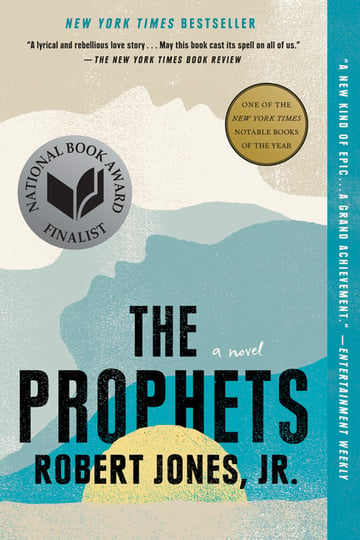
The Prophets
By Robert Jones Jr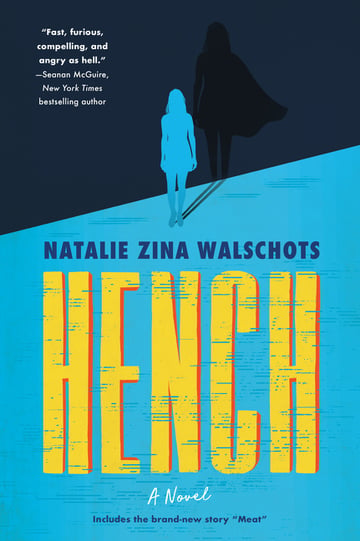
Hench
By Natalie Zina Walschots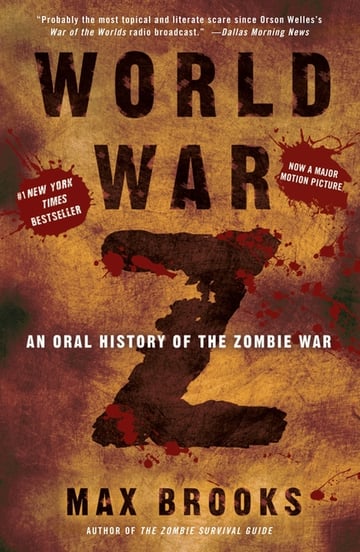
World War Z
An Oral History of the Zombie War
By Max BrooksSo this book is obviously about Zombies, which was fun and well done, but I think the format is what really makes it shine. Brooks carries this entire novel without any characters. The whole thing is an 'oral history' told from the perspective of a single journalist who interviews dozens of people years after the Zombie War, and this book is just a transcript of the interviews. The journalist hardly speaks, there are some prompted questions from them, but they aren't a character in any sense. You never learn anything about their own experience in the war. Most of the chapters are open structured essays by the interviewees, without any prompts or dialogue from the interviewer at all. I was super surprised that Brooks could carry the whole book with that format. I mean, generally you need a main character to care about, right? Well, he pulled it off.
WWZ is fun, and somehow feels authentic - possibly because the perspectives on the early days of the Zombie virus seemed so similar to our current coronavirus pandemic. First you hear whispers, and then see headlines, of a problem far, far away. Then later you see news reports of how it is severely impacting those other people, but somehow don't ever think it will be a real problem for you. And then, immediately, it is, and you suddenly live in a different world. And despite the obvious and pervasive truth that this is a Really Big Deal, misinformation and conspiracy theories are absolutely rampant. So yeah, that part was pretty depressing.
Way better than the movie. Horrible book cover.
An Ugly Truth
Inside Facebook's Battle for Domination
By Sheera Frenkel and Cecilia Kang
My Dark Vanessa
By Kate Elizabeth Russell
Four Thousand Weeks
Time Management for Mortals
By Oliver BurkemanA very worthy successor to The Happiness Antidote. I feel truly seen by Burkeman.
I took a lot of notes on this on Audible, and left it with the takeaway that I want to read the physical copy too and take quotes from there.
Central Banking 101
By Joseph J WangMore of a pamphlet than a book. Still, fantastic overview to monetary policy and international banking.
The Cult of We
Wework, Adam Neumann, and the Great Startup Delusion
By Eliot Brown and Maureen FarrellA fantastic book. This was about WeWork in particular, but the interesting parts are less about the specifics of WeWork, and more about the qualities necessary to create a bubble. WeWork was legitimately valued as a ~$40B company by some of the best bankers and investors in the world, sophisticated people that understand finance, fundamentals, etc - but was never even close to profitable, and run by a nepotistic, narcissistic, dysfunctional couple. It should have been evident to everyone at the time (and is certainly evident in hindsight) that this was a complete disaster, yet the intense FOMO didn't let anyone back off.
Related, it's an interesting review of Adam Neumann's undeniable charisma and megalomania, and how his force of will was enough to drive everyone (internal employees, external investors) to just blindly believe in him, even when the numbers weren't there. The book briefly explores this characteristic, and how other entrepreneurs (Jobs, Holmes) could perform similar feats (RDF). WeWork was an exceptionally cultish place, hence the appropriate book title. Neumann pulled the wool over everyone's eyes, not just dumb people.
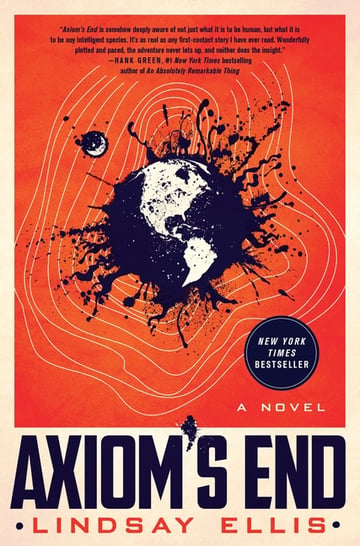
Axiom's End
By Lindsay EllisIt's very interesting to read (more or less on accident) two books back-to-back about humanity's first contact with aliens. The Weir book was super compelling, driven by interesting puzzles, and a rational, science-based reasoning throughout. This book was... none of that. This was awful. It wasn't laughably bad. The writing was... serviceable, maybe? It's just, it was deeply incurious. The characters in the book don't react the way that I guess I would think most people would. Maybe I'm wrong?
These characters are so internally driven that when they make first contact, the narrative stays all about them. How does this thing affect me? How can I use it to achieve my same, pre-contact goals? I was bored, honestly. Many times I almost gave up, even though it's a fairly fast-paced book, and I burned through most of it at 1.5x speed just to get on with things.
I didn't like it. Great cover though.
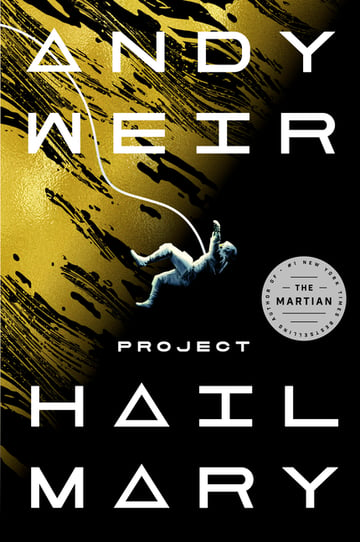
Project Hail Mary
By Andy WeirA very fun sci-fi read. This was actually very similar to The Martian, in that a lot of the dialogue was the internal thoughts of a single, isolated man. It was quite good, and I'm looking forward to the inevitable movie. Two interesting bits popped out for me:
- The premise here is that humans send a mission to a nearby star to investigate an existential crisis back at home. Near the star they discover an alien race with similar technology who is attempting the same thing. There is interesting discussion about why the two different species would be so similar in terms of technological evolution, and the theory is that they are sort of in a 'goldilocks' zone where each had sufficient tech to be able to launch such a mission, but were to so advanced as to not even have to worry about it (i.e., a more advanced civilization likely wouldn't be facing the existential crisis at all). This was sort of an interstellar version of the anthropic principal.
- Second, there was similar discussion about why the two species were roughly of the same intelligence. While this is partially explained by the above, they also theorized that intelligence evolves as a solution to hunt / survive, and so will only do so up until a species is smart enough to survive. This is generally limited by the speed necessary to capture / kill / dodge / escape; that is, the speed at which large matter can interact, which is more or less driven by friction and gravity. That is - planets with less gravity would generally have much slower motion, and so would produce a less intelligent apex species. Not sure this is all the way thought out but it was very interesting and I hadn't heard of it before.
Barbarians at the Gate
By Bryan Burrough and John Helyar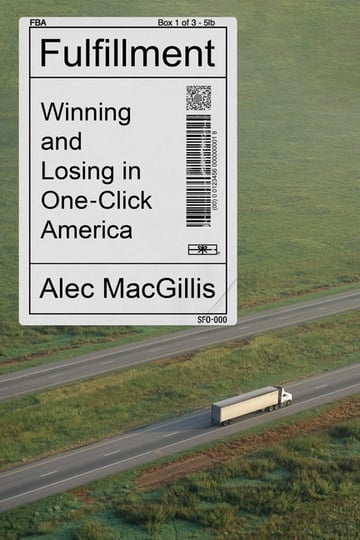
Fulfillment
Winning and Losing in One-Click America
By Alec MacgillisAn absolute damnation of Amazon. Totally different focus than Brad Stone's books, MacGillis makes no effort at all to understand Amazon the company, but instead focuses only on its actions and the effects they have on lives and communities across the country.
The comparisons he makes to Bethlehem Steel, and the robber-barron monopolist pigs of that era, are precise and perfectly appropriate. The pervasive theme throughout, as MacGillis jumps around telling detailed stories and histories from a variety of main characters, is just how invisible individual people and communities are to Amazon. Amazon isn't malevolent in any particularly active sense. It isn't an evil empire trying to further an evil cause, exactly. It's just growing. And it grows at any cost. And it's absolutely indifferent to the people and things that it needs to displace, remove, break, threaten, coerce, or otherwise damage and destroy in order to achieve those means. It is a perfect libertarian thought experiment, executed at scale. And it is unstoppable.
Truly, truly depressing.
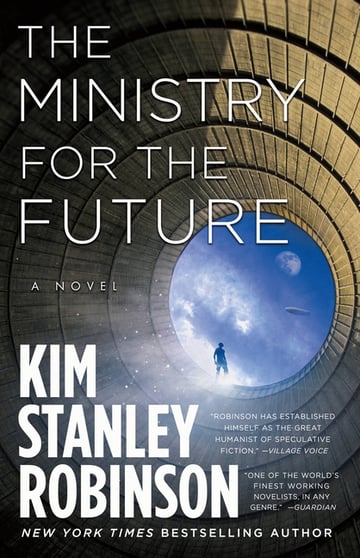
The Ministry for the Future
By Kim Stanley RobinsonI think a lot of climate change articles I've read do a poor job of contextualizing the actual impact of climate change. They will say things like "the polar ice caps are melting at X cubic meters per day", or "sea level will rise by Y inches by 2050", or even "average temperatures will go up globally by Z degrees", but I hadn't really seen something that describes what impact that will really have on the world. What will that make my life like? Or other peoples lives? What will be the inevitable sociopolitical consequences of this?
This book addresses those questions head on, in interesting ways. For me I guess the most interesting were:
- The general physiological impact that it will have on people, particularly those who survive famines / heat waves, etc.
- The non-centralized approach to solving climate change - each nation addresses the issue independently, somewhat proportional to their population's impact from climate change.
- The effect of terrorism post tipping point - particularly targeting carbon profiteers or those who still use carbon-heavy processes (planes)
- The general ingenuity of addressing the problem from so many angles.
- Really liked the plot line around carbon coins - a crypto currency backed by carbon sequestration, and supported by G8 federal banks.
It's a long book, probably too long, but it really does a great job describing the world we're quickly running towards. At times its rightfully terrifying.
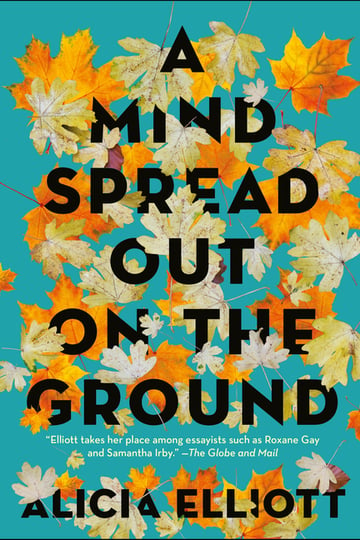
A Mind Spread Out on the Ground
By Alicia ElliottThis is billed as a collection of essays, but that doesn't do it justice. It's not quite an autobiography either, nor is it memoir. But it is an absolute tour de force. Elliot's perspective and lived experience is deeply powerful, even to someone like myself who frankly had so little overlap or sympathy, though that of course made it all the more urgent of a read. Some of it was very uncomfortable. Some of it I didn't 'agree' with (to whatever extent one can disagree with this kind of writing, which is not explicitly persuasive but obviously does persuade). But all of it felt deeply essential, and raw, and authentic. The writing is just absolutely fantastic. Really, spectacularly good.
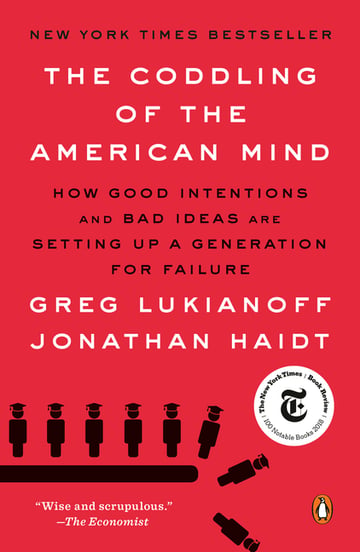
The Coddling of the American Mind
How Good Intentions and Bad Ideas Are Setting Up a Generation for Failure
By Greg Lukianoff and Jonathan HaidtMeh. Too focused on cancel culture. I agreed with most of the text, especially the free-roam kids stuff, but the tone was more alarmist than I cared for, and I ended up abandoning it. Unusual, I really like Haidt.
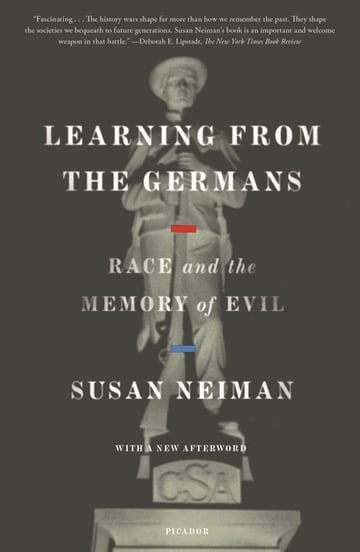
Learning from the Germans
Race and the Memory of Evil
By Susan NeimanBailed on this one early. It was good, but not great, and something else came up. Anyway, a whole book about how Germany addressed Nazism and WW2 head-on.
Amazon Unbound
Jeff Bezos and the Invention of a Global Empire
By Brad StoneThis is more a biography of Jeff Bezos' tenure as Amazon CEO than it is a book about Amazon the company. But then again, what's the difference? The book was fantastic, and left me with three key thoughts.
First, Jeff is more deeply involved in the company than I expected. Frankly, even from my perspective, I assumed that the richest man in the world would be moderately checked out, and just signing off on the bigger decisions every now and then. But from Stone's telling, Jeff personally drove much of the most innovative products Amazon's made. AWS, Kindle, Alexa, Marketplace, Prime, Go - these were Jeff's ideas. He thought of each of them, prioritized them, and then was deeply involved and micromanaged the execution of them. Absolutely nuts.
Second, Jeff and the Steam are total sociopaths. You need to be, frankly, to run a company that large. Or better said, to be successful at a company that large, in a country like this, at this point in time. There were many examples, but in particular, the reveal that 'span of control' was never about flattening communication within the company, but instead was entirely based on cost-cutting and a cheap way to get less effective middle-managers to leave the company... I mean, just wow. Genius, diabolical, stone cold.
Third, Jeff is spinning out. Stone didn't focus on this, so this is a bit of editorializing on my part, but for a guy who is supposed to always be focused and disciplined, Jeff seems to be losing it. I don't judge the guy on his private life, but his relationship with Sanchez was obviously undisciplined, and it seems to have affected his decision making, and the company, several times. (E.g., the last minute request to put helo pads in NY HQ2 contracts, which helped botch the deal).
This is a great book, very well written. I'm terrified thinking about what a third book would look like in another decade.
2020
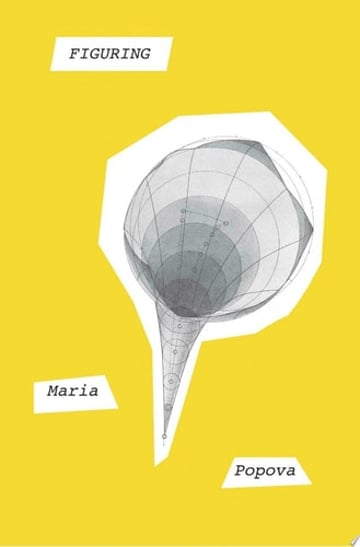
Figuring
By Maria PopovaI've known about Brain Pickings for a very long time, well over a decade. I've occasionally dipped in and out, but never been a frequent reader of the blog. I'm not certain why, possibly because it was so overwhelmingly well done that it's intimidating just to read. When I read a book, I may have a couple disjointed thoughts about it. But when Maria Popova reads a book, she writes incredible essays about them, often illustrated, and always linking heavily to other contextual items - contemporary or adjacent works - that she's read and reviewed before. Reading Brain Pickings makes me feel like a bad reader myself. That said, Brain Pickings is easily the single biggest influence I had on making this site. The platonic ideal of Addabook has always been to provide a platform to democratize Brain Pickings quality personal write-ups of books. Obviously Addabook falls very far short of that. Both technically in terms of design and appearance, but primarily, of course, because Brain Pickings relies on the incredible genius and wonderful, passionate writing of Popova.
When I saw Popova wrote a book last year, which it's unique cover, I knew I would read it eventually. I purposefully stayed away from learning anything about it, and since I'm not that frequent a reader of Brain Pickings itself, all of the content was entirely new to me. And wow, what an experience.
Here is how Maria Popova summarized her book, Figuring.
Figuring explores the complexities, varieties, and contradictions of love, and the human search for truth, meaning, and transcendence, through the interwoven lives of several historical figures across four centuries — beginning with the astronomer Johannes Kepler, who discovered the laws of planetary motion, and ending with the marine biologist and author Rachel Carson, who catalyzed the environmental movement. Stretching between these figures is a cast of artists, writers, and scientists — mostly women, mostly queer — whose public contribution has risen out of their unclassifiable and often heartbreaking private relationships to change the way we understand, experience, and appreciate the universe. Among them are the astronomer Maria Mitchell, who paved the way for women in science; the sculptor Harriet Hosmer, who did the same in art; the journalist and literary critic Margaret Fuller, who sparked the feminist movement; and the poet Emily Dickinson.
Emanating from these lives are larger questions about the measure of a good life and what it means to leave a lasting mark of betterment on an imperfect world: Are achievement and acclaim enough for happiness? Is genius? Is love? Weaving through the narrative is a set of peripheral figures — Ralph Waldo Emerson, Charles Darwin, Elizabeth Barrett Browning, Herman Melville, Frederick Douglass, Caroline Herschel, Nathaniel Hawthorne, Walt Whitman — and a tapestry of themes spanning music, feminism, the history of science, the rise and decline of religion, and how the intersection of astronomy, poetry, and Transcendentalist philosophy fomented the environmental movement.
As a matter of summarizing the book, she's done it far better than I could ever. Though on her own personal bio she boils it down to "a very long, very yellow book" which I adore as well.
I'll just call out two additional comments:
First, I loved how well Popova interconnected the histories of these individuals throughout the book. Too often history is told from a single perspective, or focused on a single character, and the greater context of each person and their actions in the rest of the world, and onto other people, is lost. Popova just does a masterful job illustrating the surrounding context in each person's life, and connections to the other focal characters, without being awkwardly explicit about it. The book bounces around telling the stories of maybe a dozen different people through history, but it never feels disjointed or anthological — it reads as a single threaded story all the way through. It's an incredible literary achievement that works so well it is almost unnoticed.
Second, I'm just embarrassed to have not known of almost literally any of these incredible people before. Pretty much just Emily Dickinson had previously been on my radar. These women are incredible. Their achievements are unbelievable. Their accomplishments to science, art, and culture are inarguable. How are they not all household names? (Unsurprisingly, almost 100% of the contemporary men that these women worked with would be recognizable to any middle schooler).
This book was absolutely incredible. Certainly the best book I've read in a long time, but additionally just an incredible achievement of intellectualism and art. A wonderful pleasure to read, easily my book of year.
Tell Me How It Ends
By Valeria LuiselliThis was an interesting essay on the immigration crisis in Central America, and more specifically how the US is reacting to it. The book focuses on child immigrants who are generally fleeing CA countries (south of Mexico), primarily from gang violence. Luiselli very briefly tells a few stories of the travel experience across Mexico (coyotes hired to help ferry children across the region, riding la bestia across Mexico alone), and then the experience in the USA. Generally, in the US children immediately turn themselves in to border patrol (rather than risk dying in the southwest desert). They are put into ICE boxes, then usually joined with a guardian, and then await immigration trial. The bulk of the essay has to do with the hardship that these children face during these trials, and how difficult it often is for them to secure a lawyer in the US willing to defend them (often for free), particularly if they can't produce physical evidence of the violence they are trying to flee from (e.g. a police report from their home country, which most cannot). Luiselli and her daughter are volunteer translators for the children.
Obviously, this isn't anywhere near comprehensive either as a description of current immigration practices, or of the immigrant experience. It isn't meant to be. Nor does it propose any kind of policy prescription. But it is a compelling and deeply human set of anecdotes that clearly illustrate the problem.
A Brief History of Seven Killings (Booker Prize Winner)
By Marlon JamesI made it halfway through this before calling it. The half I read wasn't bad, per say, it just has a terribly steep learning curve. The book follows maybe ~10ish main characters, and each chapter is told from their first person perspective. Most of the stories don't directly relate to one another, at least for the first quarter of the book or so, and so every single chapter is like starting anew. Additionally, the writing style isn't very expository - it's the kind of book that just drops you into the action, and you need to figure out the context and history yourself, which is generally fine but harder to do when you're mentally juggling 10 different characters. Add to that that most of the characters are Jamaican, and written using borderline nonsensically heavy accents. I often had to re-read sentences several times to even figure out what what trying to be said.
Anyway - the first 20% of the book was a hard slog. I had started it earlier in the year and bailed because it was so slow-going. I picked it back up in December and made good progress. By the halfway point I had all the characters pretty well figured out, and was making good progress with the accents. But then I hit Part II, where all new characters are introduced, and the whole learning curve started over, and I just didn't have the patience for it again. This might be a great book, I'd certainly believe anyone who said they loved it. But you really need to fight for it and I didn't have it in me.
The Three-Body Problem
By Cixin LiuReally, just a terrible book about nothing. I don't even know how to criticize it. This book has a lot of very interesting setups that just go nowhere. Almost every single mystery or problem that's presented in the book is resolved in a hilariously unsatisfying way. It almost feels inspired by mad libs.
I can't really imagine how this made it onto Obama's list of recommended books, or how apparently it's going to be a Netflix series soon.
The one thing I did like was the premise that the people of Earth figured out that an alien armada was coming to destroy them, but that it would take 400 years to get here. The story revolves around the first generation of scientists who made that discovery, and there are very brief good sections of the book with how the struggle with the responsibility of saving the future, knowing that whatever effort made in their present won't actually affect their own lives. However, this thread really doesn't go anywhere. An awful book.
The Triumph of Injustice
By Emmanuel SaezIt's been quite a year. After the last series of books, and given current events, I've been selfishly looking forward to a book more about brass tacks, as it were. Numbers and policy that I can understand from an "economics" perspective (i.e., equations and graphs), vs an "IPE" perspective (behavior and justice). But I should have known better than to think that any problem in the USA wouldn't trace back to social injustice, and here we go right on page 27.
As in the North, there were variations in tax policy among various states, but in general taxes in the South were more regressive. ... A fear haunted the slaveholders of the SouthL that non-slaveholding majorities would use taxation to undermine -- and eventually abolish -- the "peculiar institution". They particularly feared wealth taxation: at a time when 40% of the population in Souther states was considered property, property taxes were an existential threat for slaveholding planters. They fought such taxes tirelessly, and for two centuries wielded their power to keep taxes and public institutions archaic.
Early in the book there is a primer on the general types of taxes people pay, which I found very helpful. They are (in order of proportion of total tax):
- Individual Income Taxes: This is what people generally think of as "taxes", and this is specifically (and exclusively) what Republicans refer to when they say that half the country doesn't pay taxes. This tax amounts to about 1/3 of total tax. This tax includes tax on wages, interest, dividents, capital gains, etc. About 63% of national income is taxed via the income tax. The rest is exempt (e.g., dividends/interest earned in tax-free retirement accounts). The income tax is progressive, though much less so today than historically. All but 7 states (including WA) have additional state income taxes, as do some individual cities.
- Payroll Taxes: Aka social security & medicare taxes. Today SS is taxed as 12.4% of wages, for all wages up to $132,900 per year. Then it drops to zero for wages after that. This is insanely regressive. Medicare taxes are 2.9% of wages, with no cap. Note that employers functionally pay half of these taxes (you only see a 6.2% and 1.45% tax on your paycheck, respectively), but it is a direct cost for employers that otherwise could be paid as a wage. These taxes combined started out small, but now account for almost the same portion of total tax as income taxes, which has been a driver in the regressive tax shift in recent decades.
- Consumption Taxes: This is about 50% sales taxes, and 50% license taxes (car tabs, etc).
- Capital Taxes: This covers corporate income tax, property tax, and estate taxes.
Other thoughts from the book:
- Saez/Zucman say (p134) that the optimal highest marginal tax rate on the rich is around 75%. Apparently, a (un-cited) "body of work" suggests that that rate optimizes the total tax revenue collected. E.g., the lost revenue from reduced income is offset exactly by the increased revenue of the higher rate.
- The authors advocate for a wealth tax, but I did not find their arguments for it convincing. I say that as someone desperate to tax the rich more. I just don't really like that there isn't a clean valuation system (I don't think the marginal value of the last share sold is representative of the overall value of the firm), particularly for illiquid assets. The authors put forward a system where the wealth tax can be paid using a portion of the wealth itself (e.g., shares in your private company), but now it just feels like theft. I don't know, I don't like it.
I loved, loved, loved their no-nonsense description for why we should tax the rich:
Extreme wealth, like carbon emissions, imposes a negative externality on the rest of us. The point of taxing carbon is not to raise revenue but to reduce carbon emissions. The same goes for high tax rates on the very highest incomes: They are not aimed at funding government programs in the long run. They are aimed at reducing the income of the ultra-wealthy. They prevent or impede the various forms of rent extrction associated with extreme and entrenched wealth and with the reality of the market economy in unequal sociaties. What's the point of ... earning millions by creating zero-sum financial products, of spiking the price of patented drugs, when out of any extra dollar earned, 90 cents will go to the IRS?When in place, quasi-confiscatory tax rates redistribute economic power, equalize the distribution of pre-tax income, and make the marketplace more competitive.
I'm not a tax wonk so don't have great perspective on how rare this may be, but it's soooo refreshing to see someone just say this out loud. This continues to drive me crazy w/r/t carbon taxes, where politicians need to instead sell them as "carbon pricing" or as productive revenue generating programs. I recall texting campaigns for carbon taxes in WA, where people voted no because they didn't like what the money would be spent on. AGGGH. Who cares what it's spent on?! Likewise, we spend a lot of energy hand-holding ignorant people into ideas that taxes are tied to valid programs, or the idea that we want want to punish the rich, but just want them to pay their fair share, etc. But that's not true! We should tax the rich for the single purpose of disincentivizing the rich. We want fewer rich people. I understand that this is politically poisonous to say - but damn is it nice to finally read.
Lastly, there is an accompanying website that is just fantastic: https://taxjusticenow.org/
A Season on the Wind
Inside the World of Spring Migration
By Kenn KaufmanA fine, peaceful book about birds and birding. Not a lot of takeaways, though I did have a couple.
- The Black Swamp Bird Observatory sounds fantastic, and I'd love to visit if ever making a trek through Ohio.
- Kaufman wrote a bit about fighting against wind power - he chronicles one specific project where the local government wanted to build wind power in his area in northeast Ohio. This was in a major migration flyway, and he and BSBO fought it in court and won. He may have been right to do so, (and also argues that wind power can be great in other areas), but I wish he had made a better case against wind here. It comes off a bit as NIMBYism, and I'd genuinely like to understand better if wind turbines are a material threat to birds, in the sense that should we really be spending our political and personal energy fighting such projects?
The book was free through Audible. It was fine, but I can't say I would ever recommend it.
Capitalist Realism
Is There No Alternative?
By Mark FisherThis was a very short book, but one that I very reluctantly finished. It's not bad, per say, it's just so self-referentially academic that I couldn't follow large portions of it. Fisher makes references to other authors and ideas without adding any surrounding context, and I was often left confused in exactly the same way as while reading The Left Hand of Darkness, for exactly the same reason. One random example:
Postmodernism can be construed as the name for the complex of crises that the decline in the belief in the big Other has triggered, as Lyotard’s famous formulation of the postmodern condition – ‘incredulity towards metanarratives’ –suggests.
It is baffling to me that the above sentence could mean anything at all, and the book is filled with them. That said, Fisher makes many points that I thought were interesting, and honestly just wished that someone could dumb down a bit for me.
- Interesting point that Capitalism has had no intellectual resistence since the fall of the Berlin Wall in 1990. A whole generation of people today have no viewpoint for any alternative economic ideas other than capitalism.
- "Interpassivity" as the idea that watching a film like Wall-E is actually damaging, is it "performs our anti-capitalism for us, allowing us to continue to consume with impunity."
- Interesting discussion about the stress that capitalism puts on people:
I want to argue that it is necessary to reframe the growing problem of stress (and distress) in capitalist societies. Instead of treating it as incumbent on individuals to resolve their own psychological distress, instead, that is, of accepting the vast privatization of stress that has taken place over the last thirty years, we need to ask: how has it become acceptable that so many people, and especially so many young people, are ill? The ‘mental health plague’ in capitalist societies would suggest that, instead of being the only social system that works, capitalism is inherently dysfunctional, and that the cost of it appearing to work is very high.
...
In The Selfish Capitalist, James points to significant rises in the rates of ‘mental distress’ over the last 25 years. ‘By most criteria’, James reports, rates of distress almost doubled between people born in 1946 (aged thirty-six in 1982) and 1970 (aged thirty in 2000). For example, 16 per cent of thirty-six-year-old women in 1982 reported having ‘trouble with nerves, feeling low, depressed or sad’, whereas 29 per cent of thirty year-olds reported this in 2000 (for men it was 8 per cent in 1982, 13 per cent in 2000).
...
Specifically, James points to the way in which selfish capitalism stokes up both aspirations and the expectations that they can be fulfilled. ... In the entrepreneurial fantasy society, the delusion is fostered that anyone can be Alan Sugar or Bill Gates, never mind that the actual likelihood of this occurring has diminished since the 1970s – a person born in 1958 was more likely than one born in 1970 to achieve upward mobility through education, for example. The Selfish Capitalist toxins that are most poisonous to well-being are the systematic encouragement of the ideas that material affluence is they key to fulfillment, that only the affluent are winners and that access to the top is open to anyone willing to work hard enough, regardless of their familial, ethnic or social background – if you do not succeed, there is only one person to blame.
In general, I thought that this was an interesting approach to take. The internalization of these health problems onto the individual (you are not strong enough, you are not good enough, you need to work harder) is structural necessity of capitalism (after all, each of those are selling opportunities) that must be feeding emergent behaviors at the societal level that are hot garbage.
I did not like this book. It was needlessly obtuse and honestly I lost the thread on what the main points even were. However, I've often thought about the general human misery caused by the constant push for faster progress, and what possible alternatives would be. I think the core problem is actually one of foreign policy. We feel nationally compelled to lead the world, and there are obvious lifestyle and saftey benefits of doing so. If the USA slows down in order to prioritize equity and happiness, those values don't necessarily win - USA will just diminish on the world stage. Fisher doesn't stray anywhere near these considerations, and I'm not saying that there aren't answers here, but this is the far more interesting avenue of inquiry to me.
Caste The International Bestseller
By Isabel WilkersonFor the most part I thought this was a great book. In some ways it was predictable, in some it was confusing, and in some it was genuinely new and thought provoking. It was, of course, consistently depressing. The central idea is that America has forever been built on a caste system, which remains intact today, and which has generally been defined by a persons race, though need not be limited to that. My brief notes were:
- Interesting Indian caste explainer. India's caste system is based on karma and reincarnation. I.e., you reincarnate into the caste commensurate with how you have lived your prior lives (you get what you deserve). This is fascinating. If bought in, takes a lot of the morality out of it, making all participants much more likely to believe in the justice of the system.
- Wilkerson documents how the Nazis literally modeled their laws for Jews around US segregation.
- I had quibbles / confusion over the 'race doesn't exist' language. Wilkerson goes on for some time how race is not a biological classification, it apparently does not exist in science. That might be true, but that doesn't mean it doesn't exist. A person can have physical features that I would call "black" or "Asian", and which are hereditary in nature. Can we not call that "race"?
- I think the very interesting discussion here in the book is around the questions of what constitutes a 'white' or 'black' person, which has changed dramatically over time. E.g., was Italian, Sicilian, Irish, etc, always "white"? (No). Were literal Caucasians white? (per SCOTUS, no). Are Japanese (with skin whiter than EUs) white? SCOTUS said no.
- I wish there were more discussion around the inclination of humans to develop caste systems. Wilkerson focuses on India, Germany, US - but no counter-examples. Are there examples of complex societies that didn't have castes at all? Why? Why not? The focus tends to just be "look how vile this is" rather than understanding why humans tend to organize in this awful way.
- Not sure I understand the difference between "caste" and racism. I understand conceptually, but not clear on how what we have in the US isn't just racism. Caste can certainly exist without racism, but can racism exist without caste?
- Slight counterpoint to this, I liked the examination of racism in terms of relative positioning in the caste system. E.g., it's poor whites who are going to be the most racist, because they have the most to lose from the dissolution of a race-based caste system. They may be poor, but they're still white, so they're not at the bottom rung. It is in fact highly rational, if obviously disgusting, for them to perpetuate race-based caste as much as possible.
- Additional point: Interesting discussion of race vs class in terms of recent black immigrants (Jamaica, Caribbean) who purposefully try to keep their foreign accent, to remain in an 'immigrant' class, and be treated as only 'black' and not 'African American', the lowest caste.
- The anecdotes about American military racism were largely new to me and somehow surprising. Wilkerson writes about how black (American) troops were popular with the French during WWI, and that the US military explicitly instruct the French to treat American soldiers like shit, particularly when/if American whites were around.
Language toward the end of the book, on the post-WW2 German reaction to Nazism compared to post-1865 American reaction to the Confederacy is amazingly considered and written. One long section below, while Wilkerson was speaking to a German about their reaction to their own actions after WW2:
And then, we have the stumbling stones. These are the micro-memorials of discrete, brass squares the size of ones palm, inscribed with the names of Holocaust victims and placed throughout the city. More than 70,000 of these stumbling stones, known as stolpersteina, have been forged and installed in cities across Europe. They are embedded among the cobblestones in front of houses and apartment buildings, where the victims whose names are inscribed on them are known to have last lived before being abducted by the gestapo. "Here lived Hildegarde Blumenthal. Born 1897. Deported 1943. Died in Auschwitz." reads a stumbling stone clustered among others outside an apartment building in western Berlin. Nearby are the stones for Rosa Gross and Arthur Benjamin, who were deported in 1942 and who perished in Riga. The stumbling stones force the viewer to pause and squint to read the inscription, force the viewer to regard the entry doors the people walked through, the steps they climbed with their groceries and toddlers, the streets they strolled that were the everyday life of real people, rather than abstractions of incomprehensible millions. Each one is a personal headstone that gives a momentary connection to a single individual. Leaning over to read the names on the stumbling stones forces you to bow in respect.
And then this:
There is no death penalty in Germany. We can't be trusted to kill people, not after World War II.
That quote absolutely floored me. I was making coffee while listening to the book, and I literally had to stop and brace myself against the counter after hearing it. I have never before heard anything so succinctly wise and empathetic, and it made me so angry and sad that the United States has instead chosen to ignore our own history rather that to confront it.
One of the last things that book touches on are the changing race demographics in the US, and how in a few decades we're expected to be a majority minority nation. How will that affect caste and politics? Prior to reading this book, I've read and heard a lot about this, and how it seems inevitable that Republicanism is charging towards oblivion, since it is doubling down on whiteness and racism in a country that is clearly moving demographically in the opposite direction. (And why R's today are pushing so hard for anti-democratic rule, like gerrymandering, senate malapportionment, judiciary control, keeping electoral college, etc.) Anyway, by looking at it through the lens of caste instead, Wilkerson argues that the nation will just instead expand the upper caste before risk losing it. That is, we would slowly accept that Asian's or lighter skinned African Americans, (or whatever other group) can be full-fledged upper caste, such that sufficient demographics remain in place to protect the caste system. I wish Wilkerson had gone into more detail here (e.g., is there historical precedent?) but this continues to linger with me.
The New Jim Crow
By Michelle AlexanderI read this months ago and went too long without writing anything about it. Suffice it to say, this is a terribly sobering, sad book about our absolute failure as a society.
The Silk Roads
By Peter FrankopanI really only just started this book. Couldn't get into the dry narration. Not to mention, it really just focused on things from a Western perspective, which seemed like exactly what it said it wouldn't do.
The Left Hand of Darkness
By Ursula K Le GuinI really wanted to get through this book, but just couldn't. I never for one second cared about anything that was happening. I made it to around the sixth chapter before I even realized that the book had been alternating main characters and storylines between the chapters. That's how difficult it was to know what was going on. The text is just absolutly riddled with people, places, names, verbs, etc that are imaginary and that the reader has zero context for, so nothing sticks. You read entire paragraphs without knowing what just happened. Who did what to whom? One random example:
Estraven’s house, sign of the king’s high favor, was the Corner Red Dwelling, built 440 years ago for Harmes, beloved kemmering of Emran III, whose beauty is still celebrated, and who was abducted, mutilated, and rendered imbecile by hirelings of the Innerland Faction.
This is a super tame example, but just something I highlighted as an example of "wow why should I care about this?". It was so tiresome to try to continue reading this book that I just called it.
Meetings with Remarkable Manuscripts
Twelve Journeys Into the Medieval World
By Christopher de HamelAn interesting book with charismatic reverence for old books. Does wonderful justice appreciating books that have existed for over a thousand years. E.g.: First Book: Gospels of St Augustine. Gospels of the bible, carried by Augustine from Rome to England in the late 500's upon instruction from Pope Gregory the Great to spread Christianity to the English. It is hard to really imagine a book that has existed for so long.
Anyway, absolutely love this book. Didn't quite clear it, but looking forward to the finish.
Politics Is for Power
By Eitan HershPolitics is for Power is a study of the current trend towards what Hersh coins 'political hobbyism', wherein people who identify as highly political and in fact think that they are highly political and participating politically in a civic sense, when they are in fact doing nothing of substance. Which is a fancy way to say that there are more people than ever who post on facebook about their political opinions, but fewer than ever who are legitimately able to convert those opinions into political power. More people than ever are treating politics as a sport - something that they might be passionate about and consume a lot of their life, but where they only observe it, not affect it. His thesis, and the namesake of the book, is that the purpose of politics is to gain political power. That's it. And gaining political power isn't done on facebook. It's done in your neighborhood, talking to peers and coworkers, and organizing locally - more-often-than-not it is done in the service of driving change at the local level. You shouldn't organize your neighborhood to vote for national campagins, but for local ones. What's happening in city hall? On the county board? Who are the local judges, or state reps? As a matter of fact it is those positions that affect your life (almost always moreso than national politics) and also it is those positions over which your local organizing can have material affect (again, in contract to national politics).
I liked the book a lot. A few bullets:
- Surprisingly to me, is the college educated demographic who claim to be politically engaged who are the most likely to engage primarily or only in political hobbyism. They are also more likely to respond/(lie) in surveys that they are frequent voters, when they in fact are not. Presumably this is because their high engagement in hobbyism placates their desire to actually be engaged. They feel as thought they are accomplishing something in their hobbyism, to a level that they claim to vote more than they actually do. Hobbyism is counterproductive in other obvious ways, but this was nuts.
- Hersh discusses "shallow hobbies"; Meaning, if you died today and no one related to your hobby ever asked what happened to you, it is a shallow hobby. In particular, if you're only political engagement is shallow in this sense, it is in fact just hobbyism and nothing more.
- Hersh spoke a bit about the 'deep canvassing', the practice/strategy of door-to-door canvassing with the strategy of just engaging in meaningful conversation with people, rather than blasting through a rote script for a particular candidate.
The Order of Time
By Carlo RovelliAppreciate that the discussion about the nature of time inevitably becomes about the nature of the self. The two are directly linked. That is, in what sense is time only a cognitive (and so subjective) measure between two events? What is a self, if different than a collection of memories?
This was a very interesting and accessible book. It stayed non-technical, but in places that was a huge handicap, e.g. when Rovelli referred to time being a "blurring" of reality.
In the end, all I really got out of this was an interesting reminder that time isn't what we think it is, and that the self isn't what we think it is - but that we don't really know what either are... yet.
The Warmth of Other Suns
By Isabel WilkersonAn incredible and sobering biographical exploration of The Great Migration and Jim Crow America. This is a long book that never feels long. It feels urgent and necessary, today more than ever. I'm ashamed that as a white man in my mid thirties I've never really come to terms with exactly how recent slavery was. It feels (again, to me) like something long past. Pre-photographs long ago. This book is a stunning coming-to-terms with how close it is, in fact, to today. Not necessarily in years, but in time measured by change. I've read a decent amount of American history, and plenty on racism, but was really struck by how ignorant I still am.
I'm not going to write any more because Jill Lepore nailed it in The New Yorker.
The Field of Blood
By Joanne B. FreemanDamn I really don't know much about American history. The book covers two major topics, as per the subtitle, and both are absolutely gripping. My biggest takeaway here was anger at the south. Like, flat out indignant, vitriolic, fuck the south. The 'violence in congress' angle was super interesting, something I really didn't expect and knew nothing about, but it's easier in my head to brush that all away under the "it was a different time" rug. The world's supposed greatest deliberative body — turns out — are a bunch of immature and privileged schoolyard bullies. But learning about the lead up to the civil war was just arresting; I previously didn't really know much beyond the really broad strokes, and this left me really hungry for more. Perhaps most disappointing of all were the clear similarities to today.
- The book primarily follows Benjamin Brown French, a lifetime political figure in the mid 1800's. He had an interesting story, but I found most compelling his lamentations of how the union was dissolving over time. It felt quite current for him to describe the polarization over congress, and the coming civil war.
- The 'code of honor' is hilarious. It is so ineffectual and unnecessary, but so interesting to view from our perspective now. This odd system of manners, where men felt compelled to kill each other by this very odd set of rules (even when, neither wanted to engage further, but each felt that the code compelled them to do so)... it's so interesting to imagine what customs we have today that are similarly ridiculous.
- The "antislavery toreador" Joshua Giddings (W-OH 1838) may be one of my favorite politicians. A man of courage and conviction, who "would rather lose my election at home the suffer the insolence of these Southerners."
- Astonishing how new tech (telegram) changed the nature of congress, dramatically changing the press. The telegram allowed news to go back 'home' on a same day cycle, and drove increased engagement in politics nationally. Congressmen began giving 'bunk' speeches (where the intended audience was not the Congress itself, but hometown constituents by way of the press. This led directly to increased polarization, and ultimately increased violence.
The full impact of this perfect storm of conspiracy theories, policy conflicts, physical violence, and press coverage was growing distrust between North and South. Not only the public become ever more distrustful of their sectional foe, but congressmen did too. The fact that large numbers of congressmen armed themselves in this period speaks volumes. These men were prepared for sectional warfare in the halls of Congress. They believed that the driving impact of aggression on aggression could spark a firestorm that would bring the Union down, and if things went that far, they considered it their duty to fight with and for their people. To reverse a much quoted aphorism: politics was becoming ware by other means. When congressmen themselves lost faith in the institution of Congress and in one another - when they no longer believed that the institution was powerful enough to prevent sectional bloodshed within the Capitol - a line had been crossed. Resolution would have to come from elsewhere, if not from mediation, then in open war.
I finished this book with a strong desire to learn more about the lead up to the civil war. It was very well written. (And I should also say that the paperback version was very well put together. Great paper, binding, type, etc. This book was physically a pleasure to read.)
White Rage
The Unspoken Truth of Our Racial Divide
By Carol AndersonThis book is a very high level introduction to racism against African-Americans in the USA. It covers a lot of history, primarily hitting the most important notes at a high level. The book is relatively short, and so necessarily doesn't go into deep detail on most topics. The key items covered, and my takeaways, were:
- After the Civil War, Andrew Johnson pardoned most of the CSA leadership/cabinet. They were reinstated as political leaders and reps in their respective (Union) states, and returned to DC to govern. They remained in charge of their states, and set the policies of the newly freed slaves. Incredible. I had no idea that this happened. This is as though instead of the Nuremberg trials, if we had just put the Nazi's in charge of southern Germany in some obtuse attempt to reunite Europe. This single fact was by far my most important takeaway from the book - something I didn't know and am left dying to know more about. I just cannot fathom how this was viewed as a legitimate course of action, or how it is remembered/taught historically as anything less than a victory for the CSA. Unreal. This also puts current confederate monuments, rebel flags, etc, in an entirely different context for me. Absolutely disgusting.
- I didn't realize what a shitbag president Andrew Jonhson was. But his history is a kind of interesting bizzaro universe compared to our current one. Johnson was a bad, racist Democrat president kept in-check by a well functioning Republican majority in congress. Congress would pass bills protecting freed slaves, Johnson veto'd, congress overrode. They passed many laws to keep Johnson in check. When he broke them, they impeached him. He avoided conviction/removal by a single vote. Ostensibly the only thing seperating today from 1865 is today's Republican controlled senate. Otherwise, I suspect the last 3 years would have looked almost exactly like the late 1860's.
- Plessi v Furgeson set precedent of separate but equal, but the south hardly even tried to maintain the "equal" standard. This is obvious, but the datapoints given in the book are illuminating. E.g., until the 1960s southern schools spent 2x-10x per capita on white schools.
- Anderson covers redlining briefly.
- Then after Brown v Board came the disenfranchisement. Poll taxes, literacy tests, etc. In 1960 more than 98% of eligible blacks were registered. And gerrymandering. This is a high level overview of Anderson's One Person, No Vote.
- In the 50s the Georgia legislature passed a resolution to repeal the 13/14/15th amendments, and impeach SCOTUS judges. In 1956 GA changed its state flag to substantially be the Confederate battle flag, specifically to send the message that, as they died for slavery, they would die to protect segregation and Jim Crow. The flag wasn't changed until 2001. Mississippi still has a prominent confederate battle flag in their flag. Particularly given the first bullet point, I honestly don't see how this is a single degree different than putting swastikas on flags.
- see Sothern Manifesto
- Some detail, but not much, on Nixon's Southern Strategy, that purposefully stoked and exploited racial resentment as an election strategy in the 1960's. It was so transparent that in 2005 the RNC chairman formally apologized to the NAACP for this.
- Lastly, discussed the Reagan contra scandal. Apparently the US funded contra aid by allowing cocaine sales in USA via gangs. Primarily impacted blacks, by design. Then Reagan gave sanctimonious speech about drugs, started war on drugs, and imprisoned primarily blacks.
Normal People
By Sally RooneyI haven't much to say on this one because I read it several months prior to getting around to logging it. It was quite good. I listened to it on audiobook and really loved the narrarator's Irish accents. I'm blown away that Rooney was born in 1991.

Lolita
By Vladimir NabokovThe language used throughout this book was tremendous. (Picnic, Lightning). What sticks with me now, writing this months after having finished the book, were the very brief glimpses of Lolita's suffering that shone through. Really quite haunting.
Down Girl
The Logic of Misogyny
By Kate ManneManne is a trained philosopher and professor of philosophy, and the "logic" in this title is no joke. While I would consider this book "approachable" in terms of formal philosophic texts, it is quite dense and dry compared to something like Traister.
Manne's central thesis here is that misogyny is incorrectly often thought of as the action or quality of a specific individual who hates all (or even most) women. She argues that this is way too narrow and naive a view, and that this view in fact would be almost impossible to find real examples of. Rather, she argues that misogyny is not individual behavior, nor is it “a plight spread by a few bad apples”, but rather an emergent property of a society that was built around male dominance, and that misogyny is expressed as any action participants (male or female) take that serves to control/police those who would challenge said dominance.
For example, if women hold subservient roles (caring wife, good waitress, etc) men will love women. We need a definition of misogyny that identifies this. In such a purely misogynistic society, where women ‘know their place’ as it were, there would be few indicators of the naive conception of misogyny. That is, men would love those women, domestic violence would be zero (either because violence itself wouldn't occur, since women are playing their role -- or because violence against women wouldn't even be thought of as violence) , and Pinker would likely write a book about how we’ve made progress!
Another example she briefly brings up, but that I hadn't thought about as clearly as she put it, is how homophobia is misogynist in that it is an attack on masculine norms vs feminine ones. By enforcing what a man is, it’s clear about what a women is allowed to be.
On the difference between misogyny and sexism: "sexism wears a lab coat, where misogyny goes on witch hunts." Which is to say, sexism tries to point out a difference between men and women (accurate or not), but misogyny is concerned with identifying good women vs bad ones. They are obviously related, but this framing put things in a way I hadn't thought of before.
Anyway, this was a great book, but I didn't have the endurance to get through it - particularly as an audiobook. The subject matter is obviously quite heavy, but Manne's very formal approach here is hard to muster. I knew it was time to turn it off when she starting talking about "quasi contra-positive morale psychological claims".
2019
Business Adventures Twelve Classic Tales from the World of Wall Street
The New York Times bestseller Bill Gates calls 'the best business book I've ever read'
By John BrooksThis was fine. That's it. It was interesting but much longer than it needed to be. I'd rather just read a few HBR cases. I put it down. It's not bad at all, just wasn't compelling for me. Perhaps I wasn't in the right headspace, but I expected much more.
The Boy Who Was Raised as a Dog And Other Stories from a Child Psychiatrist's Notebook--What Traumatized Children Can Teach Us About
By Bruce PerryThis was really good - a book a bit in the Oliver Sacks' style of one-anecdote-per-chapter, each focusing on a case when severe abuse (often from neglect rather than a more active abuse) on a child led to catastrophic consequences to their development and behaviors as an adult. Each of the cases were very interesting. I did get the slight impression that Perry had a "when all you have is a hammer, everything is a nail" mentality though. I mean, it's his book, so it makes sense that the examples he used here were cherry picked as the clearest and most compelling, but he very much struck me a bit as though he though all personality disorders and/or deviant behavior stem from early childhood abuse. In terms of "nature vs nurture", he leans super hard on the nurture. When doing an evaluation (in the book), he never really thinks about running a cat scan, or inquiring about other genetic or physical predispositions. I found this odd, but again, his book. Overall, super interesting and a great companion to Sacks.
One tidbit that stuck with me: the resting heartrate of the Waco Devidian Children was 160! Wow.
Good and Mad
By Rebecca TraisterTraister explores how women have been limited in their ability to express anger. For men it makes them effective and heroic, but angry women are portrayed as unhinged and hysterical. Traister explores the history here, and it is disgusting and depressing and somehow (for me) both entirely expected and yet surprisingly worse than I thought. I first heard of Traister and this book when she went on Ezra Klein's podcast. That interview aligned with Brett Kavanaugh's confirmation hearings, and frankly it would be hard to distill a more essential and comprehensive single example of what she was trying to describe. This book is raw and hard to read, and that's coming from someone with zero direct experience of ever actually having to tolerate and navigate this bullshit every day, every decision, every reaction.
I can't refute anything in this book, and am not looking for reason to do so. But Traister did have me thinking about anger as a catalyst for action, and if anger is a vice or virtue. Anger is easy, and almost always myopic and focused on the short term. Trump used anger, and stoked anger among his base, in order to win an election. I think it's correct and incredibly important to recognize how and why women & POCs have been disallowed to be angry in public and to use it as a tool - but I don't think that that injustice is necessarily evidence that it should be used more. Women should, of course, be allowed to be angry in exactly whatever capacity men are permitted to be angry. But I'm not convinced that anger should de-facto be advocated for as a driver of action. Why shouldn't we think that anger will be just as effective when used (by women) against women? That isn't to say that I think Traister is wrong about anything here - I do not think her position is that there should be more anger in the world. One cannot seriously propose a policy position that humans no longer be angry, but one can reasonably expect and hope that all people be treated equally.
I need to comment on it, because the cover to this book is horrible. So bad that it kept me from reading the book for much longer than I probably otherwise would have. I doubt Traister had anything to do with it (covers are typically entirely controlled by the publisher), but even so it seems perfectly aligned with the book, in the sense that Traister isn't here to be cute and "(doesn't) fucking care if I like it."
Bad Blood
By John CarreyrouA very interesting narrative about the brief history of Theranos. The book isn't short, but was a super-fast read. I know that I saw several headlines about this when the whole thing unraveled in early 2018, but overall I was a bit struck by how little the whole event had fallen on my radar. I had never heard of Theranos before its undoing, and even then, maybe only at the highest level.
Anyway, a few points:
- The book is quite harsh on Elizabeth Holmes (who did not cooperate/participate with it), and paints her to essentially be an entitled sociopath (psychopath?). She lies effortlessly. Carreyrou paints it in a selfish light, that she was chasing money, fame, power, etc - but it's not clear that she is willfully committing fraud. That is, I think there is some light there where she truly does believe that she's going to change the world for the better, and if she needs to crack a few eggs to do so then so be it.
- Holmes obsession with becoming a successful startup CEO is just weird. The way she emulates Jobs is unnerving. Carreyrou speculates in the book that she purposefully spoke in a lower, "less feminine" voice in order to be taken more seriously. I mean, to give her credit, she was singularly focused on achieving success and willing to do whatever it took.
- Theranos was just never a real company. At no point in its history could it do what it said it was doing. It was just a massive fraud from top to bottom, kept together by Holmes' total control of the organization and unwillingness to let anyone see too many moving parts at once.
- Theranos' BOD was stacked. Henry Kissinger, George Shultz, Jim Mattis. Holmes had incredible connections (Clintons and Obamas as well). Yet no one had done any diligence at all on the company.
- Especially after just finishing Catch and Kill, this book makes you appreciate whistleblowers and investigative journalism all the more. Theranos pulled no punches in trying to intimidate and punish anyone who dared be critical of them or leak to the press. They had crazy NDAs, and would sue the shit out of anyone that glanced sideways. I'm sure the company would have unwound eventually, but they tried like hell to stop it and it took incredible courage for the whistleblowers to come forward.
- Lastly, the completely unexpected silver lining here was a story about Rupert Murdoch, of all people. Murdoch had a $125M investment in Theranos, which was reportedly the largest non-media investment of his life. Murdoch owns the Wall Street Journal, where Carreyrou worked and broke the story that Theranos was a fraud. Prior to publication Holmes reached out to him and asked him to kill the story, but he refused to intervene. His position was that he trusted his editors and that if there was no "there" there, then they both had nothing to worry about. In retrospect (knowing that that Theranos was a giant scam) this doesn't seem that impressive. But a priori, Theranos was a $10B tech darling with two former Secretaries of State on the board, all vehemently denying any wrongdoing. And Murdoch had $125M on the line. In stark contrast to NBC leadership in Catch and Kill, it was fantastic to see him step aside and let the cards fall. He ended up taking a total loss on his investment.
Catch and Kill
By Ronan FarrowThis is not a hopeful book. I thought that it was primarily about the Harvey Weinstein allegations that Farrow broke last year in the New Yorker - and it sort of is, tangentially. I would say there are several focuses of the book:
- Retelling the Weinstein story, and what a criminal shitbag he is.
- The narrative around Farrow's investigation of that story, which he was originally doing at NBC but which NBC slow-played for months before eventually killing on the basis of not being newsworthy enough. (Farrow subsequently shopped it to The New Yorker, which took it up immediately, and for which Farrow was awarded the Pulitzer prize).
- Of course, it was revealed the Weinstein had back-channels with NBC management, whom he was encouraging to kill the story.
- NBC itself had a culture of not giving a shit about women, or allegations of rape or misconduct, particularly when such allegations were made against personalities that were making the network money.
- Farrow alleges, convincingly, that NBC killed his Weinstein story primarily because they did not want to encourage the skeletons coming out of their own closet - primarily that they had been willfully enabling Matt Lauer to harass and rape pretty much whoever he wanted for years.
Its a great book, told very well. I think that Farrow particularly does a good job empathizing with the victims, describing the effect that these events had on their lives. The guilt and shame of being victimized, the powerlessness to do anything about it, the uncertainty of its effects on their professional future, etc.
It also provides an interesting window into power structures, and understanding what power does to a person (or perhaps, in describing the kind of person who is attracted to such power). I often thought back to The Psychopath Test - I'd put very good money that Weinstein and Lauer are indeed psychopathic to some extent.
Anyway, it's a kick in the ass and should be read by everyone, but its terribly hard not to feel like shit afterwords. To date, none of these people have gone to jail or faced what I would call consequences of any meaningful significance, and it seems increasingly unlikely that any of them will. I'm obviously glad the book was written, and is getting the attention that it is, but it seems like such a tiny, tiny step in the right direction. Ugh.
How to Hide an Empire
A History of the Greater United States
By Daniel ImmerwahrGreat book that pokes around a lot of corners of US history that I hadn't known about before. Immerwahr looks at US colonial/empiric history and tries to explain how and why it developed as it did. Unsurprisingly, the general theme is that the US has tended to do whatever is most beneficial to the interests of its white ruling class - and that incidentally those interests over the last 100 years have had less and less to do with the occupation of foreign territory. I thought a lot of the history was really interesting, especially having just returned from a trip to Singapore and gotten a taste there of recent colonial impact. I remain fascinated by the territory to statehood process, and why that succeeded for places like Hawaii and Alaska but not Guam or Phillipeans or Puerto Rico.
A few random notes:
- Pearl harbor (Dec 7, 1941) was actually a small part of the coordinated attack that took place that day by the Japanese against UK and US territories. Also attacked Guam, Midway, Phillipeans, Malaya, Singapore. For most, the Japanese subsequently occupied those places as well. Hawaii wasn't even a state at this time, and it was a legit political question whether/how to frame it as an attack against America.
- Cherokee Nation was an actual nation for some time, with a president! They tried to send senators to US congress but surprise the white dudes weren't having it.
- American expansionist empire started with a few islands off of Peru in effort to collect bird droppings (guano) to use as fertilizer in mainland. These acquisitions fueled American agriculture for decades.
- The expansionary trilemma: In order to expand US territory (on and offshore), Americans needed to pick two of three values: empiricism, republicanism, and white supremecay. The fact is, no one wanted to expand outward if it meant taking in non-white people and equal American citizens. But Roosevelt had such a boner for Daniel Boone's mythology that they pressed on with Empiricism regardless, and just never gave the people in territories any rights. I.e., we abandoned republicanism in deference to the other two values. That remains the case today. 4 million people (primarily on Puerto Rico, Guam, USVI) are natural American citizens, but can't vote and have no representation in congress.
- The SCOTUS "Insular Cases" at turn of the 20th century ruled that the US constitution only applies to US states - not territories. This is still considered good law, but speaks volumes that this precedent was set by the same SCOTUS that ruled Plessy v Ferguson.
- After the Phillipean war in the early 1900's (America's longest war until Afganistan), there was less energy for further imperialist expansion. This is primarily because it was replaced with Dollar Imperialism, where instead of taking over an area and assuming the overheard that comes with management of the unwanted (i.e., non-white) people, the USGov could make treaties so as to essentially have economic control of an area without all the baggage.
- WW2 in Phillipeans was most destructive event to ever occur on us soil. 1.6m Phillipeans (US nationals) killed.
- No US president said the word "global" until FDR after WW2. It wasn’t common vernacular until then, as the idea of global anything just didn't make sense.
- Interesting discussion of colonialism in terms of raw materials. E.g., the US was out of rubber in 30's FDR imposes a nationwide 35mph speed limit in order to conserve tires, and desperatly needed to trade for it. This rubber trade had driven a lot of prior European expansion into Africa and APAC. (Hitler invested massively in German petrochemical companies in order to produce synthetics to replace the raw materials that Germany didn't control). In the early 40s the US cracked it and found how to synthesize rubber. Immediately after, 90% of all us rubber was synthetic. Like guano earlier, once this was figured out, no longer needed to trade or colonize for.
- Plastic blew the doors open in this regard. Funny that very first plastic was to replace ivory billiard balls. WW2 drove plastic R&D into overdrive, as we needed all kinds of substitute synthetics.
- US today has ~800 offshore military bases. All other countries combined have ~30. US today has ~4M naturalized citizens of this country living in Guam, Samoa, Puerto Rico, etc - who can't vote and have no representation in congress.
Did colonialism and Empire ever end? Immerwahr argues no, and that it only slightly changed. Tech developments during the 1900's rendered old-school colonialism less relevant. The airplane, e.g., made it no longer necessary to control huge swaths of land, and drove colonialism to become more pointilist. Same with the telegraph, and then radio and satellites. Post WW2 globalism shattered the need - particularly the spread of English globally, and US-led standards across industry.

Drive Your Plow Over the Bones of the Dead
By Olga TokarczukThis book came exceptionally well reviewed from Bookmarks, but not quite deservedly so in my opinion. It's good, fine. I appreciated the writing style (translation by Antonia Lloyd-Jones, Tokarcczuk has a unique, poetic voice), but never quite connected with the narrative in the sense that I needed to read more. It filled the time while relaxing in Singapore, and on the flight back, but I don't expect to think about it much in the future.
I did surprisingly appreciate the focus on astrology, and found the main character (an astrology devotee) surprisingly likable despite that affliction. If anything, I didn't quite grasp onto the threads of "does free will exist - was she destined to live out this narrative in this way?" insomuch as I was thinking "is this women in fact insane, and is her obsession with astrology proof-positive?". The astrology is strong evidence in favor, but her awareness and empathy towards all living things was a strong counterpoint that no, it's just the rest of us that are monsters.
There There
By Tommy OrangeReading this book was interesting insofar as it made me really realize how little I empathize with Native Americans, and particularly how little I really think about the current condition of Native Americans and their cultural preservation as apart from the condition and overall well being of Americans as a whole. That is, I more frequently think about Natives in a strictly historical context - something that happened exclusively in the past - not something that is happening today.
There There doesn't explicitly focus on historical injustices - it highlights the stories of some 20-or-so Native Americans through an interconnected narrative, but it is (naturally) impossible to present their lives without seeing the consequences our history has wrought. I actually enjoyed the few interludes best, where the author speaks directly, rather through the narrative of the characters.
When we go to tell our stories, people think we want it to have gone different. People want to say things like "sore losers" and "move on already," "quit playing the blame game." But is it a game? Only those who have lost as much as we have see the particularly nasty slice of smile on someone who thinks they're winning when they say "Get over it." This is the thing: If you have the option to not think about or even consider history, whether you learned it right or not, or whether it even deserves consideration, that's how you know you're on board the ship that serves hors d'oeuvres and fluffs your pillows, while others are out at sea, swimming or drowning, or clinging to little inflatable rafts that they have to take turns keeping inflated, people short of breath, who've never even heard of the words hors d'oeuvres or fluff.

Seasonal Associate
By Heike GeisslerI suspect, but don't really recall, that I first heard about this book in The New Yorker, and I was much looking forward to "a labor memoir for the Amazon era." Amazon has taken its lumps over the last decade, particularly from investigative pieces from Mother Jones, for having horrible working conditions in FCs (i.e., grossly negligent and deadly, allegedly). I've read those articles, but was interested in hearing a longer form account of the experience of working there.
Surprisingly, I didn't find too much here. Seasonal Associate is not an expose about inhumane working conditions at Amazon in particular, I think it was more a criticism of blue-collar unspecialized labor more broadly. I'm not making excuses for Amazon - Geissler's experience sounded terrible. She is more or less dehumanized, turned into a commodity cog in a large machine, and pushed to be as efficient as possible. She does not receive any special comforts, and is generally reminded at every turn (implicitly and explicitly) that she is replaceable. The book is a (lightly fictionalized) chronicle of trying to keep her sanity in such an environment; the little things that she thinks about during the work day, the workplace gossip she invents (not being able to have long/meaningful interactions with other employees), small acts of resistance against the corporation in order to feel like something greater than she's been made to be, and observations of general corporate ineptitude and inefficiency.
Geissler doesn't excoriate Amazon here. I wouldn't even say she attacks Amazon. This is no Mother Jones. Geissler doesn't place blame on Amazon for the way things are, rather, she acknowledges that this just is the way things are, and laments it. This is what it's like doing menial labor in the 21st century. This is how far we've come, this is what we're worth.
You thread the locker key onto a ribbon and hang it around your neck. You carry the luminous vest in one hand, not putting it on right away. That's your sign of not belonging, a small luxury that interests no one, an act for which you'll soon have no time.
Anything you could possibly want from this company, you'd have to tell the company's customers and make them understand. You'd have to win the company's customers over to your side to get paid for the training day, but just you try getting hold of them all.
Anyway, 75 percent of the customers would probably respond to your request to get paid for the training day with: Why? I didn't get paid for my training day either.
The opening of the book, below, is stone-cold. It really is the essence boiled all the way down.
Is all this a matter of life and death? I'll say no for the moment and come back to the question later. At that point, I'll say: Not directly, but in a way yes. It's a matter of how far death is allowed into our lives. To be precise: compared to that which kills us, death is nothing but an innocent waif. Or: death, compared to that which kills us, is a gentleman with good manners and a shy look in his eye.
From now on, that which kills us is your constant companion; that much I can say.
Enlightenment Now
The Case for Reason, Science, Humanism, and Progress
By Steven PinkerReading this book is, by and large, an exercise in frustration. I've never been more upset or annoyed while reading arguments and data that I mainly agree with. Pinker is such an asshole that even when I agree with him I'm upset about it. There is 570+ pages of data, the great majority of which I suspect is honestly gathered and presented, but the editorializing around the data is so inane and fragrantly, obnoxiously stupid that it really raised my heart rate to read a lot of it.
His 570+ pages pretty much breaks down to this:
- For the last 10,000 years, including and especially the last ~300 years, the world has been getting better by every single measurement available to us.
- This is attributed to the continued expansion of (lower case) liberal/progressive ideals, epitomized by the European Enlightenment movement. These ideals are Reason and Humanism.
- There is no reason to suspect that these trends will stop.
- Ergo, keep calm and carry on.
I really cannot believe that Bill Gates called this his favorite book of all time. I had three major issues with the book.
Pinker does not appropriatly ground the book in a moral foundation of good vs bad. How do we know that things are getting better if we don't formally define this? Who are they getting better for? He doesn't ignore this topic entirely - particularly around a discussion of inequality, he does address the conceptual value of good for few vs good for many. But he never takes this head on. One of the first chapters is about life expectancy; for most of human history life expectancy has been around 30 years. Today it's in the mid-70s and still rising. He claims this is good, but does not build a foundation upon which to defend that claim. Sure, I personally don't want to die soon, but I sure as shit don't want everyone else to live forever either. Why is longevity objectively good? Is Pinker's barometer for success just total mass of human consciousness? Is exploding population objectively good? I often think back to The Moral Case for Fossil Fuels, especially around discussions like this one, and wonder what would happen if humans discovered a free source of infinite energy here on Earth? Pinker's arguments in this book suggest it would be a massive win. I'm not convinced.
All Pinker's charts are well and good, but it's hard to see this book being written any other way. Assuming they had the data available, someone could have written a very similar book in 1700. At that time, all the metrics that all the educated people cared about were also getting better. But we can all agree today that 1700 was a shit show, right? I mean, doesn't it without saying that for the people alive in the world today, on average, things are going better than ever? All the other people are dead! There was no chart in this book about how ivory billed woodpeckers or Native Americans are doing better than ever before. History is written by the winners, and Pinker is the winner. His obliviousness to this is maddening.
Not surprisingly, Pinker is hyper myopic about how awesome the future is going to be, and completely brushes off any existential threats to our species, Fermi be damned. Pinker is an idiot on climate change. He seems to say that everything is getting better, and that we're right on the cusp of solving it - but given that it is a existential problem, I'm not sure this is a gamble to be optimistic about. How much genetic diversity will be permanently lost because of us, and how morally reprehensible is that? I appreciate that Pinker seems focused on actual, plausible solutions, but he should respect this problem much more than he does.
I did like two topics that came up in the book. First, in a few places Pinker dances around ideas of path determination. I.e., are the shitty parts of our history necessary to get to where we are today? Is religion (and religious war) a pre-requisite to enlightenment? Was feudalism necessary to get to capitalism? Is human slavery necessary to get to more widespread economic freedom? Pinker never touches this directly, but it is an interesting subtext that I'd love to see a more capable author discuss. Second, Pinker references several interesting papers from DM Kahan that remind me of Haidt and that I'd like to check out.
Most annoyingly, the conclusion of all of this (while never stated explicitly) is: carry on. Stop Worrying. We're doing great. Things are getting better. Things will keep getting better. He reinforces this idea by condescendingly dismissing arguments that would say otherwise. For example:
Those who condemn modern capitalist societies for callousness toward the poor are probably unaware of how little the pre-capitalist societies of the past spent on poor relief.
No, you asshole. One can be simultaneously aware of conditions in the past being horrible, as well as things today being bad. Just because we effectively enslaved and murdered the poor in the past doesn't mean today we're doing awesome. Or:
The left tends to be sympathetic to yet another movement that subordinates human interests to a transcendent entity, the ecosystem. The romantic Green movement sees the human capture of energy not as a way of resisting entropy and enhancing human flourishing but as a heinous crime against nature, which will exact a dreadful justice in the form of resource wares, poisoned air and water, and civilization-ending climate change. Our on salvation is to repent, repudiate technology and economic growth, and revert to a simpler and more natural way of life.
Here's another bullshit sarcastic comment:
Though intellectuals are apt to do a spit take when they read a defense of capitalism, its economic benefits are so obvious that they don't need to be shown with numbers. They can literally be seen from space.
Another, though, interesting:
A second realization of the ecomodernist movement is that industrialization has been good for humanity. It has fed billions, doubled life spans, slashed extreme poverty, and, by replacing muscle with machinery, made it easier to end slavery, emancipate women, and educate children. It has allowed people to read at night, live where they want, stay warm in winter, see the world, and multiply human contact. Any costs in pollution and habitat loss have to be weighed against these gifts.
This is just the worst:
The epitome of environmental insults is the oil spill from tanker ships... and few people are aware that seaborne oil transport has become vastly safer. Figure 10-5 shows that the annual number of oil spills has fallen from more than a hundred in 1973 to just five in 2016. The graph also shows that even as less oil was spilled, more oil was shipped; the crossing curves provide additional evidence that environmental protection is compatible with economic growth.
A free market schmuck. I mean, the below is just so willfully ignorant of the other social-economic factors at play (incumbency, barriers to entry, etc).
An energy source that is cheaper, denser, and cleaner than fossil fuels would sell itself.
On progress on racism and equal rights:
Contrary to the fear that the rise of Trump reflects (or emboldens) prejudice, the curves continue their decline through his period of notoriety in 2015-2016 and inauguration in early 2017.
On social media:
Users of social media have more close friends, express more trust in people, feel more supported, and are more politically involved. And notwithstanding the rumor that they are drawn into an anxious competition to keep up with the furious rate of enjoyable activities of their digital faux-friends, social media users do not report higher levels of stress than non-users.
On existential threats:
The fundamental fact of the nuclear age is that no atomic weapon has been used since Nagasaki.
Generally, I really enjoy reading smart people I disagree with. It's a very helpful practice to try to understand, in good faith, why other people think different things than you. Pinker really burns that theory to the ground. Pinker writes as though he is trolling liberalism. Ostensibly he defends liberal values, but then he shits all over them with horrid, broken logic masked as intellectualism. Ug. I often really got angry at him, and the book was terribly frustrating to read.
While finding quotes and notes for my own review I came across this in Current Affairs, which is the best analysis of Pinker I've ever read, and I agree with pretty much every word.
I'm glad I read this book, but I'm never wasting another minute of my attention on Pinker.
Circe
By Madeline MillerThis was fine. I'm not terribly familiar with Greek mythology - I was likely assigned Homer in high school, but don't think I ever actually read beyond the Spark Notes synopses. I'm generally familiar with some of the bigger gods, as well as some of the more famous stories around the Trojan War, but that's about it. My understanding is that Miller has chosen Circe, something of a bit player in the larger tableau of the mythology, and built out a proper biography for her. Unfortunately for me, I have no real understanding of what is canonical and what Miller's additions were - which I assume lead to a lack of appreciation.
Regardless, the prose in the book was delightful. Miller's language was detailed and evoked the style of Greek poetry without losing me with run on sentences. The book was very enjoyable, but I don't suspect I'll remember too much. Even now, a few weeks later, large pieces already seem to be missing.
The Psychopath Test
A Journey Through the Madness Industry
By Jon RonsonRonson's schtick is writing about interesting, different people - a kind of laymans Oliver Sacks. But what he does exceedingly well is to go a step further than just a clinical analysis of an individual (though, he does this well also). Ronson's strength is how he puts these unique people in context of society, and describe the effect they have on others at large.
In The Psychopath Test, Ronson starts by exploring the nature and some history of psychopathy, with the obvious extreme examples in mass murderers, serial killers, etc. But the book quickly pivots to an exploration of more functional psychopaths - the CEOs, the bankers, the titans of politics and industry, military leaders, and how the mental conditions traditionally tied to psychopathy lead to success in those other contexts, and how psychopathy more broadly has changed society at large. The driving force in the book is Robert Hare's Psychopathy Checklist, which Ronson uses somewhat humorously to examine himself and seemingly everyone else he meets. The highlight for me was his interview with Al Dunlap of Sunbeam infamy.
This ultimately leads to its own undoing. Ronson scrutinizes this method of diagnosis-via-checklist and briefly explores other ways that the practice generally leads to other terrible consequences - e.g., how so many children are now classified as bipolar, or ADHD, etc.
Ronson's humor, borne mainly from his own crippling internal anxiety (either that he himself is a psychopath, or that he is doing something terrible by labeling others as such) is great. His genuine fascination with eccentric people is compelling. I always enjoy his books, though this one came in several notches below Them. Oddly, this is the first Ronson book I ever wanted to read - it's incredible cover put it on my wishlist right as it was published, but it took me a decade to finally get to it.
Lords of Finance
The Bankers Who Broke the World
By Liaquat AhamedThis book is a history of modern monetary policy, from about 1900 to 1950. Prior to this time, there really wasn't much monetary policy at all. Coinage and notes existed, but almost always only to the extent that they were backed by some physical commodity in reserve, most commonly gold. This is insane, but generally worked for a few reasons. First, because economic growth coincidentally tended to track well with the amount of gold that was being mined, expanding the money supply as the economy grew; and second, because people at that time just needed to believe that money needed physical backing. You can make all the academic arguments you want about the necessity of the gold standard - but at the end of the day no bank or government would have been taken seriously on the world stage without it. There simply was not no historical precedent for a currency without backing to garner trust and hold value. Un-backed currency was seen as a license to inflate, the last ditch effort of despots clinging to power.
Other notes:
- "An petite coup de whiskey". In August 1927 NY Fed president Strong agreed to reduce US interest rates by 0.5% (down to 3%) in an attempt to stabilize and value of the British pound, which had stagnated due to their gold peg. Strong said that in doing so, he'd give a shot of whiskey to the US stock market, which was already doing gangbusters. Indeed, that same month the market quickly grew, and 6 months later Strong reversed the decision. However, the 6 month relaxation in rates is widely credited as the match that sparked the US bubble, whose popping in 1929 led to the Great Depression.
- Coolidge was heavy into pumping up the market during his administration. He left in early 1929, and Hoover inherited a bubble. Hoover was a known skeptic and had publicly said that market was in a bubble. Once POTUS, he didn't know how to responsibly communicate the same without ending up being the fall guy who undermined market confidence. Poor guy. Coolidge sounds like a real asshole, and Hoover was hemmed in by the prior policy. When disaster hit, Hoover didn't have the the political support nor the instinct and fortitude to a) go off gold and b) shut down banks to stop runs. Doing neither, he oversaw the Depression.
- Americans tried to bleed Germany w/reparations. We pushed the hard, and refused to grant debt forgivness to them or to our other debtors (UK, France), who respectively needed to bleed Germany in order to pay us. Had we just written this off, their depression, and thus WW2 would likely have been avoided. In the end, we never got what we want anyway - total reparations paid was only about 4 of 32B dollars.
- Generally, central bankers did not perform the basic functions we think of today as central banking. They pushed to remain on the gold standard, and fought deflationary economic depressions with austerity. All the while, Keynes was screaming into the void that they were doing it wrong.
- The US left the gold standard in 1933 to stop deflation and get out of the great depression. [Note that the US Treasury did continue converting USD to gold upon request for other nations until the early 70's. I would have appreciated a distinction in this book about to what extent that obligation continuing to hamstring us to gold, but it was not discussed in the book].
Becoming
By Michelle ObamaI wake up every morning in a house that was built by slaves."
Can you imagine any other person writing that line about the White House? I mean, damn.
Becoming is really two books. The first is about Michelle Obama's lower-middle-class upbringing, and her path up through Ivy League undergrad and then law schools, and ending up as an IP lawyer. I was honestly a bit surprised at her starting point - I figured anyone going to Princeton and then Harvard was either rich or connected, but she just worked her ass off and got into incredible debt. Her internal struggle with the IP work was interesting too. She never got into the details on the finances - but it was clear that when she left her good-money lawfirm job to go work at city hall, that she had a whole lot of debt left and was taking a big risk in order to do more fulfilling work.
The second part of the book is about Barack and politics. Here, I was surprised at how consistently and explicitly she's disliked politics. From the beginning she didn't want Barack to do it, and thought that together they could create more positive change in other areas (via private or non-profit work). She never admits to being wrong about this, and while she's obviously very proud of the work that both she and Barack did while in office, I wonder if she suspects that she was right the whole time (particularly now, as much of their work is undone by the current administration).
Overall I enjoyed the book a lot. It does a good job describing the almost-overnight transition from normal person to 1st family, as well as the trappings of the White House itself. (E.g., when living there it's a huge secret service hassle to even get outside, or even get fresh air at all).
I also thought it was interesting that Obama is an outspoken feminist, but has adhered to very stereotypical gendered roles. She is hyper-focused on her role as a mother and largely abandoned her personal career and interests in order for her husband to do what he wanted. Whereas, her description of Barack is certainly one of a loving husband and father, but one who (with very small exceptions) always prioritized his career and constituents above his own family. She was often frustrated by this, but didn't go into as much detail on the topic as I would have been interested to read.
More than anything, Obama presents herself and her husband as overwhelmingly decent people - highly intelligent and ambitious - good people who overcame massive odds and yet are directing their passion and energy at trying to make the world a better place for all. It was terribly sad to read, because juxtaposed against the current administration and headlines of the day, you long for a return to this kind of normalcy where leaders are admired for their intelligence and decency, even if you disagree with their particular politics. But here also lies the biggest fault of the book. I understand this is the personal memoir of the First Lady and not a political discourse, but no discussion of the Obama administration - even from this perspective - seems complete without some kind of reconciliation on how we got from there to here. What happened in 2015/2016 that sent us so off-course? I tend to flip-flop on how much I think the outgoing administration could have done, and who holds responsibility. There are many defensible interpretations. But Obama's read of the situation is entirely in the vein of "and then this surprising exogenous event happened", rather than "and then we totally dropped the ball", which makes sense, but is too incomplete.
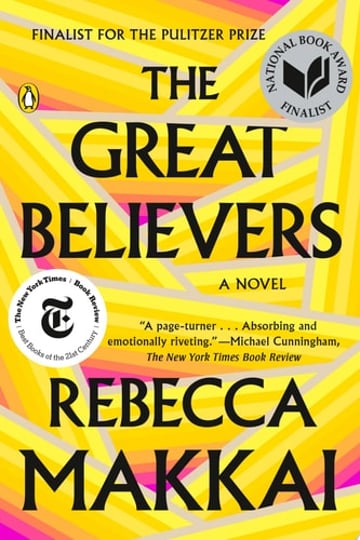
The Great Believers
By Rebecca MakkaiThis book was profoundly sad and eye opening. I knew that AIDS was a crisis in a strictly academic sense. Which, I don't mean to make sound like I was well-informed academically about it, I absolutely wasn't, but I mean that I knew it was bad, I knew that it started in the 80's and that for a long time was a death sentence, and I knew it particularly affected homosexual communities (particularly early on). But I had never in my life given any thought at all to what the experience of living in that time, in those communities was like.
Makkai conveys the humanist experience of AIDS in a deeply affecting way. Particularly, the crossroads of the gay experience when, at a time in history where (really for the first time) it is becoming just tolerable to exist, to be out, to live and love and actually be optimistic about a future where you aren't ashamed of who you are - right then - a horrible virus begins arbitrarily infecting and killing everyone you know. What is that like? How did that feel at the time, before anyone understood the disease? Before there was any practical treatment for it? What is the experience of being positive? Of loving someone who is? Of surviving?
It's hard to read, and I'm ashamed to have never really thought about societal impact that AIDS had. This is a beautiful book, written perfectly.
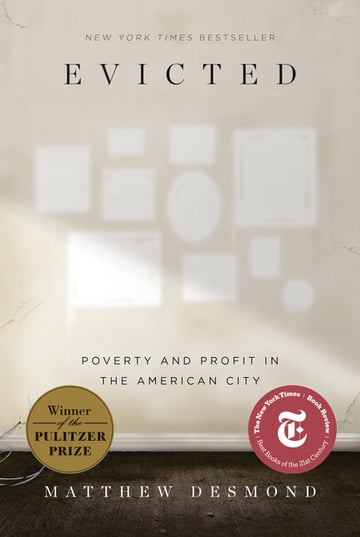
Evicted
Poverty and Profit in the American City
By Matthew DesmondThis was a really great book, not only about poverty, but about the relationship between the rich and the poor. About how poverty is a way of life, not a metric, or a temporary condition. The book tracks several families and people in Milwakee in the early 2010s, but there's nothing about it that wouldn't be true everywhere. The real strength of the book is Desmond's empathy. The book is a collection of stories that he's put together over years of living with the poor, and his reporting from their perspective is effective in ways I didn't expect.
For me there were a few key understandings.
Residential stability is the bedrock of most other forms of stability and well-being. Where you live, and the stability of that situation, generally determines where you can work, and the income that you have access to. This is especially true for the poor, who have unreliable transportation, or rely on public transportation. It determines who your friends are - not only in terms of who you is generally around you, but it alters your ability and desire to invest in those relationships. If you might be moving at any moment, there is less reason to meet your neighbors, to clean up the neighborhood, to invest in and maintain your community. This lack of community investment is devastating - it makes a huge difference in the neighborhood once a certain critical mass of people have this "no investment" mentality. It is especially hard on children, who will be removed entirely from their friend group, their schools, etc. Unplanned moves will set children back severely in their education and social development, which obviously does not prepare them for success later on.
The people in this book experience poverty as a permanent condition. They are not hopeful that they will someday escape it, or that they will be wealthy or even middle class. They typically come from poverty, and are surrounded by poverty, and simply don't seem to waste energy thinking that it can be any other way for them. This leads them to act in ways that are frustratingly short-sighted, like blowing a month of food stamps on a lobster dinner, or refusing to sell your jewelry to avoid an eviction. When you know that you're going to be poor for the rest of your life - why bother saving? Why not enjoy an indulgence on the few opportunities you have to enjoy them? This is, of course, a self fulfilling prophecy, but Desmond describes it with such empathy that it really hits home.
A few more notes:
- SSI (welfare) has a resource limit of $2,000 - meaning that if you have more than that much in your bank account, SSI will stop paying. Huge effing surprise that this incentivizes the poor not to save money. Desmond tells stories in the book where, upon coming by some unexpected cash it is immediately spent on layaway items, which are viewed as "savings", because in the bank account cash is literally a liability. While I'm sure this resource limit was well intentioned, holy hell is that dumb.
- I was blown away by the Milwakee real estate market, post financial collapse (~2009). Desmond tracks a landlord who buys entire homes in poor neighborhoods for less than $10,000 or $20,000 routinely. She would then repair them for ~$2,000 more, and rent them out for $800/mo. No kidding. She would have a full mortgage repaid, using only rent cashflow, in under 2 years. After that it's 100% cashflow profit. That is insane. The cost, of course, is that you're dealing with awful neighborhoods, and very poor tenants. High eviction rates, high wear-and-tear, etc. But still. Slum-lording is disgustingly profitable.
- If police are called to an address too many times, they'll issue a nuisance order to the homeowner. This will cost the landlord money, who will then either raise rents or evict the "problem" tenant. (Even if the source of the disturbance wasn't the tenant themselves). This, of course, leads to poor tenants (particularly women in abusive relationships) never calling the police and getting help, because they know that there is a real chance of eviction if they do.
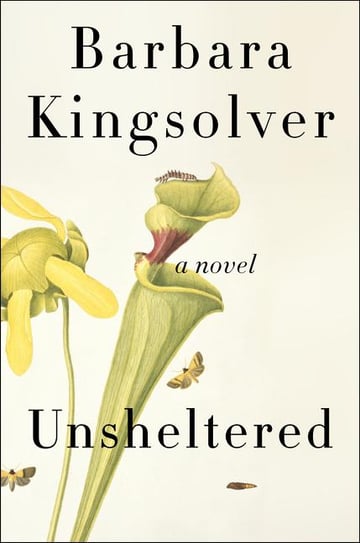
Unsheltered
By Barbara KingsolverKingsolver tried to tackle a lot with this book: fate, luck, poverty, journalism, truth, propoganda, capitalism, racism, populism, politics, sexism, to name a few. I think she does a great job, and for the most part its a good book. It follows two narratives that never directly interact (they take place 100 years apart), but which rhyme thematically.
For me the biggest impact were the events and conversations around climate change. Too often, and quite unfortunately, climate change is politicized and made to seem like a partisan issue. R's challenge that it exists, or that it is a problem, and D's insist that it exists, and that we must act to stop it. This is an easy story, and makes the issue appear two dimensional. In a few different parts of this book, Kingsolver really challenges that, and illustrates climate change as a problem that is orthogonal to the R and D tug-of-war. At one point Willa is speaking to Tig (her daughter), and describing herself in this light, as a progressive and very much opposed to her Trumpian father-in-law. But Tig very deftly exposes Willa as still being part of the problem. Willa is highly progressive, but still thinks climate change is something that other people need to solve. She seems to think that because she acknowledges that it's a problem, that she has done her part. But she still wants her own house, on her own land. Though she would never admit it, she wants the solution to climate change to be something that doesn't impact her, or even inconvenience her. Most succinctly, Tig summarizes Willa's position as "wanting your kids to have more than you did". This is, of course, what every parent has always wanted for every child since time immemorial. But put in this context, so flatly, it becomes plainly obvious how literally unscalable such desires are.
Yes, Trumpian policies are an enormous step backwards. But hating Trump isn't enough, and it is in fact an irrelevant distraction. No one wants to be told that their good intentions are ruining the world, but Kingsolver does it.
I don't know if that's what anyone else would get out of this book - there are a lot of different themes throughout. But this, along with the wonderful descriptions of Cuba, are what made the most impact for me.
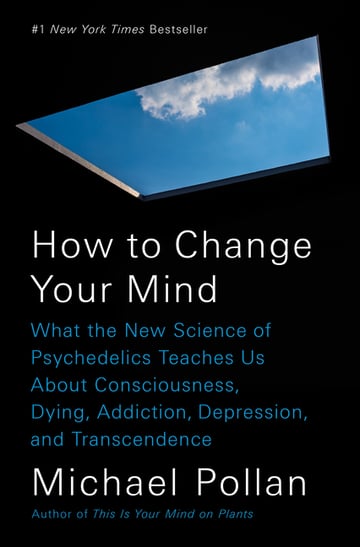
How to Change Your Mind
What the New Science of Psychedelics Teaches Us about Consciousness, Dying, Addiction, Depression, and Transcendence
By Michael PollanI loved this book. I don't have a lot of experience reading books about drugs, but my suspicion in doing so would be that the author of any such book has had their lives so influenced by it that they've lost any objective perspective on things - that the book would be more of a confabulated defense of their own lives. I've not read Pollan before, but I really enjoyed his perspective throughout the book. He had never tried psychedelics, and didn't even feel strongly that he should, he just saw a lot of discussion and growing interest in this topic, and was genuinely curious to learn more about it - and in that process, ended up trying 3 different drugs (in safe, controlled ways, for the most part). His curiosity and skepticism are great, and the effect of the book is to really be on a journey with him, rather than just reading an essay. It's very interesting, and I suspect I'll be returning to it someday.
Some other thoughts/notes:
- "Noetic quality" is the term used for the conviction that a physcadelic trip is a genuine revelation of truth, and not just a random hallucination like a dream. All acid trips tend to have this effect.
- Some light discussion on the nature of consciousness. Is it a phenomenon created in the brain, or is it something that exists in the universe, and that brains are like radio antennas that just pick up a consciousness signal? Pollan didn't dig too deep on this, but it was interesting.
- Native S. American word for mushrooms was 'flesh of the gods', a direct challenge to christian sacrament. "It took an act of faith to believe that eating the bread and wine of the Eucharist gave the worshiper access to the divine, an access that had to be mediated by a priest and the church liturgy. Compare that with the Aztec sacrament, a psychoactive mushroom that granted anyone who ate it direct, unmediated access to the divine".
- Psychedelic compounds (mushrooms and then LSD) were discovered in the late 50's. Other than a small group in central America, no other humans had experienced these drugs before. The effect of them is primarily one that reduces/dissolves the sense of ego and individuality, and leads to a more harmonious feeling with others. At the time, the US Gov was instituting a draft to get young people to go fight and die in a proxy war that they really didn't care about. These drugs were extremely dangerous to that effort, and its pretty clear that they were banned only on this basis - not for any material concerns about the effect they had/have on individual health. They are dangerous to society.
- In the last 20 years, and especially the last 10 or so, these drugs have re-entered the mainstream in academic circles, and have been undergoing a lot of human testing. In particular, they have been extremely helpful for terminally ill patients to accept their prognosis and live out their remaining time with a sense of happiness and purpose.
- There is a series of brain functions/activity that is typically firing for all humans called the Default Mode Network. While under psilocibin/LSD that activity tends to quite down. The same is true of advanced mediators.
- The term psychedelic was coined by Humphy Osmond, in a letter to Aldous Huxley. They were trying to name these drugs using novel words inserted into poems, and Osmond landed on: "To fall in hell or soar Angelic, You'll need a pinch of psychedelic." The word is a portmanteau of "mind manifesting" in Greek.

The Scholar of Moab
By Steven L PeckThis was a very interesting book, and very original, but ultimately a swing and a miss for me. The story centers around an uneducated man named Hyrum, and the various mysteries and odd events that happen around and to him.
I traded off reading this while also reading Educated, which may have been to my detriment, as I felt that the themes here were actually quite similar. Moab is a narrative constructed to investigate truth. What is true, how do we know that it is true? How do different people react to new information, and how is that contextualized into their existing worldview in order to determine truth? The narrative style - told through a series of journals and historical archives, by an unnamed historian - is interesting. I very much didn't like it at the beginning, but it eventually grew on me.
Overall, the more subtle lessons in introspective truth-finding here were outmatched - or at least outshone - by their counterparts in Educated. Moab was interesting and unique, but not something I expect I'll remember very much at all in the future.
2018
Educated
A Memoir
By Tara WestoverEducated might be the best book I've read - it's at least up there. It is a memoir, but many times while reading it I surprised myself by remembering that fact, after thinking to myself how rich the 'characters' in the book are, and how improbable the events seem to be. Very broadly, it is an autobiography about growing up in an extremely radical-religious / conspiratorial / abusive family, and the personal journey of escaping that orbit, getting educated, and integrating into society (and in fact, quickly excelling). Westover is clearly gifted. With no formal education whatsover (no home school, even), she manages to get into BYU, and then quickly after a Cambridge doctoral program. Her success is such a compelling story, and her imposter syndrome as she succeeds is, at some level, relatable to all.
My key thoughts/themes while reading were:
- Morality. This seems foolish to write about a memoir (vs. a fictional story), but it was interesting to examine and re-examine her family throughout the book, making judgements on them as parents, and as people. Very often, they are awful. They're negligent, ignorant, and horribly abusive. They are a slam-dunk case of "should not be allowed to raise children" people. But, are they evil? By the end, it's clear that they're trying their best to raise kids, given their circumstances and beliefs. And it's plainly obvious that they love them. And most oddly, they are by many measures highly successful parents. They basically had nothing, and ended up with 3/6 kids getting PhDs. Show me a family that can do more with so little.
- Related to the above... how do I know that Tara is "right" in all this? Why is the way that she chooses to live her life better than her parents? Epistemologically - how do I know this is true? Her parents both led lives rationally consistent with their beliefs, and were very highly rewarded by it. An objective observer would say that they were highly successful. Why are they wrong to do what they've done? I don't mean only from my perspective - obviously I think they're wrong because their lifestyle is highly inconsistent with mine - but from a more objectively rigorous point of view... if an alien who didn't know what life or culture was like on Earth saw this story play out, would they take Tara's side or her parents? Part of what made the book so compelling was Tara's own struggle with this question. She's never sure that she's doing the right thing when breaking from her families norms, she just feels compelled to do it. Even by the end of the book it's not clear to me if she ever felt certain that she did the right thing. After finishing the book, one question that stuck with me was wondering why she wrote it. It's a magnificent story, but it wasn't clear at all to me what she had to gain from making such a private experience so public. The more I've thought about it, I think that this question is exactly what she's trying to answer for herself.
- Fate. I'm not exactly sure this is the right word, but it's at least adjacent. What I'm trying to capture is, what exactly is it that ultimately motivated Tara to leave? What inconsequential event snowballed inside her until she was driven to leave the family? Why didn't she become her parent's daughter? What thin veil of circumstance separates her life from her brother Sean's? The impression I'm given is one of chaos theory - at some point in Tara's childhood something tiny happened, as small as hearing a song on the radio, that somehow led her down a road of escape. What tiny thing was it? What part does it play in our own lives?
Tara Westover has earned a permanent place on my "5 people, living or dead, that you'd have to a dinner party" list. This was really an incredible book. My single complaint about it is that I need to struggle now between this and My Absolute Darling as book of the year....
One Person, No Vote
How Voter Suppression Is Destroying Our Democracy
By Carol AndersonThe well-researched and articulated thesis of Anderson's book is: since the end of the civil war, conservative whites have been working relentlessly to disenfranchise African American voters. Implicit in that sentence is that such efforts are ongoing, and in fact, Anderson illustrates clearly how they are actually ramping up again.
This book (for me) initially read very similarly to The Color of Law. That book was about how racist (government) housing policy prevented many generations of blacks in America from owning a home, and illustrated how despite today's improved regulatory environment around housing discrimination, the damage done w/r/t wealth accumulation was severe and its effects are absolutely ongoing. In contrast, One Person, No Vote has nothing even resembling a rosy ending. There is no "we've fixed most of it, and are ironing out the remaining issues today". Racially-motivated, lawful voter suppression is not even close to fixed, and is in fact getting worse. So here are the highlights. This is how shitty we are:
Different states have shit laws requiring ID to vote. I was initially sympathetic to this - I do think it's reasonable that you prove who you are in order to vote. Unfortunately, the reasonability of this claim is used as a bludgeon to make it unreasonably hard to actually vote.
- Voter ID requirements are different in each state.
- Very specific forms of ID are required/accepted in each. In some states, a driver's license (the overwhelmingly most popular form of ID) from outside states is not accepted. This is such bullshit that I can't think about it for too long without spinning out.
- To get an ID, you need to go to a DMV. So, e.g.,:
Governor Scott Walker made sure of that. The Republican had curtailed the operating hours or removed many of the DMVs in the Democratic stronghold of Milwaukee, where 70 percent of the state’s black population lived, and in the Navy veteran’s university town of Madison.
The NAACP and ACLU noted, for example, that a birth certificate was necessary to get a driver’s license, but in an obvious “Catch-22 of classic proportions” in Marion County, where more than two hundred thousand of the state’s black population lived, the health department required a driver’s license as proof of identification to get a copy of a birth certificate.
With more than 80 percent of Texas urbanized, and Dallas now a Democratic stronghold, Houston overwhelmingly minority, and San Antonio as well, it was clear that the burgeoning Latino and African American population had the ability to turn a red state not just purple, but blue.97 Texas’s answer was S.B. 14, passed a mere two hours after the Shelby County v. Holder decision came down. The law skewed acceptable government-issued photo IDs to those “which white people are more likely to carry,” such as gun licenses. It made driver’s licenses the virtual holy grail of IDs because nearly one-third of the state’s counties, including some of those that are heavily minority, do not have DMVs. Republican legislators recognized that it would require some citizens to travel up to 250 miles round-trip to obtain a license, but the lawmakers decided to remove language from S.B. 14 that would have reimbursed those who had to make that poll tax–like trip. In fact, one of the state’s lawyers “brushed aside geographical obstacles as the ‘reality to life of choosing to live in that part of Texas.’
IF (this is a really big if) you can get past the idea that people need to register to vote at all, then it becomes reasonable that a state should have an ability to remove people from the voter roll over time. After 100 years you don't want to have the names of every single person who ever registered in the state still on the list. Obviously, it doesn't scale, so there must be a method to remove dead/emigrated people, right?
- In many states, they just remove people who don't vote 'frequently', at the discretion of the secretary of state. (This dovetails wonderfully with efforts that make it hard for people to vote at all, see above).
- If your registered name doesn't match your gov ID name perfectly, you get removed. Guess how often this happens to "John" vs non-English names?
African Americans, who were one-third of the applicants, accounted for 64 percent of the tens of thousands of voter registrations that Georgia’s secretary of state canceled or “placed in ‘pending status’” for data mismatches between 2013 and 2016. Meanwhile, “Asian-Americans and Latinos were more than six times as likely as white voters to have their applications halted.”
His most devastating weapon to date, however, has been Interstate Crosscheck, which he has nurtured and promoted as an important device to eliminate voter fraud from the American political landscape. The program is supposed to root out those who are registered to vote in two different states as part of “a national move to bring more integrity to the voter rolls” and provide a solution to “registration systems [that] cannot keep up with a society of voters who move from state to state.” It works through an alliance of twenty-seven states, which sends voter information to Arkansas to upload. Kobach’s Kansas then pulls and runs the data for every member of the consortium, searching for comparisons “of registered voters to weed out duplicates.”
...
Arizona purged almost 271,000 voters. Michigan removed nearly 450,000 voters, and North Carolina managed to eliminate close to 600,000 from the system. The staggering numbers fueled the narrative of massive, rampant voter fraud.
...
Not all states require the same information that Crosscheck uses to purge the rolls. Social security numbers, for example, are rarely used. Ohio doesn’t bother with a person’s middle name either. Suffixes rarely make it in, as well. As a result, it believes that James Willie Brown is the same voter as James Arthur Brown, as James Clifford Brown, as James Lynn Brown. The possibility for error is exponential.
...
Minorities in America tend to have common or shared last names.
...
researchers at Stanford, Harvard, Yale, and the University of Pennsylvania discovered that Crosscheck has an error rate of more than 99 percent.
Unfortunately, the assault on democracy is not only about the way congressional and legislative district lines are drawn. The undermining of democracy is also achieved in the way long, seemingly interminable lines at the voting booth have been artificially created. We’ve seen the results: A five-hour wait in Maricopa County, Arizona. A line with four thousand people stretching for one quarter mile in Cincinnati. Lines in Miami-Dade County, Florida, bending beyond the photographer’s lens and melding into the horizon.
...
this is a burden that is disproportionately borne in order to exercise that fundamental right to vote. In 2012, on average, blacks had to wait in line twice as long as whites. In the “10 Florida precincts with the longest delays … almost 70 percent of voters were Latino or black.” Nationwide, in the 2012 election, whites who lived in white neighborhoods had the shortest wait times of all citizens—just seven minutes.
...
In Ohio, for example, the secretary of state allocates only one polling station per county for early voting. On the surface, that gives the aura of fairness and equity. But all counties are not equal. Pickaway County has fewer than sixty thousand residents total.95 Hamilton County, where Cincinnati is located, however, has a population of more than eight hundred thousand.96 Yet despite this seismic disparity, each had only one early voting polling place available. There were, obviously, no lines in Pickaway County, home to Circleville. Hamilton County, however, in trying to squeeze a population of that magnitude through only one facility, had a line that stretched a quarter mile.
...
North Carolina, in a “subtler maneuver” than the gerrymandering and voter ID laws that landed the state in court, “moved the location of almost one-third of the state’s early voting sites,” which then “significantly increased the distance African Americans have to travel to vote early, while leaving white voters largely unaffected.” This was deliberate.
Ahh yes, the evergreen practice of allowing the elected officials who seek more power to determine who is allowed to vote for them. This is a well documented pile of horse shit, so I'll keep it light.
Before the redistricting, Pennsylvania’s congressional delegation was composed of eleven Republicans and ten Democrats. The Census-driven reduction of two seats did not lead to an eleven-to-eight ratio, however, but one that would yield thirteen or fourteen Republicans out of a total of nineteen seats.
Indeed, after the high-powered gerrymandering, “more Americans lived in areas with uncontested elections than … before.” And when there is a competition, it usually isn’t much. Only 4.9 percent live in districts where the margin of difference between the winner and loser was 5 percent or less.
I've gone on for too long. This is too many quotes, and sadly only about 10% of what I highlighted in my kindle while reading. To read this book is to be disgusted with our nation, and disappointed with its people. To read this book while watching, in real time, Stacy Abrams "lose" the gubernatorial election in Alabama to a super racist shitbag who was also the AL secretary of state, and who actively did all of this quoted bullshit in order to eke out a "win" was unbearable.
I don't know what the end game here is. I don't understand what the GOP thinks is going to happen, by not allowing minorities to be represented, while 1) income inequality rises significantly, 2) 'minority' populations grow faster than whites. This is obviously, painfully obviously, going to end badly.
I appreciated:
Based on research out of Stanford, the activists knew that the message wasn’t to ask whether someone was going to vote; the point was to define the person as a voter because a “voter is who you are” whereas “voting can be a task competing with lots of other ones.” The volunteers were, therefore, instructed to use “HIGH VOTER TURNOUT LANGUAGE AND ASK HIGH VOTER TURNOUT QUESTIONS LIKE: ‘I know you’re a reliable/consistent voter’ and ‘We rely on reliable voters like you’ and ‘What time of day are you going to vote?’
And lastly, this is a bit of a tangent, but I definitely stopped when I read:
What ruined the U.S.’s credibility, the Soviets gleefully claimed, was that people who “dream of nooses and dynamite … who throw rocks at defenseless Negro children—these gentlemen have the audacity to talk about ‘democracy’ and speak as supporters of ‘freedom.’” Don’t be fooled, the Kremlin warned—the U.S. goal was to export Jim Crow, not democracy. “American racism and its savage practice of cruel persecution and abuse of minorities is … the true nature of the American ‘democracy’ which the United States is trying to foist on other countries and peoples.”
The US was so scared of the USSR during the cold war, and so desperate to win it, or to appear to be winning it, that Anderson alleges here that a driving force of the civil rights movement was not in fact a repudiation of our disgusting history and practice and culture of racism and hate for moral reasons, but only (or primarily, or even only partially) for political reasons. The country needed to appear to be united, and peaceful, in order to credibly show that democracy and capitalism (and lets face it, mainly just capitalism) were better than authoritarian communism.
Truly, we are pathetic.
Hope in the Dark
Untold Histories, Wild Possibilities (Updated)
By Rebecca SolnitI read this book hoping for guidance or wisdom on how to react and maintain hope in today's political reality in the United States, despite knowing that Solnit originally wrote this in 2005 as a reaction to the Iraqi war and broadly the G.W. Bush presidency. And, from the outset, that made me hold something against it. Not because anything in the book is wrong or bad advice, but I can't in my head get past the comparison of that era to this one. It doesn't seem possible to me that any reasonable reaction or advice for that situation could be appropriate to this one.
Nothing in the book was bad, or wrong. (Well, except for the bit praising the revolution in Venezula that led to Hugo Chavez's authoritarian dismantling of that country -- that didn't age well). And, in fact, it does seem like a good reaction to an alarming-but-not-existential threat to western liberal democratic values. Solnit encourages the reader to act, shows example after example of how progress is always fought for, and is never easy. The book is a call to action.
But for me the message comes too close to the notion that 'the moral arc of history bends towards justice'. I'm strongly against the idea that liberalism and western democratic values represent some kind of absolute moral truth. There's that old saying that if every book on Earth disappeared today, in fifty thousand years humans would have recreated all the science textbooks - chemistry and physics and biology would all be rediscovered the same as they are today - but that the Bible and Quran, or the Iliad and Odyssey, etc, would be lost forever. The idea of course being that those sciences represent an absolute truth about the universe, whereas story books are only an idea. I think western democratic liberalism is only an idea, not a truth. There is no great force that has pushed us towards it, or that will keep us moving in a democratically progressive direction. What we have now is fragile, and if we lose it there is no guarantee, or even reasonable expectation, that it should return.
My Brilliant Friend
By Elena FerranteI initially heard about these books on Kottke, and feel like every few months I'd see another passing reference to how solid this book (and series) about female relationships and coming-of-age is. I enjoyed it a lot. Though I need to say, this is one that I felt was underserved by the audiobook. I'm not sure why, but I found myself very easily losing attention to it, and would often need to jump back a minute or two. Though for whatever reason I'm not sure, because I don't think the book is boring, or that reading the physical copy wouldn't hold my attention.
This book is a story about two girls as they grow up, told from their perspective. I don't often read books about children, so this may not be very insightful, but (similar to It) I very much enjoyed the limited perspective of the child, and how isolated it was from the 'adult world'. Growing up in Italy in the 1950's, the children have almost no notion of fascism, or of WWII, or of the struggles their parents must face trying to raise children in such a time and place. Tiny elements of these seep through to the reader, but it is deftly done.
Elena and Lila are both incredible characters, and their friendship and various personal hardships and development was powerful to read. I'm looking forward to reading the rest of the series - though I'm going to try not to rush it.
At that moment I knew what the plebs were, much more clearly than when, years earlier, she had asked me. The plebs were us. The plebs were that fight for food and wine, that quarrel over who should be served first and better, that dirty floor on which the waiters clattered back and forth, those increasingly vulgar toasts. The plebs were my mother, who had drunk wine and now was leaning against my father’s shoulder, while he, serious, laughed, his mouth gaping, at the sexual allusions of the metal dealer. They were all laughing, even Lila, with the expression of one who has a role and will play it to the utmost.
Lastly, I want to leave this link from The New Yorker which is just way better than anything I would write here, and also begins with an interesting piece about "Ferrante" herself, which I've copied into the author bio.
An American Marriage (Oprah Book Club)
By Tayari JonesThis one was painful to listen to. Phenomenally well told story, with particular focus on how one's entire life can ride on so little luck, on just one moment going sideways.
Little Fires Everywhere
Reese's Book Club
By Celeste NgSometimes at work I think about how almost every single problem I have, and frankly almost everything I do there, is just an effort to reduce friction in communication. Obviously "meetings" are just an effort to communicate, so is email, so is conversation - but even when I'm "working", what I'm really doing is trying to figure out how to do something, or how something works - things that other people, somewhere, already know. Sometimes I marvel at how much we could increase overall productivity by just making very small incremental improvements to communication. If we could reduce the friction, and increase the accuracy, of information exchange, such that we just "knew" what other people know - boy oh boy.
I was reminded by that a lot while reading this book. Little Fires Everywhere is fantastic. It's exceptionally well written, has great characters, and has a plot that really keeps you coming back for more - I went through this book very quickly. What it really excels at though is showing several sides to each situation. Every moral conflict in the book is first told from one perspective (letting the reader get on that character's 'side', as it were), and then re-spun and told from the other character's perspective, and you're made to feel like a schmuck and now realize that in fact, character #2 is 'correct', etc. It's very deftly done. At the end, you're left with many complex characters, whose motivations you understand, and all of whom you can empathize with quite well.
But the fact of it is, they're all good characters. No one is evil in this book. Some folks are unlikable, but in pity-able ways. This is really a book full of good people, with good intentions, who are, by all measures, trying to do good things. I'm left thinking that if they could all reduce the friction of their communication - if they just knew what the intentions and motivations of the other characters were, if they just talked to each other more - then they would have all avoided so much pain.
And really, in that way, the book is quite sad. It shows so explicitly how we can all have the best of intentions, and still be capable of hurting each other so much.
Origins of Totalitarianism
By Hannah Arendt
The Argonauts
By Maggie NelsonWhile I think this was a good book - unfortunately, it was not a very good book to listen to. Maggie Nelson is a legit good writer, and the book is so littered with quotes and references that it became very difficult when listening to know when you were inside of a quote and when you weren't. The language in this book is really meant to be savored slowly, read and re-read - many sections are almost poetic in their brevity and impact, such that, when cruising through the audiobook, much is lost.
The book itself is about a personal relationship, and framed by personal events (pregnancy), but Nelson uses this as a structure to explore relationship through transformation. While Nelson is pregnant, her partner is undergoing FTM surgery/therapy, and these transformations provide different perspectives on normality and perceived experience that were very interesting.
Swing Time
By Zadie Smith
Whenever I spotted him in my reluctant daily walk around the village ... Fern would be locked in an intense discussion with men and women of every age and circumstance, crouching by them as they ate, jogging next to the donkey-drawn carts, always listening, learning, asking for more details, assuming nothing until he was told it. I compared all of this to my own way of being. Keeping to my dank room as much as possible, talking to no one if I could help it, reading books about the region by the light of a head-torch, and feeling a homicidal fury, adolescent in nature, towards the IMF and the World Bank, the Dutch who'd bought the slaves, the local chiefs who'd sold them, and the many other distant mental abstractions to which I could do no practical damage.
"So, you see, a lot of money will be saved there, for sure," she said, and folded her hands in her lap to formally mark the end of this thought, and I did not contest her. But I could see she wanted to talk, that her pat phrases were like lids dancing on top of bubbling cooking pots, and all I had to do was sit patiently and wait for her to boil over.
Being Mortal
Medicine and What Matters in the End
By Atul GawandeBeing Mortal is probably one of the most important books I'll ever read. It's not so much a narrative (though, there are a series of personal stories throughout that are very compelling), but moreso it's a wakeup call that hard conversations are unbelievably necessary. The book is broadly about the American experience of growing old and dying. I actually read it for the first time a few years ago after seeing a review in a newspaper article. I thought it was powerful then, but somehow it didn't make it into these reviews. I hope I'll read it several more times in my life. [As a brief aside, I'm incredibly happy and proud that he got the job as CEO of the Amzn/Berkshire/JPM healthcare initiative, and I'm very excited to see what comes of his work there].
The driving force of the book is the end of the subtitle: 'what matters in the end'. Gawande describes the process of aging, and particularly the evolution of how American's have treated the elderly. The first half of the book is about nursing homes, why they're so often feared and disliked, and the kinds of things that make them more tolerable, and borderline even enjoyable. (No surprise; autonomy, purpose, being around other living things [animals, plants]). Gawande espouses Assisted Living over nursing homes, though concedes that the term has been co-opted and is no longer necessarily safe. This was all very interesting.
The second half of the book is about the process of dying itself. About how in America in particular, we have a healthcare system that almost doesn't allow people to die with dignity. Doctors aren't trained to let people die, they only know how to offer potential solutions.
We've created a multi-trillion dollar edifice for dispensing the medical equivalent of a littery tickets. And have only the rudiments of a system to prepare patients for the near certainty that those tickets will not win. Hope is not a plan. But, hope is our plan.
Doctors will only explain what possible treatments exist in order to potentially help; and not necessarily meaningfully help. The purpose of doctors is to allow you to live the life you want to live. But to doctors, their purpose is to cure disease/ailments. These do not always align, particularly when one is no longer possible. Doctors seem to err on the side of aggressively trying to stop a sickness, even if it means increasing the likelihood of the patient spending their last days suffering in a hospital - something that overwhelmingly, most people would not prefer, even if it meant living a shorter life. People have awful deaths in the US, simply because we're pushed - by doctors, by family, by people with good intentions but without understanding and true empathy - to fight to the bitter end. Death used to happen at home. Death used to be peaceful.
A study led by the sociologist Nicholas Christakis asked the doctors of almost 500 terminally ill patients to estimate how long they thought their patient would survive, and then, followed the patients. 63% of doctors overestimated their patients' survival time. Just 17% underestimated it. The average estimate was 530% too high. And the better the doctors knew their patients, the more likely they were to err.
Gawande suggests the following questions to discuss with someone - preferably before they're terminally ill - but better then than never:
- What are you biggest fears and concerns?
- What goals are most important to you?
- What trade-offs are you willing to make, and which aren't you?
When you've had this conversation properly, you stand a much better chance to make decisions for yourself and your family that you actually want, that you won't regret.
As for last words, they hardly seem to exist anymore. Technology can sustain our organs until we are well past the point of awareness and coherence. Besides, how do you attend to the thoughts and concerns of the dying when medicine has made it almost impossible to be sure who the dying even are?
Lower Ed
The Troubling Rise of For-Profit Colleges in the New Economy
By Tressie McMillan CottomThis book came and went so quickly, and with so little impact on me, that I almost forgot to write it up here. It was was a fine book, and by and large I agreed with every word of it - but I didn't find a lick of it surprising at all, which just made it broadly pretty uninteresting.
The main points are:
- For-profit schools are a horrible scam. They (obviously) aren't structured with the student's best interests in mind, and so don't serve the students well. They've exploded in size / impact / popularity in the last few decades, particularly as the financial markets and securitization really flourished. (Though, their business model is not really like securitization, other than the two share in common the reckless disregard for the system they are meant to be improving).
- The students themselves aren't stupid. It's not like they're all dumb and can't see what's going on. But the fact is that they're often in tough circumstances, facing competitive job markets, and having some kind of credentials - regardless of the quality for the education supporting them - is a valuable differentiator. It is, unfortunately, a signal - not necessarily that one candidate is more qualified than the other, but that one candidate cares more than the other, is willing to buckle down more that the other, is more financially stable than the other, etc. I.e., if you can spend $50 on a piece of paper, you probably have your shit together more than someone who can't.
- In addition to this, these companies use awful predatory practices to drive these points home, and bilk as much as they can from folks right on the margin. Cottom's direct experience here was interesting, though again not surprising. Really disgusting what these companies will do. (E.g., they give kickbacks to local companies that hire their graduates in order to boost their "hire rate" numbers - and then after a short period the company will fire the student (to hire new ones).
All of this was disgusting, and I was disgusted reading it, but it really just was right down the middle of what I expected this industry to be. I also found Cotton's writing style a bit patronizing. I don't have any specific examples, but several times felt like she was just one step shy of sounding the words out for me, which just made the experience seem more unpleasant.
Overall, a good book with good information in it, but not something I could really someone else spend their time reading.
The Essex Serpent
By Sarah Perry
Of Orcas and Men
What Killer Whales Can Teach Us
By David NeiwertI read this book quickly over the summer, inspired by a trip out to the San Juan islands where we searched for, and eventually found, Orcas. I don't have much to say now, other than:
- Orcas are incredible. They are smart, social creates with unique cultures. We could do well to understand them much better. They are ancient.
- For 50 years we have tortured them, putting them in tanks hardly larger than their own bodies, to entertain us for profit.
- The ones we haven't tortured, we are eradicating via environmental damage. We've completely ruined their main food source (salmon), and tanker traffic in the Pacific Northwest is additionally highly disruptive and dangerous. We are making no significant efforts to stem any of this impact.
So yeah, overall pretty depressing book about how callous and ignorant humans are, and how we're going to terminate this wonderful species for no real reason.
Homo Deus
By Yuval Noah HarariThis was a fascinating book, which made very interesting points beyond the headline thesis that Harari thinks humans are moving towards developing a high-inequality super-species. Some bullets:
- Max Plank quote: "Science advances one funeral at a time."
- Very light, but interesting discussion on how society will change when people live longer. In contrast to the quote above, Harari comments on the rather obvious conclusion that as some people are able to extent their lives, income inequality will skyrocket, and innovation will broadly slow down.
For thousands of years, the scientific road to growth was blocked because people belived that old scriptures and ancient traditions already contained all the important knowledge the world had to offer. A corporation that believed all the oil fields in the world had already been discovered would not spend time and energy searching for oil. Similarly, a human culture that already beleived it knew everything worth knowing would not bother seraching for new knowledge. This was the position of most premodern human civilizations. However, the scientific revolution freed humankind from this conviction. The greatest scientific discovery, was the discovery of ignorance.
- Harari encapsulates social progress through time as such: Modernity is the exchange of meaning for power. This is still the case now; consciousness, free will, personal experience, brains, etc. Most poorly-understood phenomenon are still ascribed special (and often supernatural) meaning. As we progress, we will give away that meaning in exchange for more power. Once we understand more complex systems, these lose their meaning, but through our new understanding we can control them.
- Part 3 is facinating. Narrative vs Experiential self. Peak/end average rule. Also references free will and illusion of self identity.
- Idea that liberalism (dominance of individual liberties, expressed as democracy, capitalism) is a consequence of technology. In the 1700's, post industrial revolution, individuals came to matter more and more in the economy and on the battlefield. Because individual work is valuable, and became increasingly valuable, it came to make sense to give individuals democratic representation. How should we think about this as the 21st century unfolds, and individuals become increasingly less valuable as they are replace (in both the economy and military) by machines and algorithms? What new social philosophies (and/or religions) will replace liberalism? Is liberalism doomed? Interestingly, this book was published in 2016, just as the liberal world order fell.
- Harari describes humanity and social structures in ways I haven't really seen before, and thought made a lot of sense - using religion as a term not necessarily about humans agreeing to worship a same god, but rather humans agreeing about how they want to organize themselves socially. He argues that 'humanism' itself is a religion in that it is an organizing principal around which individual experiences are the thing that matters, and that humanism will soon give way to Dataism, where personal experience is meaningless, and all that matters is the information attributable to that experience, and how that information is shared.
The Checklist Manifesto
How to Get Things Right
By Atul GawandeI think, but am no longer certain, that I came upon a reference to this book while reading Tim Geithner's memoir on the financial crisis, as a system of managing complexity.
This is an interesting, short read. This is a bit of a tangent but I'm fascinated with things that are just ideas (versus a physical / tech / engineering advancement) that can be a productive enhancement. Recently I've been thinking about blockchains and encryption and those are literally just ideas written down and made manifest through software, but that have an incredible economic impact on the world. Checklists are a bit similar - you wouldn't think that using a checklist can make such a profound increase in results, across so many industries, but here we are.
Some notes:
- Thesis of the book is: when facing difficult, but well-defined and well-understood problems, centralizing power via highly directive checklists are the best way to go. However, when facing non-routine, novel, highly complex problems, you need to decentralize power entirely, allowing all team members to opine and contribute toward final solution.
- Example of the latter as Wal-Mart's response to Katrina, where Wal-Mart mobilized effectivly and provided better a better humanitarian response in the US South than FEMA in the immediate aftermath of the storm.
... [the Wal-Mart CEO] issued a simple edict. "This company will respond to the level of this disaster. A lot of you [local store managers] are going to have to make decisions above your level. Make the best decision that you can with the information that's available to you at the time, and, above all, do the right thing." ... Acting on their own authority, Wal-Mart's store managers began distributing diapers, water, baby formula, and ice to residents. Where FEMA still hadn't figured out how to requisition supplies, the managers fashioned crude paper-slip credit systems for first responders, providing them with food, sleeping bags, toiletries, and also, where available, rescue equipment. The assistant manager of a Wal-Mart store engulfed by a thirty-foot storm surge ran a bulldozer through the store, loaded it with any items she could salvage, and gave them all away in the parking lot. When a local hospital told her it was running short of drugs, she went back in and broke into the store's pharmacy - and was lauded by upper management for it.
- After Guwande makes a safe-surgery checklist for the WHO, he sees that using it reduces surgery complication rates by 36 percent, and deaths by 47 percent. This is at the best hospitals in the world. All from just running through a list of 20 or so things every time, making sure that the full team knows that the routine stuff is done, and allowing a moment of decentralized power, where teams meet on a first name basis and are empowered to bring up any concerns they have, regardless of role power. Insane.
The Color of Law
A Forgotten History of How Our Government Segregated America
By Richard RothsteinRothstein's goal in The Color of Law is incredibly precise: to show how and why, since the ratification of the 14th amendment following the US civil war, racial segregation in US housing has not been de facto (reflecting the natural and free-market preferences of the people), but rather de jure (a consequence of unconstitutional US law and social policy). Rothstein is effective in doing this, and the book is a disgusting reflection of a sordid US history and present.
- "Blockbusting" used to be a common practice, where (white) speculators would sell a white-neighborhood home to a black family, then scaremonger the remaining homeowners of a pending "Negro invasion" into selling their homes at highly below market rates (they would basically race each other out of the neighborhood). The speculators would buy the homes directly, and then turn around and sell them to black families at above-market rates, since housing was so highly demanded by blacks, and so poorly supplied. These blockbusters would literally hire black people and pay them to loiter in the neighborhood and cause trouble. This was not illegal.
- Until about the 1950's the FHA/VA would not insure mortgages to blacks (full stop), nor to whites when buying homes in predominantly black communities. This blew my mind. It's hard to imagine how a court could not interpret this as a violation of the 14th amendment. This single item made it almost impossible for black families to own homes in the US until the 1950's. Not only did this policy segregate races into distinct neighborhoods, but it blocked blacks from accumulating wealth via home equity.
- As a tangent, I was surprised to learn how hard it was even for whites to own homes during this time, even through the 30s. Mortgages used to be 50% down, interest only payments, with lump sum due 5-7 years later. This began to change with the FHA in the 30s/40s, and really changed during the 80s with Louis Ranieri. For all its downsides, mortgage securitization was, at a time, a very good thing.
- City zoning ordinances allowed the outright blocking of black home ownership/rentals by zone. In black-zoned areas, cities also allowed industrial zoning, garbage dumps, bars, brothels, etc. They also allowed super high density and lot subdivision in black-zoned areas, leading to overpopulated slums, whereas white-zoned areas were single-family only.
- Housing covenants (private agreements, similar to HOAs today) strictly limited POCs from owning or residing in homes, except as servants. This limited who you could even re-sell your home to.
Reading this book makes it so clear how little we've done since the civil war, and how far we still have to go.
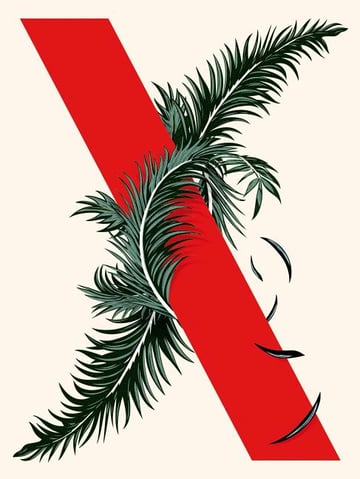
Area X
The Southern Reach Trilogy: Annihilation; Authority; Acceptance
By Jeff VanderMeerAll three of these books have fantastic covers, and the one for the full trilogy, shown here, is amazing. The series explores a biological phenomenon vs a system of control - this is remarkably well illustrated here, and I just adore the lack of all text (though, it is admittedly grandiose). "Area X" is itself a terrible name, so this is a really spectacular treatment. The US individual book covers were pretty good as well, but the UK versions are spectacular.
I started reading Area X about three years ago, while still living in Luxembourg. I really enjoyed the first few chapters, but knowing I was signing myself up for a three book marathon, I decided to bail and focus on more European history books that would give me better perspective of my limited time there. During those three years, the first few chapters of Annihilation stuck with me. The writing style was good, and the book was an interesting blend of mystery and biology. I wondered for years how things would turn out, what the nature of the tower would be, the writing on the wall, etc, etc.
Turns out, the whole thing was a mess. Annihilation was pretty good, but mainly in that it setup a lot of great plot points and mystery and intrigue that were just never and/or poorly executed on. It's goodness is actively undone by books 2 and 3. Authority (book 2) was garbage. Really bad. Reminded me of the (third?) book of War Against the Ctorr, where the writing style and characters are totally different, and it just absolutely kills the momentum built up earlier in the series. I was fine with the idea - in fact I really liked the concept, but the execution was off. Acceptance (book 3) was just a zero. It was very neutral, didn't answer anything, no big questions or big answers, and didn't really make me care more or less about anything. It seemed very much detached from the first book, and sprawled out in ways that weren't interesting. There was just never any payoff on the things that book 1 had gotten me vested in. Everything just moves on.
Overall, a big waste of time. I like sci-fi for its opportunity to pose big questions, thought experiments, etc. These books, particularly 2 and 3, don't execute well in any regard but the covers. I think Annihilation is itself a great stand-alone book, but it's really soured by the followups.
Dreamland
The True Tale of America's Opiate Epidemic
By Sam QuinonesLight lifting. This was like a Malcolm Gladwell book on sleep - but not as well written. Not to say it was bad - I certainly enjoyed it - but this was more like 10 sequential magazine articles than it was a book. It just barely skims the surface of many topics, hits the talking points, and moves on. I'd really like something a lot deeper, but can't complain too much about this offering. I don't think there was anything here I hadn't seen before - but worth calling out:
- No one really knows why we need sleep, but it seems to be particularly related to relaxing the prefrontal cortex.
- Discussed the idea (which came up in How The Mind Works) about the purpose of dreams being to prepare our brains for bad/novel scenarios. Dreams are essentially 'practice' mode for our brains, so that when we experience novel situations in life we'll be better prepared.
- There seems to be evidence that without artificial light, it seems like humans naturally sleep twice a day: 1st sleep, then an hour or so awake, and then 2nd sleep. There's evidence that most people actually did this regularly until just a few hundred years ago.
- Teenagers circadian rhythms make them want to sleep from 12-8, whereas older folks (50+) tend to want to sleep from 9-4. Theory is this was evolutionarily advantageous so that families/groups of humans would always have someone "on shift" looking out for danger. I love this. What an elegant solution to a legitimate, if totally obsolete, problem.
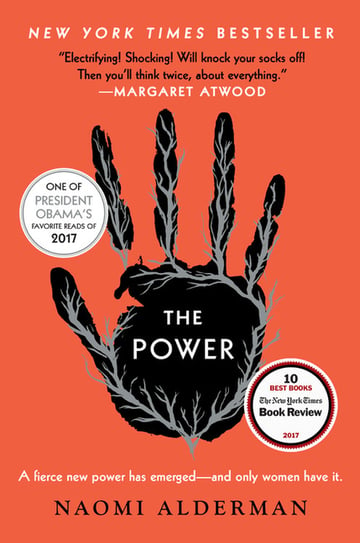
The Power
By Naomi AldermanThis was a great book. Alderman did a great job communicating (often satirizing) the power imbalance between men and women today. The second chapter of the book nails this when a women shocks a man, probably for fun, as they are making out. The man feels totally vulnerable and betrayed - yet blames himself for getting into that situation, telling himself she probably didn't mean it, and refusing to tell others for fear of not being believed. These are super straightforward parables (parables?), but their obviousness does not make them any less effective. Most examples are more subtle, and it is disappointing and surprising how things you didn't realize were sexist become obviously sexist once the genders are switched. This is a perfect high-school-reading-list-book, if not for the graphic rape and torture scenes...
Back when I read the Hunger Games I was deeply disappointed with the ending. In The Power, Alderman executes the ending that I wished the Hunger Games (and most other generic fiction titles) had the gumption to do. Alderman demonstrates well how power changes people, and ultimately, corrupts. The power of the book is in showing that if women had physical dominance over men, that the world would actually be very similar, if not identical, to how it is today - but with gender's reversed. The conclusion is speculative, but its interesting to remove gender from sexism and view it exclusively as a power imbalance. And as a work of fiction, it's highly refreshing to have such moral ambiguity in the protagonists.
Faster, Higher, Farther
The Volkswagen Scandal
By Jack EwingThe Volkswagen Scandal can be broadly broken into four parts, each worse than the last:
- The manufacture of diesel engines that did not meet EPA standards according to US law (these engines emitted up to 35x the legal limit of highly toxic nitrous oxide gas).
- The intentional design and implementation of a "defeat device" that would temporarily lower engine performance (and resulting emission levels) when it was detected that the car was being tested for emissions. This device allowed the diesel cars in 1) to pass inspection and be sold in the USA. The sole purpose and intention of the device was to evade US law.
- The egregious marketing of these cars as "clean diesel", and as environmentally responsible.
- Upon discovery of the deception, the systemic denial, obstruction, and attempted cover-up of VW management.
The book digs into the details of what happened, but all of it was pretty cleanly summarized in the Statement of Facts that VW eventually had to cop to. It really was a disgusting corruption, and I'm convinced from reading it that I'll never buy a VW/subsidiary car. Some of the more interesting discussion in the book was theorizing what led to such corruption... what led so many people to act so terribly? In most cases you can pretty easily trace a straight line from an outcome like this back to a system of incentives that caused it (e.g., stock bonues, sales targets, etc). That's partially the case here - but there was nothing particularly unique about VW in this respect as from other car companies. Everyone has stock bonuses and sales targets - everyone would love to lie and juice results and get away with it. But VW somehow had/has a really poison corporate culture that doesn't respect the law, or didn't fear being caught. I wish the book had focused a bit more on that, and sought to understand better the first-principals that led to the eventual result. How did the culture get so tolerant of that? How can those lessons be applied broadly to other orgs? Ewing gives some brief thoughts here, with comments around the concentrated control of VW by very few family shareholders, and no diversity on their board at all. A great jumping-off point for a discussion that never fully developed.
Other items:
- Quite surprised the emissions standards in the EU were looser than the US. While VW was definitely against the spirit of the law in the EU, they never explicitly broke the letter. In the EU, car manufacturer's are allowed to over-emit pollutants when they determine, in their sole opinion, that they're doing so to "protect the engine".
- Big surprise: no one has gone to jail, all the executives got giant bonuses, the stock has totally recovered (and then some). I.e., nothing at all has changed.
My Absolute Darling
By Gabriel TallentThis book is so well written that me trying to say anything about it is just foolish.
I am a girl things go badly for.
It is about damaged people.
You are supposed to come to the door and believe that hell awaits just on the other side, believe that this house is full of nightmares; every personal demon you have, every worst fear. That’s what you stalk through this house. That’s what waits for you down the hallway. Your worst fucking nightmare. Not a cardboard cutout. Practice conviction, kibble, strip yourself of hesitation and doubt, train yourself to an absolute singularity of purpose, and if you ever have to step through a door into your own personal hell, you will have a shot, a shot at survival.
At times it is very dark, and sad, and depressing, and sometimes it's very uncomfortable to read. But it's also inspiring and happy and joyful and uplifting.
She switchbacks through myrtles and rusty fronds. She comes into the rocky creek and wades up it, her feet numb with cold. The trees rise blackly into the star-glittered vault. She thinks, I will go back now. Back to my room. I have promised and promised and promised and he cannot bear to lose me. To the east, the stream shines glassy from out the riotous dark. She stands breathing, taking in the silence for a very long time. Then she goes.
The prose is unbelievable.
Turtle climbs out of slaughterhouse gulch and comes into a forest of bishop pine and huckleberries, deciphering them in the darkness by the wax of the leaves and the brittle mess of their sprawl, the dawn still hours away. At times she breaks from the woods into moonlit open places filled with rhododendron, their flowers pink and ghostly in the dark, their leaves leathery and prehistoric. There is a part of Turtle that she keeps shut up and private, that she attends to with only a diffuse and uncritical attention, and when Martin advances on this part of herself, she plays him a game of tit for tat, retreating wordlessly and almost without regard to consequences; her mind cannot be taken by force, she is a person like him, but she is not him, nor is she just a part of him — and there are silent, lonely moments when this part of her seems to open like some night-blooming flower, drinking in the cold of the air, and she loves this moment, and loving it, she is ashamed, because she loves him, too, and she should not thrill this way, should not thrill to his absence, should not need to be alone, but she takes this time by herself anyway, hating herself and needing it, and it feels so good to follow these trackless ways through the huckleberries and the rhododendrons.
This is the best novel I've ever read. I never wanted to stop reading it. Not necessarily because it's gripping, or because I wanted to know what happened next, but because the act of reading it was so effortless and compelling and rewarding. The best way I can describe it is that most of the time reading feels like my brain is pulling words out of the book, doing work to lift them from the pages and into my brain for processing and comprehension. Reading My Absolute Darling had the effect of the words being siphoned out of the book and directly into my head - once it was started, gravity did all of the of the work. If anything, the work for me became a struggle of making enough room in my head for the words to fit, faster and faster and faster until the book was done.
Artemis
By Andy WeirMeh. This book was super vanilla. I've been reading fantastic fiction lately, which really makes the flaws in this book stand out. It's super predictable, the characters are shallow, they don't develop at all, and the writing is just very ... normal? I don’t know - nothing really stood out here at all. I’m sure they’ll make this into a movie eventually, and by the time it comes out I’ll have forgotten everything about it.
I don’t really remember The Martian well enough to do a fair comparison, but I seem to remember the writing in that book being a bit more creative and unusual.
This was dissapointing.
2017
Human Acts
By Han KangDamn this is a great book, in both subject matter, vision, and execution. (Also, that cover!). The book revolves around the events of the Gwangju uprising in May 1980, and the subsequent torture of South Korean citizens by their own government. This isn't a history book though - there is no effort to catalogue the events in any kind of academic way. Kang focuses on the events of that uprising to tell a broader story of what it means to be human in the face of the worst acts that humans can inflict on each other. This sounds terribly depressing, and many parts of it absolutely are. But finishing the book didn't leave me depressed. The writing style is so deft and poetic, that a kind of beauty comes through as well. (Credit to Deborah Smith for the English translation).
Quotes:
Certain crowds do not blench at the prospect of looting, murder, and rape, while on the other hand, others display a level of courage and altruism which those making up that same crowd would have had difficulty in achieving as individuals. The author argues that, rather than this latter type of crowd being made up of especially noble individual;s, that nobility which is a fundamental human attribute is able to manifest itself through borrowing strength from the crowd; also, similarly, that the former case is one in which humanity’s essential barbarism is exacerbated not by the especially barbaric nature of any of the individuals involved, but through that magnification which occurs naturally in the crowds.
And another:
Is it true that human beings are fundamentally cruel? Is the experience of cruelty the only thing we share as a species? Is the dignity that we cling to nothing but self-delusion, masking from ourselves this single truth: that each one of us is capable of being reduced to an insect, a ravening beast, a lump of meat? To be degraded, damaged, slaughtered—is this the essential fate of humankind, one that history has confirmed as inevitable?
...
I heard a story about one of the Korean army platoons that fought in Vietnam. How they forced the women, children, and elderly of one particular village into the main hall, and then burned it to the ground. Some of those who came to slaughter us did so with the memory of those previous times, when committing such actions in wartime had won them a handsome reward. It happened in Gwangju just as it did on Jeju Island, in Kwantung and Nanjing, in Bosnia, and all across the American continent when it was still known as the New World, with such a uniform brutality it’s as though it is imprinted in our genetic code.
I never let myself forget that every single person I meet is a member of this human race.
Foundation
By Isaac Asimov
White Trash
The 400-Year Untold History of Class in America
By Nancy Isenberg- Interesting review of class structure during different times, but little focus on specific structural barriers to class mobility. To me the most interesting question is WHY can't the poor or the lower class change their status? To me the American founding myth wasn't ever really one of classlessness in an egalitarian way - but classlessness in an impermanent way. That in the US class doesn't exist precisely because it is not a permanent classification, but rather, a temporary station. Rags to riches, etc. Isenberg spent her time focusing on the existence of classes, and the disparity between them, but little time on why they are solid lines, rather than dotted.
- Where Isenberg DID comment on class permanence was interesting. There was some discussion of pedigree and breeding. Class came to be seen as a bloodline issue. Particularly in late 1800's, lower classes weren't only economically separated, but believed to just be a worse kind of people. (E.g. mud-eaters).
- This actually morphs into a national hysteria that I wasn't really aware of before. In late 1800's, early 1900's, pedigree and eugenics were highly popular and academically justified. See SCOTUS Buck vs Bell. This really gives some additional context into global mindset prior to WW1/2.
Physics for Future Presidents
The Science Behind the Headlines
By Richard A MullerThis book awkwardly fumbled between giving broad educational advice to a broad audience under the guise of it being meant for a president, and actually giving advice to a president. The two are very different. Despite being a bit odd to read, I was generally okay with it for most of the reading. The final chapters on climate change were unbearable though. Muller bends over backwards to explain how we're not 100% sure that climate change is caused by humans, and that there's a chance that it might not be. I honestly couldn't actually tell if he was for or against environmentalism (which is awful - he's a very strong advocate for addressing climate change, but none of that comes across in this book). He writes as though the president of the US is literally reading this book. If that were the case, yeah, I get it, you'd want the president to understand that, and to understand the nuance behind how all these measurements are taken, etc. But if you're writing a book meant for popular consumption, you don't emphasize the doubts. Muller needs to understand that he isn't actually briefing the president, and that any doubt he introduces is just going to stoke resentment and dampen any willingness or enthusiasm for readers to actually change their habits, or to demand better policy of their government.
Overall, the book was actually quite disappointing. I've seen other books by Muller that seem highly reviewed on Amazon, but I don't think I'll be giving him another shot. Muller might have good intentions here, but the advice he gives is horrible. Two giant gaps for me were:
Our love affair with fossil fuels ultimately derives from the fact that they are so cheap
This is false. Muller repeats this so many times in the book, and makes similar counter-claims about how cost-ineffective lean energy like solar is. And he boils it all down to the inane sentence above, which is so terribly myopic. If anything, we love fossil fuels because they deliver high energy density in an easily transportable package - THAT you can argue. But the only reason they're cheap is because 1) we've subsidized the shit out of the entire industry for the last 60 years - from low corporate taxes, to taxpayer funded infrastructure (highways, etc), and 2) we don't price in the very high externalities. Worst yet though - Muller pretends throughout this whole book that the intended audience is the future POTUS - but misses an opportunitiy here to scream at the POTUS that this is exactly the kind of thing the government needs to subsidize in order for it to become competitive and lead to greater social good. How he doesn't see and do this is mind-boggling.
Later, Muller argues that although WE KNOW AS FACT THAT 1) human activity is increasing atmospheric CO2 levels, AND ALSO 2) that increased atmospheric CO2 levels will, in part, contribute to increased global temperature due to greenhouse effects, AND ALSO 3) that Earth's temperature is rising proportionately with the rise in atmospheric CO2 levels, WE CANNOT THEREFORE conclude that 1) is directly causing 3), because we don't know for sure that the man-made increase in temperature isn't being offset by changes in cloud behavior. That is to say, Muller is arguing that it is possible (~10% chance) that atmospheric carbon increases makes the atmosphere hotter, which changes cloud density, which cools the atmosphere, and that therefore man-made CO2 increases aren't actually raising global temps, and that the increase in global temperature may be coincidental and completely unrelated. He doesn't actually believe this garbage - but he spends dozens of pages making the point, such that the book literally reads like a climate denial handbook. I literally finished the book thinking he was a climate skeptic, and only later learned that this was not the case. He's just a terrible writer.
A few other little notes below, which were interesting.
- Intro is primarily about terrorism and has aged poorly. Focus is on dirty bombs/nukes, not on simple things like cars/guns. Also, dismissive on DPRK’s attempts at building a nuke, saying that those attempts have fizzled, whereas today they are announcing imminent testing of a hydrogen bomb.
- Energy section is a useful cliffs notes:
- Kilowatts are rate/flow of pwer consumption (i.e., miles per hour). Kilowatt-hours are the stock of energy used.
- 1 kwh is approx. equal to 1 hoursepower, approx. equal to 1 sq meter of sunlight.
- Average US household energy consumption rate at any given time is 1 kw. So, amount consumed per day is 24kwhs.
- Average cost per kwh is about $0.10 in the US.
- A medium sized power plant generates 100 megawatts = 100,000 kws = 100,000 households of energy.
The Invention of Nature
Alexander Von Humboldt's New World
By Andrea WulfI only listened to about half of this (about the first quarter, and then the last quarter), so I don't really have a full picture... BUT it was pretty incredible. I literally didn't know anything about Alexander Humboldt, hadn't even heard of him, but the book and story about his life was fascinating. It's interesting to think about a time before "environmentalism", or "ecosystem", or "cosmos" were things, or even words. Humbolt was a pretty incredible pioneer.
The final chapters, talking about people that Humboldt strongly influenced, was the best of what I heard. Long chapters on John Muir, Charles Darwin, Earnst Heckle, and others, were great. I particularly liked the description of Earnst Heckle, his radiolarian artwork, and later came to find that he coined the phrase "ontology recapitulates phylogeny" - something that's stuck in my head since high school.
Overall, this is something I'd love to re-read properly, and hope to do so at some point in the next few years. If nothing else, for the nostalgic feeling of listening to this book during drives to Beaune, France, and throughout Crete.
Lastly, this book won the 2016 Royal Society Insight Investment Science Book Prize, which made me realize that there was such a thing, and led me to this list of incredible books to read going forward. So, good times.
The Heart
By Maylis De KerangalI lost track of where I initially saw this recommendation. Unusually, I don't think I ever saw the cover either prior to, or while reading the book. (It was a kindle purchase, and I don't really have memory of whatever image would have been on that buy screen). Due to that, I don't really have much imagery associated with the book, and seeing this cover is a bit of a surprise now. The cover fits though. After having read it, had I had to design a cover, I would have chosen some theme on waves as well. The main character is a surfer, so that's no surprise. But my waves would have been darker. The waves here seem optimistic, great big white caps, perfect for surfing. Too upbeat. The feeling I got reading it was so much more downtrodden. Used and dingy. More like looking at the ocean on a rainy day, when you can't really tell where the rain ocean stops and the clouds start.
This book was about the consequences of death, and impact that it has on others. It was good, though not in any way that will really stick with me. Despite being mired in death, and even in how death can literally bring life, the book gave me very little in terms of how life should be lived.
From a process perspective I only really have two comments. First, that De Kerangal does character intro/exposition better than I've ever seen. In a few short pages at the beginning of each new section she'll introduce a new character, and do it in such eccentric detail that it feels perfectly intimate and genuine. Second, disappointingly, is that her female characters are not good, as they are all based on men. (By based, I mean their foundations are on other male characters - in a sense they are defined by those characters. They define themselves by who they love, who doesn't love them back, etc. Whereas the men all define themselves on their other passions.)
Some quotes:
Sean’s face—those catlike eyes—lights up the screen of her cell phone. Marianne, you called me? Instantly she bursts into tears—the chemistry of pain—incapable of uttering a word while he repeats: Marianne? Marianne? He probably imagines the echo of the sea in the harbor is interfering with the signal, probably hears her spit and snot and tears as so much static while she bites the back of her hand, rendered speechless by the horror she feels at hearing that voice she loves so much, that voice familiar to her as only a voice can be, but become suddenly strange, abominably strange, because it comes from a space-time where Simon’s accident never occurred, an intact world light-years away from this empty café; and now it was dissonant, this voice, it disorchestrated the world, tore apart her brain: it was the voice of life before.
And
It is time, now, to turn our attention to those who are waiting, scattered throughout the country and sometimes even beyond its borders, people whose names are on lists, classified by organ, to be transplanted, and who, every morning, ask if their position has changed, if they have moved up the ladder, people with no conception of the future, whose lives are restricted, suspended by the condition of one particular organ in their body. People living their lives with the sword of Damocles hanging above their heads. Imagine that.
Istanbul
City of Majesty at the Crossroads of the World
By Thomas F Madden- Emporer Constantine I of Rome in 300s had fever dream that Jesus told him to put iconography on his armies. C then replaced his standard with the Chi Ro symbol. This was at a time when Christianity was a minor and ostricized religion. C won major battles, convered to CC, and the rest is history. This guy basically made Christianity.
- Theodocian Wall - 3 tier wall system. 60 ft, 30 ft, 10ft. Then huge moat, all around the city. Inpenetrable.
- 400's - Attila & the huns sack Rome, it falls. "Roman Empire" alive and well in Constantinople. Attila makes his way in that direction. In Northern Italy sacks Aquielia, driving refugees and escapees into the marshlands. They establish a village that later becomes Venice.
- 400's - Council of Calcedon. Christianity going through a lot of changes and interpretations at this point, many open questions on the nature of Jesus (man vs God). This is ultimatly settled at this council, convened in Constantinople, where they declare the holy trinity to be a thing. This is still what most Christians believe in. Nuts.
- 450s - Justinian and Theodora, the peasant and prostitute emperors of the Roman Empire. Beset by riots, are prepared to flee the city. Theodora calls everyone in the room a coward, says she'll die on her throne. Ends up swinging the fight, they retain power, kill 30,000 rebels in the hippodrome. Grisly. Justonian goes on to create the Ella Sophia (?) church. Incredible.
- The One True Cross was housed in the Church of the Holy Sephulchure in Jeuruselem.
- Around the 550's/600, history begins referring to the people of Constantinople as Byzintines, and it as the capital of the Byzantine Empire. Which is odd, because they still see themselves as Romans, and Byzantium is looong gone. That finally fills in the gap of what the Byzantine Empire was though, interesting. Just Greeks and Romans that went northeast.
- The original black rock at Mecca was "from the heavens", a likely asteroid, that the pagan Arabians worshipped long before Islam.
- 600s. Emperor Leo fends off the Arabs, just barely. The Black Death hits. He thinks god is pissed, and blames it on worshipping idols. Goes full on iconoclastic, bans/burns every single religious figure/art. No religious art from prior to this exists today.
- In 600s first empress of Rome/Byzantium comes to power, repeals iconocylsm, commissions portrait of Mary in Hagia Sophia. It is still there. Wow.
- Most of the best remaining art from Constantinople was lost in 1204, when the 4th crusades (led/financed by Venetians - Henrico Dandolo) invaded and conquered the city. They sacked the whole thing. The city had been in decline for a while already (otherwise would never have lost to the crusaders) but this was really the beginning of the end. The crusaders did an awful job administering the ruined city for about 60 years, until the Byzantines were able to take power again.
- Muhammad prophecized in the 600’s that Islam would conquer Constantinople, and that the person that did it would be richly rewarded - and so, the city had been a target of the Muslims/Ottomans for forever. They attacked it many times, but it took almost 1000 years of effort, until 1452, for them to succeed. The night before the invasion (when the outcome was obvious), Constantine XI held a final Christian mass inside Hagia Sofia, knowing it would likely be the last mass in the church for a long time. The next day the victorious Sultan converted the church to a Mosque, which is was for about 500 years. Today, it is a museum, though fundamentalists in Turkey want to convert it back to a Mosque today. The church has stood for nearly 2,000 years. It’s interesting to imagine if/when another Christian (or other religion) mass would be held there. Such an interesting history inside that building.
- Instructive moments Teaches me to be better prepared, resourceful, teaches me humility and to be gratefulAfter Ottoman conquest, I lost a lot of interest in the book. Partly because the Ottomans themselves lost a lot of interest in the city. Other than build large, beautiful mosques (of which there are many, though none larger than Hagia Sofia), the Ottomans didn’t really do anything to the city. They weren’t interested in civic life or urban planning the way the Greeks and Romans were, and so the city, its art, statues, icons, history, and infrastructure, all pretty much deteriorated after 1453.
- After WWI the Ottoman empire fell apart (having sided with the Germans), and was dissolved after internal revolution within Turkey. After almost 2,000 years with the same name, Constantinople was changed to Istanbul (a term already in use, derived from the Greek term “the city”). In the last 50 years or so, the population there has exploded, primarily due to unregulated urban sprawl (shanty towns that are built overnight and eventually incorporated into the city limits). This method of growth has left the city feeling especially chaotic and unplanned. While we didn’t spend any time out in the subburbs, it didn’t look like an organized or nice plae to live.

The Expats
By Chris PavoneWe picked up this book three years ago, before moving to Luxembourg, since apparently that’s something that all the American expats need to do. I never read it while there, but now upon leaving, felt obligated. Plus, it’s a great stupid/fun novel for vacation. It lived up to that expectation. A fun page turner, but the most likable bits were the descriptions of little Luxembourg. Pavone clearly has lived there, and nailed the feel of the place, while including gratuidous descriptions of specific locations that the locals would know. It’s fun to see your little nook described perfectly in a book.
A few items hit home. Of course, the Grund:
There were a handful of pubs clustered around the bridge in Grund, each with its own discrete micro-atmosphere of smoke and noise, the sound of TV rugby in one, a Euro-pop jukebox in another, sloppily drunk teenagers in a third, where a sign clearly prohibited entry by anyone under sixteen years old, thus attracting every sixteen-year-old in the city. Kate walked across the bridge, entered the long well-lit tunnel cut deep into the rock upon which the haute ville was built, the rough-hewn walls hung with derivative art, the faint stench of urine, as in every urban tunnel...
And...
This is the expat life: you never know when someone you see every day is going to disappear forever, instantly transmogrifying into a phantom. Before long you won’t be able to remember her last name, the color of her eyes, the grades that her children were in. You can’t imagine not seeing her tomorrow. You can’t imagine you yourself being one of those people, someone who one day just vanishes. But you are.
The Age of Cryptocurrency
How Bitcoin and the Blockchain Are Challenging the Global Economic Order
By Paul Vigna and Michael J CaseyGoing into this book I really didn't know anything at all about bitcoin. I understood it vaguely to be some kind of fad whose value had risen a lot recently, but not based on any strong fundamentals. I wrote it off as a bubble, and have ignored it for the last five or so years. Even at work, where it has potentially significant and long term disruptive potential, I've never really dug in - so I'm pretty late to the game on this.
The key takeaway has been better understanding of what the blockchain is. It is, essentially, an immutable, transparent accounting history of every historical bitcoin transaction. Anyone can inspect it, and no centralized source controls it. When bitcoin "miners" are mining for coins, the computations they're doing are transaction processing for pending bitcoin transfers - they are working to organize and validate a block of transactions. When done, that block is appended to the chain permanently.
The blockchain is what allows bitcoin to be entirely decentralized. There is no, and can be no, central bitcoin monetary authority.
The advantages of bitcoin, (and potentially other digital ccys) are significant. There is no clearing network. Bitcoin transaction clearing is nearly instantaneous and nearly costless (for now, but will increase over time). The elimination of so much economic friction could be a massive disruption.
A few bullet points on risks:
- Security. Once bitcoin is spent, its spent. no chargebacks, debits, etc.
- If someone gets your private key, they can steal your coins. (requires hack, often physical). If you store BTC on a public exchange, then if that gets hacked your BTC could be lost.
- 51% miner concentration risk; if a single party owns the majority of the mining computational power, they can purposefully create a hard fork, and conspire to double spend bitcoin. There are internal incentives against this, but it remains a core flaw of the system. Mining pools have come very close to this concentration amount.
This is the best video overview I've found of Bitcoin so far. Overall a pretty good book that has gotten me hooked on the subject.
Misbehaving
The Making of Behavioral Economics
By Richard H ThalerA great book on the history of behavioral economics. Covers the relationship Thaler had with Kahneman and Tversky, and really took me back to my undergrad thesis research. That said, didn't take good notes while going through this one, so not much to report here. As a resource on behavioral econ/finance, it was not better than Thinking, Fast and Slow.
The Bonfire of the Vanities
By Tom WolfeTypically I only write what I want to remember about books here - which puts me in a pickle with fiction books since there is no explicit lesson or takeaway, rather an interesting journey. I suppose if I remember anything about this book, it would be that it's the best written book I've ever read, by a mile. Wolfe spins a ho-hum, pedestrian plot into a page-turner on the strength of just great, great writing. Epically good writing. 'Bonfire' had been on my radar ever since seeing the cover slug on Bombardiers. While Bonfire doesn't center around finance or bond trading the way that book did, Wolfe captures the aura around 1980's wealth and extravagance in a similar way than Po Bronson and Michael Lewis - but Wolfe excels far beyond those other attempts. Far surpassing them. It isn't even close.
I don't have any particular pullquotes that I kept. I'm sure there are many worth quoting, but that would do a disservice to the rest of the book. The whole thing is completely fantastic. I loved it.
The Euro
How a Common Currency Threatens the Future of Europe
By Joseph E StiglitzI've understood for a while why the shared EUR currency causes problems for its member states; mainly that monetary policy is restricted to a broad economic region, but that fiscal policy and political realities are localized to individual member states. Meaning, e.g., that Greece can't just inflate its own currency in order to boost its own economy.
A key thing I'd like to understand after reading this book is: what is the core difference between the EU and the separate states of the USA? Why is the EU barely able to stay together (for now), and the USA has been more or less secure for 250 years? Is it just that the USA is more politically similar? I don't think that's good enough. I want to understand that better on a first principals basis. The USA is basically 50 states with 50 economies and 50 currencies that are all pegged to each other. Detroit can't inflate their currency in bad times to boost the economy...
There are three adjustment mechanisms in the US that don't sufficiently apply in the EU....
- Ease of migration:
- English is the common language
- Assistance programs (medicare, medicaid, social security, SNAP) are federal, and so localized economic downturn within a state is offset by increased federal subsidies in these forms.
- w/r/t these points, migration in EU is hard. Large linguistic, cultural, and licensing barriers. EU nations also want to preserve these cultures more than US States do. A South Dakotan is an American first, and that identity doesn't change as they move within the US. "A South Dakotan is not in California as a guest, but as a right. A right, the revocation of which, is unimaginable. There is no distinction between a native Californian, and an immigrant from South Dakota." This is not so in the EU. A Pole in Ireland is still a guest. Most economic assistance programs in the EU are national (not federal), and so during an economic downturn the local Gov needs to subsidize the people via these programs exactly when it can least afford to do so.
- Banking system is shared. Insolvent banks are bailed out by FDIC (a federal agency). Whereas in EU, banks are federally owned, and a banking downturn is pro-cyclical. Banks will need to be bailed out the most exactly when the gov can least afford to do so.
Why the EUR is good
- No FX eliminates FX risk to individual firms and workers. This should encourage investment and movement of capital across borders, to where it is most needed. This principal of economic gravity is generally true, in that, ceteris peribhus, capital-deficient areas provide the highest risk adjusted return, and so absent other frictions capital should flow there naturally.
- Having a single CCY creates a community mindset amongst member nations.
Why the EUR, is bad:
- ECB's mandate is only to monitor inflation. Not to promote economic growth and/or limit unemployment. This single mandate means that's all the ECB technically focuses on, and so it misses opportunities to combat high unemployment amongst member nations.
- Proponents of the EUR advocate that single economies can experience "internal devaluation". When the local economy falls, unemployment rises, so wages should fall, then prices should fall, since their are fewer customers with disposable income (this would be true even in a fixed ccy). Falling prices would increase exports and naturally help reset the economy, bringing it back to full employment. However, that doesn't happen as easily as predicted, partially due to wage rigidity. For prices to fall, firms need to lower wages, which is tough to do given worker moral. Additionally, local firms are highly unlikely to lower prices during local financial crisis, where they've lost confidence in their local banks. If a business doesn't have faith that it can borrow money in order to stay afloat, then it is highly incentivized to keep as strong a balance sheet as possible (buffer cash), and will be less willing/able to lower prices (than they would be if they had confidence in their banks).
- EU "convergence criteria", the requierments that must be met in order to join and stay in the EUR, demand austerity at the worst times. In this respect it seems like the EUR leaders have no understanding of macroeconomic history. They're limited in their ability to juice the economy through deficit spending.
- They are not alone. Clinton republicans tried to pass a constitutional ammendment capping federal deficits. Crazy!
- EU still has someone onerous barriers to migration, particularly language, though licensing barriers are significant as well. A Spanish person trying to work in Germany is much different than a Floridian trying to get work in Ohio, noted above.
- While EUR does have the ECB, the banking system in EU is still national, not continental. Banks within the EU are not backed by the ECB, and so are more risky, and more likely to fail when they are most needed. In contrast to USA, where banking system is nationalized. For instance, no specific state could have bailed out the banks in our 2008 crisis - we needed coordinated USG response.
- EU does not have continental assitance programs, like USA's SS, medicare/medicaid/ snap. Assistance programs are nationalized, another pro-cyclical spend. When the local economy crashes is when spending in these programs is needed the most, but that's exactly when the local gov can least afford to spend here, and they can't run heavy deficits to do so given the convergence criteria, so there is little faith/efficacy with these programs.
- Key levers in correcting a bad economy are: FX rates, interest rates, fiscal policy. EU nations cannot change FX rates and interest rates. And EUR convergence criteria limits the third option, since member nations must keep fiscal deficits (even temporary ones) to a prescribed minimum.
What can we do to fix it?
- Stiglitz summarizes this by saying we either need a lot more EU or a lot less EU. He strongly supports the former, since the EU project overall is a global stabilzer. He lists several reforms that are needed immediately. The most urgent once are expansion of the role of the ECB - giving them a common deposit insurance, and expanding the mandate to cover inflation, employment, and financial stability (like US).
- Stiglitz has some interesting ideas in terms of how to potentially stabalize the currency from here. He suggests breaking it up into several different currencies (EUR North, South, etc) between more similar countries, and suggest ways to integrate them over the long term, eventually leading back toward a single ccy.
- In the end though, the book is pretty pessimistic. It seems like none of the real banking reform is going to happen, and also that the German's are going to remain in charge, and continue to impose non-Keynsian convergence policies, which is going to continue to destabilize the weaker EUR nations. This, combined with the anti-globalist populism that's becoming increasingly popular politically, seems like it spells the end for the shared currency.
Conquerors
How Portugal Forged the First Global Empire
By Roger CrowleyIn the 1480's the Portuguese (a very small European power at the time) were exploring Africa for two primary reasons.
- They correctly assumed that by going around Africa they would be able to access India, and gain access to the trade market there, which Genoa and Venice basically monopolized at the time. This wasn't a sure thing though, since they didn't know how large Africa was (or that Atlantic Ocean connected to India Ocean. There was reasonable speculation that the Indian Ocean was actually a very large sea). They were accustomed to European scale, and assumed it to be no larger than the Iberian peninsula. Imagine the disappointment when rounding Liberia, thinking that you've finally gotten around the southernmost point, and then hitting Equatorial Guinea.
- They believed rumors that there was a wealthy kingdom of Christians in central Africa led by "John the Priest". And that if they alligned with him they could crusade against the Muslims in Europe/Constantinople.
Based on this, the Portuguese threw bodies at the problem until they solved it - finally rounding the Cape of Good Hope and settling east Africa and India.
What I liked about this book:
- Maps. Lots of talk about ancient maps. How they made them, how they protected them. Maps were the most valuable IP of the ancient world. The coolest one they mentioned was Fra Mauro's map, on display today in Venice. Amazingly, about two weeks before reading about that I was in Venice, standing outside the very Library/Museum that it is in, wondering to myself if I should go it. I did bad.
- The book gives a great sense of discovery and despair. These explorers were people that were willing/eager/expecting to die, only to have a shot at finding something new. To get on a boat and sail it further into the void than anyone else ever had. To live in that world would have been interesting. There was still mystery. No one knew how anything worked. They didn't know where anything was. Communication took years.
Anyway - great book.
Venice
A New History
By Thomas F Madden- Venice was arguably the first real republic. Since about the 900's, local inhabitants have been there after having fled the Huns on the mainland. Venetians had representative government long before it was trendy.
- Venice was it's own independent, and extremely powerful state. Master of the seas, masters of trade. They totally owned Mediterranean trade and pretty much monopolized access to spices and goods from the east. They only began losing steam when Spain/Portugal found their way around Africa in the 1500s and began trading with India directly.
- Well... that and La Serrata, which dramatically increased inequality in Venice, undermining the efficacy of the republic and eventually (combined with the above) its economy. This came up four years ago for me in Plutocrats - wonderful to close the loop on it.
- Venice missed overlapping with the USA by 10 years. The two never coexisted. F'ing Napoleon.
- Venice was deeply involved in the crusades. This was covered in pretty good detail, but Madden has written several other standalone books on the topic that I'd like to get into.
The Federalist Papers
A Collection of Essays Written in Favour of the New Constitution
By James Madison, John Jay, and Alexander HamiltonA few main ideas going in.
- It's hard to imagine a world where engaged citizens would read articles like this on a weekly basis. I'm sure only a tiny fraction of colonists had access to this material, or read it - but in today's toxic political culture, it's hard to imagine. Today people vote, if at all, based on headlines at best, or on tweets and soundbites. I'd love to live in a world where people read like this.
- This is dense. In the sense that if your brain gets lazy you can easily read a full page and realize that you didn't understand a word of it. The book reads like a EULA agreement. It was actually good practice to focus. You really need to take things one sentence at a time, and not move on until you're sure you understand everything said so-far.
- I thought many of the arguments here were interesting when considered from a contemporary point of view as applied to the current EU. The EU is today a loose band of nation-states, with much to arguably be gained/lost from tighter integration and a larger, more Federalist EU government. Do Hamilton's arguments in favor of the US Constitution apply now to a presumed EU constitution?
Favorite so far: #10. James Madison writes about how a strong centralized government is best defense against the tyranny of the majority in political parties (and that a representative republic is better defense against the same, versus a true democracy).
- The regulation of these various and interfering interests (different socioeconomic classes, brought upon as a natural consequence of private property) forms the pricipal task of modern legislation, and involves the spirit of party and faction in the necessary and ordinary operations of government (i.e., the genesis of political parties is the nature of different socioeconomic classes).
- Acknowledgment that elected officials are themselves part of the system that they are trying to regulate, and therefore bias participants in the process, without "sole regard to justice and the public good". Madison makes clear that you cannot trust that representatives actually are without bias, and so must therefore construct a system that checks and controls that bias.
- The role of elected representatives is represent "the true interest of their country ... (and) least likely to sacrifice it to temporary or partial considerations". (i.e., should not necessarily act in the short term interests of their direct representatives, but be willing to make sacrifices in order to benefit in the long term. Such representatives would be "proper guardians of the public weal".
Command and Control
Nuclear Weapons, the Damascus Accident, and the Illusion of Safety
By Eric Schlosser- Completely unbelievable the decisions that these leaders were facing, and the state of the world. How are we still alive?
- Interesting take on first-strike policy, and how/where to keep nukes. not until submarine were we able to step back a tic from "strike first". Nuts that we had a constantly flying airborne nuke capability for some time.
- For the first time since war of 1812, attack on us seemed possible. NA didn't have a single radar to search for planes. (in 1949 we had only 23 radars for earstern US). In event of war, the plan was literally to have civillian volunteers search the sky with binoculars for russian planes. "overwhelmed by stress, lack of sleep and fears of international communism, SecDef forestall had recently sufferred a nervous breakdown, and leaped to his death from a sixteenth floor window at bethesda naval hospital."
"Two weeks after an accident that could have detonated a hydrogen bomb in morocco, the DoD and atomic enegery comision issues a joint statement on atomic weapon saftey. "in reply to inquiries about hazard which may be involved in the movement of nuclear weapons" they said "it can be stateed with assurance that the possibility of an accidental nuclear explosion is so remote as to be negligible." Less than a month later, Walter Greg and his son Walter Jr were in the toolshed outside their home in Mars Bluff South Caronlina when a Mark 6 atomic bomb landed in the yard. Mrs Greg was inside the house, sewing, and her daughters Helend and Francis, aged 6 and 9, were playing outdoors with a 9 year old cousin. The Mark 6 had a variable yield of anywhere from 8 to 160 kilotons, depeding on the type of nuclear core that was used."
"The only weapons in todays stockpile that trouble Purefoy are the W76 and W88 warheads carried by submarine launched Trident 2 missiles. The drell panel expressed concern about these warheads more than 20 years ago. Both of them rely on convention high explosives, instead of insensitive high explosives. The navy had insisted on the use of the more dangerous explosive to reduce the weight of the warheads, increase their range, and slightly increase their yeild. The decision was unfortunate from a saftey perspective, because the multiple warheads of a trident 2 dont sit on top of the missle, they surround the rocket motor of its third stage as a space saving measure. And the navy chose a high-energy propellent for the rocket motor thats much more likely to explode in an accident, simply by being dropepd or struck by a bullet than other solid fuels. the trident submarine has as many as 24 of these missles, each carried btwn 4 to 5 warheads. An accident with one missile could detonate the third stage propellent, set off the high explosives of the warheads, and spread a good deal of plutonium around the ports of Georgia and Washington state, where Trident submarines are based."
2016
The Man Who Folded Himself
By David GerroldOnce I created a world where Jesus Christ never existed. Yeshua ben Yusef went out into the desert to fast and he never came back. Never went to Jerusalem. Never got crucified. Never had followers. The twentieth century I returned to was—different. Alien. The languages were different, the clothing styles, the maps, everything. The cities were smaller; the buildings were shorter and the streets were narrower. There were fewer cars and they seemed ugly and inefficient. There were slave traders in the city that would have been New York. There were temples to Gods I didn’t recognize. Everything was wrong. I could have been on another planet. The culture was incomprehensible.
Interesting.
This is a very odd book about time travel. Nothing about it was terribly novel, or very well done. I remember in college really liking Gerrold's War Against the Ctorr series, and so was a bit disappointed by this book. It's all about alternate timelines and parallel universes but eventually sort of gets too wrapped up in itself and loses its thread on reality. Would be a more interesting short story, in a way. I think the ideas about death here are more interesting than the ideas about time.
So You've Been Publicly Shamed
By Jon RonsonAnother very interesting Jon Ronson book. In this one, Ronson focuses on instances of public shaming, a bit of the history behind it, as well as the efficacy. The book isn't academic though. Similar to Them, Ronson makes his case anecdotally, following several high profile public shamings (several in real time, as he was writing the book), documenting the incident and response. Two of the highest profile stories are of Jonah Lehrer and Justine Sacco.
I think there were two core interesting ideas. First, why do crowds do this? What is it about a public shaming that almost feels good? How has it changed with technology (particularly social media)? While Ronson doesn't zero in on the why too much, the whole time I had Jared Diamond in my head, and how he hypothesized social reputation as a kind of zero sum game.
The second core idea was: once this occurs, what are the different responses to it, and consequences of each? Why was Jonah Leher buried, but scandalized businessmen sometimes are not?
The Third Industrial Revolution
By Jeremy Rifkin
President Obama’s bailout package saved the banking system but did little for American families.
The upshot of eighteen years of living off extended credit is that the United States is now a failed economy. The gross liabilities of the US financial sector, which were 21 percent of GDP in 1980, have risen steadily over the past twenty-seven years to an incredible 116 percent of GDP by 2007.31 Because the US, European, and Asian banking and financial communities are intimately intertwined, the credit crisis swept out of America and engulfed the entire global economy. Even more troubling, the International Monetary Fund forecasts that the federal government debt could equal the GDP by 2015, throwing in doubt the future prospects of the United States of America.
We are left with a collection of pilot projects and siloed programs, none of which connects with the others to tell a compelling story of a new economic vision for the world. We’re strapped with a lot of dead-end initiatives—wasting billions of dollars of taxpayer money with nothing to show for it.
The infrastructure that emerges annihilates time and shrinks space, connecting people and markets in more diverse economic relations.
When those systems are put in place, economic activity advances, moving along a classic bell-shaped curve that ascends, peaks, plateaus, and descends in tandem with the strength of the multiplier effect established by the communications-energy matrix.
Time Travel
A History
By James GleickOne thing I'm facinated by is the concept of revolutionary ideas that are purely intellectual. Gleick's last book, The Information, brought this particularly into focus regarding language, (as did Jared Diamond in Guns, Germs, and Steel in describing the development of written language, particularly the Cheroke co-opting of latin forms). Abstract ideas like language or math don't depend necessarily on technology in order to be thought of, or made useful to humans, they can theortically just be thought of in an epiphany moment. Time Travel is apparently on of those ideas. Before reading this book I would have assumed that the idea of travelling into the past or future has been around as long as language itself. Surely there must be old myths of time travelling gods, right? Wrong. Time travel as an idea wasn't popular, or documented, prior to Orsen Wells' Time Traveller in the 1890's. That's incredible to me. Money quote:
Time travel feels like an ancient tradition, rooted in old mythologies, old as gods and dragons. It isn’t. Though the ancients imagined immortality and rebirth and lands of the dead time machines were beyond their ken. Time travel is a fantasy of the modern era. When Wells in his lamp-lit room imagined a time machine, he also invented a new mode of thought. Why not before? And why now?
...
How strange, then, to realize that time travel, the concept, is barely a century old. The term first occurs in English in 1914—a back-formation from Wells’s “Time Traveller.” Somehow humanity got by for thousands of years without asking, What if I could travel into the future? What would the world be like? What if I could travel into the past—could I change history? The questions didn’t arise.
Gleick spends a little time actually answering those questions, but not nearly enough. (Short answer is that life just didn't move fast enough prior to the industrial revolution to really think that either the past or the future were significantly different from the present, so it just wasn't a common thought. Combine that with time zones (new after railroads) and you have a society that is much more aware of time as a concept than any before it).
More good stuff:
“Mere shadows,” Minkowski said. That was not mere poetry. He meant it almost literally. Our perceived reality is a projection, like the shadows projected by the fire in Plato’s cave. If the world—the absolute world—is a four-dimensional continuum, then all that we perceive at any instant is a slice of the whole. Our sense of time: an illusion. Nothing passes; nothing changes. The universe—the real universe, hidden from our blinkered sight—comprises the totality of these timeless, eternal world lines. “I would fain anticipate myself,” said Minkowski in Cologne, “by saying that in my opinion physical laws might find their most perfect expression as reciprocal relations between these world lines.”
This is inline with how I've come to think of the world over the last few years.
When his friend Besso died in 1955, Einstein consoled his family with words that have been quoted many times: Now he has departed from this strange world a little ahead of me. That means nothing. People like us, who believe in physics, know that the distinction between past, present, and future is only a stubbornly persistent illusion. Einstein died three weeks later.
Great quote.
Sebald also asked, “In what way do objects immersed in time differ from those left untouched by it?” This was a nice conceit: that some parts of our world, like dusty, shuttered rooms, may stand outside of time, may be cut off from time, immune to the flow.
I've often felt that isolated places somehow sit outside of time. This past weekend I was in an old electrical closet that was rarely used, in an old, pitch black space. Being inside there, I felt aware that no one had been there in quite some time. When I left that room, in a sense, was time stopping inside of it? Reading Lee Smolin (cited extensivly in this book) brought that even more in focus. Does time, or space, exist at all without a conscious being to experience it? Is everything just Schrodinger's cat?
Not sure much else good stuff was in here. Plenty of good quotes, but not sure there were really any big ideas. The book was fine, and interesting, but in a sense it is almost a literary review of time travel in pop culture. Gleick spends a lot of time, most of the book, just reviewing popular fictional works related to time travel.
The Death of Ivan Ilyich
By Leo TolstoyAtul Gwande's book that turned me onto this one - he described it as required reading as a med student, and a powerful description of a person going through the dying process (mentally, not physically). It makes sense that there would be little good literature on the experience of dying, since those going through it are generally not in a condition to write about it, nor do they make it out the other side in order to describe it. (One recent counter example that comes to mind being Oliver Sack's essays as his condition worsened over time). Tolstoy's work is fiction, but well executed. He focuses on death, not as an abstract occurrence that happens to everyone, but as an intimate and personal affair that is experienced only (and by definition) by the individual. As they say - we all die alone. Tolstoy really digs into that loneliness. In a sense, people who are irrevocably dying share nothing in common with anyone living, even their most loved ones. No one truly empathizes with the damned. They have no future, and in so doing lose their humanity.
Some quotes:
Besides considerations as to the possible transfers and promotions likely to result from Ivan Ilych's death, the mere fact of the death of a near acquaintance aroused, as usual, in all who heard o it the complacent feeling that, "it is he who is dead and not I."
The syllogism he had learnt from Kiesewetter's Logic: "Caius is a man, men are mortal, therefore Caius is mortal," had always seemed to him correct as applied to Caius, but certainly not as applied to himself. That Caius - man in the abstract - was mortal, was perfectly correct, but he was not Caius, not an abstract man, but a creature quite, quite separate from all others. [...] Caius really was mortal, and it was right for him to die; but for me, little Vanya, Ivan Ilych, with all my thoughts and emotions, it's altogether a different matter. It cannot be that I ought to die.
The book is profoundly sad - in a very obvious "meta" sort of way. Because even as I read it, and I feel sad for Ivan, and I try to intellectualize the lesson and reflect on his death, and on death in general, in the back of my head there is very much a feeling of "it is he who is dead and not I." Ivan Ilych was mortal, and it was right for him to die; but for me, with all my thoughts and emotions.......
The Great Leader and the Fighter Pilot
A True Story About the Birth of Tyranny in North Korea
By Blaine Harden
The Boom
How Fracking Ignited the American Energy Revolution and Changed the World
By Russell GoldGreat book about the oil industry and particularly fracking. I liked it a lot, but unfortunatly didn't take good notes while listening and put off writing about it for too long. I don't remember much more than you'd be able to look up on wikipedia at this point.
A Fighting Chance
By Elizabeth WarrenI don't have an awful lot to say about this book. I went into it wanting to know more about Elizabeth Warren, and I was also curious what a political marketing book would be like. This delivered in both categories. Warren's bonafides as a defender of the common man were pushed pretty hard, though honestly I was surprised at her history advocating for consumer finance protections, particularly during the financial collapse of 2008.
Guns, Germs, and Steel
The Fates of Human Societies
By Jared DiamondMuch ink has already been spilled about this book, and searching for reviews and opinions online leads to very polarizing results. There's a lot about this book that I didn't like, a lot of places where the logic didn't quite add up, and for me it happened enough that I'm pretty squarely in the "skeptical" camp regarding Diamond overall. I don't buy into every detail here, but I think he does largely get the story right. That story being that Eurasian people were the first to colonize the planet only because of geographical conditions in Eurasia that led them to develop civilizations (guns, germs, steel) before other cultures were able to do so. This is in contrast to any kind of theory that Europeans were smarter, more apt or able, destined, or simply lucky. Diamond argues that what happened simply couldn't have happened any other way, given the initial endowment.
And that's what I like. I don't necessarily agree with every point, but I appreciate that Diamond is creating a theory of history, rather than simply telling a story. He's not describing what happened, he's describing the theory behind it. He's approaching it scientifically, insofar as one is able to without the benefit of falsifiable hypotheses. It could not have happened another way.
There is simply no way indigenous Australians could have ever colonized the world first; regardless of ingenuity, they simply didn't have the resources. This is obvious, and yet, somehow controversial.
Anyway, some quotes.
Once people began to produce food and become sedentary, they could shorten the birth spacing and produce still more people, requiring still more food. This bidirectional link between food production and population density explains the paradox that food production, while increasing the quantity of edible calories per acre, left the food producers less well nourished than the hunter-gatherers whom they succeeded. That paradox developed because human population densities rose slightly more steeply than did the availability of food.
Of the 200,000 wild plant species, only a few thousand are eaten by humans, and just a few hundred of these have been more or less domesticated. Even of these several hundred crops, most provide minor supplements to our diet and would not by themselves have sufficed to support the rise of civilizations. A mere dozen species account for over 80 percent of the modern world’s annual tonnage of all crops. Those dozen blockbusters are the cereals wheat, corn, rice, barley, and sorghum; the pulse soybean; the roots or tubers potato, manioc, and sweet potato; the sugar sources sugarcane and sugar beet; and the fruit banana. Cereal crops alone now account for more than half of the calories consumed by the world’s human populations. With so few major crops in the world, all of them domesticated thousands of years ago, it’s less surprising that many areas of the world had no wild native plants at all of outstanding potential. Our failure to domesticate even a single major new food plant in modern times suggests that ancient peoples really may have explored virtually all useful wild plants and domesticated all the ones worth domesticating.
I don't buy this logic at all, it rings of survivorship bias to me. Of course the most important crops we eat today are the ones that were domesticated long ago. That goes without saying. But that isn't evidence that no other plants could have been domesticated back then as well, or that if having done so, they wouldn't be more productive today.
Australia and the Americas, but not Eurasia or Africa, lost most of their candidates in a massive wave of late-Pleistocene extinctions—possibly because the mammals of the former continents had the misfortune to be first exposed to humans suddenly and late in our evolutionary history, when our hunting skills were already highly developed.
I feel like here you could argue that a more intelligent people would have had the foresight to domesticate these docile megafauna, but that's neither for nor against Diamond's case.
Finally, a higher percentage of the surviving candidates proved suitable for domestication on Eurasia than on the other continents. An examination of the candidates that were never domesticated, such as Africa’s big herd-forming mammals, reveals particular reasons that disqualified each of them.
Similar to the quote above with plants, Diamond seems to argue that horses were more domesticatable than zebras by showing how modern horses and modern zebras differ. Well of course they do, the horses have been domesticated. Had anyone actually succeeded in domesticating zebras, then zebras would be quite different. Diamond never looks at what cows or pigs or sheep were like before they were domesticated. Why can we assume they were easy to domesticate? I'm sure there are answers to this, and I think Diamond tried to address it, but he never convinced me.
A striking example from the history of writing is the origin of the syllabary devised in Arkansas around 1820 by a Cherokee Indian named Sequoyah, for writing the Cherokee language. Sequoyah observed that white people made marks on paper, and that they derived great advantage by using those marks to record and repeat lengthy speeches. However, the detailed operations of those marks remained a mystery to him, since (like most Cherokees before 1820) Sequoyah was illiterate and could neither speak nor read English. Because he was a blacksmith, Sequoyah began by devising an accounting system to help him keep track of his customers’ debts. He drew a picture of each customer; then he drew circles and lines of various sizes to represent the amount of money owed. Around 1810, Sequoyah decided to go on to design a system for writing the Cherokee language. He again began by drawing pictures, but gave them up as too complicated and too artistically demanding. He next started to invent separate signs for each word, and again became dissatisfied when he had coined thousands of signs and still needed more. Finally, Sequoyah realized that words were made up of modest numbers of different sound bites that recurred in many different words—what we would call syllables. He initially devised 200 syllabic signs and gradually reduced them to 85, most of them for combinations of one consonant and one vowel. As one source of the signs themselves Sequoyah’s syllabary is widely admired by professional linguists for its good fit to Cherokee sounds, and for the ease with which it can be learned. Within a short time, the Cherokees achieved almost 100 percent literacy in the syllabary, bought a printing press, had Sequoyah’s signs cast as type, and began printing books and newspapers. Cherokee writing remains one of the best-attested examples of a script that arose through idea diffusion. We know that Sequoyah received paper and other writing materials, the idea of a writing system, the idea of using separate marks, and the forms of several dozen marks. Since, however, he could neither read nor write English, he acquired no details or even principles from the existing scripts around him. Surrounded by alphabets he could not understand, he instead independently reinvented a syllabary, unaware that the Minoans of Crete had already invented another syllabary 3,500 years previously.
How awesome is this? I'm fascinated by the epiphany moment here. Imagine what it's like to just realize that words can be written down. Could there still exist leaps forward like this that require no significant new technology - just a new perspective?
The Moral Case for Fossil Fuels
By Alex EpsteinEpstein starts off on the right foot. He kicks things off by defining his normative morality as being humanitarian – putting human “well being” above all else. He contrasts this with a needlessly disparaging caricature of his opposition as defining their morality as putting the environment above human needs, and that their normative “good” as a state of nature unchanged by humans. Later in the book he refers to these positions as humanist vs anti-humanist. It is disappointing, because so many good conversations could be had here. I’ve often wondered myself where I sit on this spectrum. For instance, environmentalists often decry invasive species as bad – but why? I understand they can change the local ecology dramatically, and it’s especially questionable when it’s a direct result of human interaction that causes it – but why is it necessarily bad? Is it only dangerous in that small ecological changes can cause unexpected and disproportionately larger changes over time? Is it bad only in the sense that it may disrupt human health or prosperity in the long term? Is it immoral for human activity to reduce the number of wolves, even if it increases the number of elk? Is it immoral to kill plants cause human suffering or inconvenience? Even if there’s no risk of extinction, is it immoral to needlessly chop down a tree? To kill a bear? Is morality only concerned with the suffering we inflict on other conscious creatures? Is any loss of genetic diversity immoral?
I don’t know exactly where I stand on many of those questions, and I don’t think Epstein does either. Epstein continuously pushes the idea that industrial progress (fueled by fossil fuels) has been unambiguously good because life expectancy and average income are up. He gives examples where there are hospitals in Africa that can't keep people healthy/alive because of intermittent power reliability, and says that cheaper energy would solve that. the problem is, he completely ignores the socioeconomic factors here. Is the problem that we don't have enough energy in the world today, or is the problem that we're not distributing it fairly?
Ever since reading the Traffic book, I've been more aware of processes that continuously exist on the margin. In that book the examples were that traffic never actually decreases when roads are expanded, just more people start to drive. Or similarly, as cars get safer road deaths don't actually decrease, people just feel justified driving faster. Back to energy, I wonder what Epstein sees as an ideal long term state of the world? If we can imagine that human beings invent some kind of perfectly free, perfectly clean, perfectly portable energy, what would actually happen? He seems to think this would be unambiguously good, but I have my doubts. Certainly a lot of good would come from it, but you're kidding yourself if you think that in that scenario everyone on Earth would somehow have access to an equal proportion. In this extreme scenario, it's clear to me that people would just keep having babies until the next limiting factor is met, be it in physical space, or sanitation, or water, etc. If we had infinite energy population would skyrocket until those living on the margin could just barely survive. In absolute terms, the amount of human suffering would go through the roof, and we'd completely destroy the Earth in the process. Is that morally good? Epstein says yes. And that says nothing about the current, actually-happening, world conditions caused by fossil fuels. For instance, look at the political regimes propped up by oil reserves. Is it moral to economically support dictators and theocrats? Epstein never considers it.
This was a horrible book. Almost everything in it is as wrong as it can be, and it's not even satisfying or consistent within its own terms. However, it did make me spend some time thinking about what the right questions, and the right answers are for myself. Most disappointingly though, is I don't think it helped me at all in terms of understanding how to argue with someone that believes this. Epstein isn't a retarded, or even uneducated person. He knows what externalities are. I'm sure he's aware of behavioral economics. I mean, it's trivially easy to disprove classical assumption-based econ as a reflection of real markets and market participants. So I'm left feeling as though I just read a religious text, entirely faith based. Is there a rational argument, or dataset, that could possibly get Epstein to consider another policy? I don't think so.
Them
Adventures with Extremists
By Jon RonsonI expected this to just be a description of many different extremist groups. And at the base level, it is. Ronson hangs out with extreme islamists, gun crazy isolationists, white supremacists, etc. The narrative loosely revolves around an investigation into the Bilderberg group, which many of these extremist groups seem to believe are a secret organization running the world. He spends a lot of time with these people, getting to know then, describing their beliefs. He never excuses them. He never says that it's okay to share their opinion, and never describes their positions in a sympathetic way that would encourage others to follow on. But he also doesn't ever call them stupid, or make fun of them.
But, somehow, he does get the reader to build a sense of empathy for these people. At various points in the book, it starts looking pretty convincing that these Builderbergers do actually secretly run the world. The brilliance of the book is in how well it demonstrates how different people can come to different information based on the same evidence. It's very well done. It also sheds some interesting light on the people who actually do run the world, the Bilderbergers and their ilk. I often wonder how at what point in my life impostor syndrome would run out, and I'd actually become a real adult that knows what I'm doing. By the end of the book, I think Ronson does a fine job of showing how no one, not even presidents, really have an idea what the hell is going on.
I dug it. I feel like everyone is a bit better off reading this book.
Bird by Bird
Some Instructions on Writing and Life
By Anne LamottGreat book about writing, and reading, and in general on paying attention to the world. This is a great book that has gotten me excited about reading some fiction again. And, also, about getting better about writing as well. I get the feeling I'll listen to this one again in the future. Most of the advice actually seems pretty obvious; write every day, observe the world around you, create a commonplace book to draw from in the future, focus on small goals (step by step, bird by bird). So, it's isn't necessarily the substance that made this book, but the delivery. The, uh, the writing I guess.
2015
The Road to Character
By David BrooksDavid Brook's The Road to Character got a lot of attention this year, ultimately landing on Gate's best-of-2015 list. Before that, Emily told me I had to read it. The uninspired cover made that a tough proposition, I don't really remember why I agreed.
It was good, but in the way that my mom, or most peoples moms, would think it was good. I found Brook's conservatism coming through, in that all of his examples of good character seemed to be good in a very traditional, 1950's-feeling kind of way. Self-discipline and self-restraint were reoccurring themes, and I felt like spirituality came into the conversation quite a bit too often. I think part of my trouble with it is that it's become very difficult for me to think about character and motivation the way he does, seemingly from the perspective of an imperfect human struggling with a spiritual decision: hedonistic sinning vs restraint and service to others in the name of god. A typical passage:
Sin is not some demonic thing. It’s just our perverse tendency to fuck things up, to favor the short term over the long term, the lower over the higher.
I can't get on board with that. To me this is such a missed opportunity. We don't favor the short term because of sin, we favor the short term for relatively established genetic, evolutionary preferences that perform well under natural selection. There's a very interesting discussion there about how and why we do that, what the implications for us are today, and how best to subvert that legitimate desire for the greater welfare of the group. We should be studying human nature on it's own terms. I'm not saying every book needs to be a biology book - but by having the premise be the exact opposite, I feel like something is lost.
That complaint aside, as philosophy I generally found everything here very much worth reading and considering, and some of it very inspiring. A few of my highlights:
This perspective begins not within the autonomous self, but with the concrete circumstances in which you happen to be embedded. This perspective begins with an awareness that the world existed long before you and will last long after you, and that in the brief span of your life you have been thrown by fate, by history, by chance, by evolution, or by God into a specific place with specific problems and needs. Your job is to figure certain things out: What does this environment need in order to be made whole? What is it that needs repair? What tasks are lying around waiting to be performed? As the novelist Frederick Buccaneer put it, “At what points do my talents and deep gladness meet the world’s deep need?”
It is important to point out how much the sense of vocation is at odds with the prevailing contemporary logic. A vocation is not about fulfilling your desires or wants, the way modern economists expect us to do. A vocation is not about the pursuit of happiness, if by “happiness” you mean being in a good mood, having pleasant experiences, or avoiding struggle and pain.
Today, teachers tend to look for their students’ intellectual strengths, so they can cultivate them. But a century ago, professors tended to look for their students’ moral weaknesses, so they could correct them.
Many people today have deep moral and altruistic yearnings, but, lacking a moral vocabulary, they tend to convert moral questions into resource allocation questions. How can I serve the greatest number? How can I have impact? Or, worst of all: How can I use my beautiful self to help out those less fortunate than I?
Vienna, 1814
How the Conquerors of Napoleon Made Love, War, and Peace at the Congress of Vienna
By David KingWe had a trip planned to go to Vienna in December, and this book had been on my list for a while. Our trip was a good opportunity to bring this to the top. I didn't have many expectations going into this book at all. I knew very little, in fact borderline zero, Germanic history pre-WWI. I knew some French history, but had a really large hole in between the French Revolution and WWI. I think everyone in the world has heard of Napoleon, but honestly I didn't really know when we was alive, and what the consequences of his empire/actions were. Lastly, I had known that the century or so before WWI was actually quite peaceful, relative to general European history, and I wanted to know why.
This book didn't really answer any of those questions.
1814 is primarily a book about people. It's about the dignitaries, plenipotentiaries, kings, and emperors who attended the conference, as well as their staffs, mistresses, etc. It was definitely an interesting read, and provided just enough background for me to get a grasp on what was happening, but didn't dig into the historical context or consequences of the conference nearly as much as I would have liked. Instead, the author focused on the individuals, their motivations, their accomplishments, their frustrations.
For me, the most interesting parts were the side chapters covering Napoleon. Shortly before the conference at the end of the Napoleonic wars, he lost and was exiled to Elba, a very nice island right off the coast of northern Italy. He was greeted their as an emperor, and for several months ruled his Elban subjects from the 19th century equivalent of a conference room. It was not the digs he was used to. It was interesting to read about his time there, and his eventual frustration and return to the mainland. The French people were still generally loyal to Napoleon after he lost the wars, and did not like the Bourbon dynasty which replaced him. When he returned from Elba, he threw a giant wrench into the Vienna conference, and created a schism in France. Eventually he gained enough power and influence (quickly) to lead an army and march on the British and Prussians that he had previously lost to. Famously, in Waterloo Belgium, he suffered a terrible military defeat and was almost himself captured. When it was clear that he no longer had an army, and only had dwindling power, he attempted to flee to America. The British caught him and exiled him to Helena, pretty much in the middle of nowhere, where he died years later.

Missoula
Rape and the Justice System in a College Town
By Jon KrakauerThere's a part in this book where a college student gets super drunk and meets a stranger (also student, also very drunk) outside her dorm room, and literally invites him up for sex. They both explicitly agree to it. But then when they get to her room, she changes her mind and says she doesn't want to have sex anymore. He gets into her bed anyway, and invites her to join, which she does - thinking they would just cuddle or something. And he ends up raping her after she decides she doesn't want to have sex after all. I read that portion of the book thinking 'wow - she's an idiot.' And in my head I had a lot of trouble feeling empathy for someone who acted so recklessly -- inviting someone drunk up to your room for sex, getting into bed with them, and then saying let's not have sex after all. The woman was distraught after, of course, and I just sort of thought - 'well, yeah, but what did she expect?.'
And then I read like 10 more hours of stories like that. Not all like that, certainly. But all acquaintance rape (vs stranger-in-a-ski-mask-rape) of college women. And I realized that I was totally, 100% wrong, and somehow hadn't appreciated the asymmetry of the situation. In that story above, I never faulted the man for going up to the girl's room, but he was putting himself into a ridiculously risky situation, where obviously in the end he committed a terrible crime against someone.
The lasting impression that the book left me with was that the rapist men aren't always what you imagine a scumbag criminal to be. Most rape isn't predetermined and carried out by a stranger in a ski mask. In many of the court cases described in the book, the defendant men had dozens of character witnesses from the community saying they were great people. They hadn't committed other crimes, or been deviant in other ways. Their families loved them. They had good grades. They didn't rape because they were evil sociopaths, or because they wanted to cause harm, or even because they wanted to rape someone. They weren't willfully malevolent, hateful people. They did it because they got carried away in a certain direction, have some culture entitlement, and did not feel that they themselves were ever at risk. That's the terrifying realization - for me at least. I suppose women have known this all along.
I wish the book focused more on this, and more and what we can do to change that behavior. Violent, "ski-mask" rape certainly exists, but the majority of rape is, apparently, committed by otherwise decent people when mixed with entitlement, alcohol, and opportunity. I don't use the term "decent people" there to either exonerate rapists nor to denigrate their victims' experience. I just mean that ex-ante, how do you know? And how do you catch it and fix it? Something has to change at the policy/cultural level that judges men for allowing themselves to get into a situation where they could be accused of rape, just as harshly as I had judged the women at the beginning.
I don't know any high school graduates - but this would make a much better gift than Oh The Places You'll Go.
The Soul of an Octopus
A Surprising Exploration Into the Wonder of Consciousness
By Sy MontgomeryFor a long time I expected that my review of this book would be similar to my earlier review of Montgomery's Birdology, with specific examples and quotes and reasons why I didn't like it, etc. But enough time has passed now since I've finished reading it that I've lost the enthusiasm to do so, and I've realized that it wouldn't be productive anyway.
The Soul of an Octopus is fraught with the same problems that plagued Birdology. Montgomery anthropomorphizes her subjects to such a degree that this book simply cannot be regarded as a work of science. The subtitle is the greatest offender here, as there is no rigorous attempt to describe or understand consciousness whatsoever. I won't be reading Montgomery again.
The Man Who Wasn't There
Investigations Into the Strange New Science of the Self
By Anil AnanthaswamyThis book is in the tradition of Oliver Sacks, in that it's broken into separate chapters that each touch on a specific topic, and then drill down into a patient or acquaintance of the author who had the condition described. The purpose of the book is to try to tease out what it is the defines the self, and that makes us "us", but it never really hits that mark. The book straddles science and philosophy without ever committing wholly enough to either to really make a dent.
The overviews of the various diseases was very interesting - particularly Alzheimers and schizophrenia (which, I just found out that I am quite certain I've never had to spell in my whole life until now). Things didn't really heat up until the end though, and a few particular things got me.
- There was a great description of a theory on how the brain experiences time - essentially the way a compiler would compile a computer program, doing that once every X milliseconds, and bringing in current data states from different parts of the brain. The implication was that, there really isn't any physical reason why it would do that every X milliseconds instead of every Y milliseconds, and that changes in that parameter can cause dilation in how an individual subjectively experiences time. I thought that was fascinating and it made we wonder to what extent different people do this every day. There is an old saying that you can't describe color to someone without using other color terms as a reference, and that the logical consequence is that we may all see things in completely different colors from each other, but just have consistent names for them. Anyway, this was sort of the same thing. What if we all subjectively experience time passing at wildly different speeds? What if one of the properties shared by super smart people is that they actually experience time slower than we do? What if they essentially live in slow motion?
- Anxiety. He describes a supported theory that there is a specific part of the brain that is constantly predicting the future. Not like lotto numbers, but things all around you. You always have a contextual model in your head of what is happening around you and what to expect next. Like, if you're indoors, you shouldn't see a bird. Something like that. Anyway, one part of your brain is constantly making predictions, and then another part is assessing those predictions. Typically, the delta between those two should be pretty small, since these predictions are on a super short time scale. But, if you suffer from chronic anxiety, that means the function of your brain that judges the performance of your predictions is broken. Your predictions might actually be just fine, but your brain is receiving the message that the predictions are constantly way off! So essentially you're walking around feeling as though your predictions are wrong. Put another way, you would feel like a person who is sitting in their living room when all of a sudden the floor opens up into a lava pit.
- Lastly, there is a great metaphor in the book about the nature of the self by Dan Dennet, text below. I thought this was very well put.
The self is the same kind of thing as the center of gravity in physics - an abstraction that is, in spite of its abstractness, tightly coupled to the physical world. Any physical system has a center of gravity. It's not a thing, but a property of the system. There is no one atom or molecule that makes the center of gravity. Nonetheless, this mathematical abstraction has real consequences. The self is the center of narrative gravity. A fiction posited in order to unify and make sense of an otherwise bafflingly complex collection of actions, utterances, fidgets, complaints, promises and so forth, that make up a person.
All the Light We Cannot See
By Anthony DoerrCan't think of this book apart from driving from Lux to San Sebastian. Great book with interesting perspective on passive resistance during WW2. Really enjoyed it.
Girl at War
By Sara NovicAn amazing, powerful book. I read it long ago and didn't take notes - but absolutely loved it. In top 10 fiction books I've ever read.
Elon Musk
Tesla, Spacex, and the Quest for a Fantastic Future
By Ashlee Vance2014
Superintelligence
Paths, Dangers, Strategies
By Nick Bostrom- Great premise: That advanced machine intelligence is coming, and that we may not be able to control it once created.
- Great author: Bostrom was early to the 'Matrix' style argument that we are likely already living inside a computer simulation.
- Great cover. I mean, right?
- First, Bostrom makes a clear argument that superintelligence (which he defines very formally over many pages but which I can here sufficiently define just as completely by saying "something very, very much smarter than human beings") is coming, probably inevitably. Humans are making progress at genetically selecting embryos to be smarter. We're also getting really good at scanning/mapping/recreating biological brains digitally, which we would then be able to improve upon. And lastly, it looks like we might actually be getting somewhere with artificial intelligence software. Those three things combined make it pretty much inevitable that we will be able to build/design superintelligent agents in anywhere from 50 to a few hundred years. (Bostrom also makes a compelling, if not obvious, case that this will happen sooner than we think due to the snowballing effect of building things that are more intelligent than the builder).
- At one point, Bostrom characterizes humanity's defining characteristic not to be our intelligence, but our unique(ish) ability to preserve knowledge across generations. I thought this was interesting.
- Bostrom describes (but, I don't recall if he names) a broad set of real-world problems that behave very much like jigsaw puzzles; often the beginning of problems can be easy to solve because you know the constraints, and the end of problems can be easy to solve because you have a clear goal and can easily see what is still required to be done (and how) before it is achieved. It is the middle portion of problems that are hard. Those are the ambiguous times where you don't really know how to move forward, or what strategy can be used to make progress. I'm not sure this comparison does anything helpful in terms of helping a person actually solve problems, but it was interesting.
- Bostrom points out that humans (unsurprisingly) have a very anthropocentric understanding of general intelligence. The same way we think of "cold" as being around 0 degrees, and "hot" as being around 100 degrees, we think of "unintelligent" to be a toddler, and "very intelligent" to be a rocket surgeon. There is no reason for this to be so. I mean, it's useful for us to think of things that way, since that is what is relevant to our usual lives, but we need to understand that "intelligence" can run a gamut much wider than our typical understanding. Humans are likely to lump everything dumber than a toddler into "stupid" and therefore fail to see or appreciate when significant progress is being made in artificial intelligence. For example, if we pretend that the complete range of all possible intelligence went from 0 to 100, human intelligence (toddler to Rainman) might be from 31 to 36 on that scale. Because of that, we often may fail to appreciate when we're able to increase robotic/artificial intelligence from 10 to 12 on that scale, because in our view such an advancement is still from "completely unintelligent" to "completely unintelligent". And in that same spirit, once we do start making significant progress in this feild, that progress may come very, very quickly. We may take 20 years to go from 0 to 10 on the scale, then 20 years to go from 10 to 20 on the scale, then 20 more years to go from 20 to 30. At that point (arguably, right about now) we'll feel like we're "finally" making progress. Then, in the next 20 years we may go from 30 to 40! (And keep in mind, once we're past the "36" Einstein point, it stands to reason that the robots themselves would start speeding this progress up). In the 20 years after that we could go from 40 to 50+, maybe 60, maybe 80! Anyway, point being this could explode quickly.
Stress Test
Reflections on Financial Crises
By Timothy F GeithnerThis one is going to be pretty short, which is a shame, but I finished this book several weeks ago and don't have a lot of strong take-aways from it to keep here. It's far, far better than Paulson's book. I thought it was more comprehensive in explaining the underlying issues during the financial crisis, as well as the resolutions. Geithner's book is obviously much newer, and so had a lot of detail I hadn't really read about yet (from the insider's perspective) on recent Fed action, and on the European banking crisis. I would say overall that this book, paired with Too Big To Fail are probably the go-to recommended resources on the crisis.
Only thing I didn't really care for was how apologist many parts of the book came across as. Geithner was on the defensive the whole time, talking up how great Obama (and, to be fair, Bush) dealt with the situation. That part got a bit old.
Going Clear
Scientology, Hollywood, and the Prison of Belief
By Lawrence WrightI don't really know why any of this book surprised me, but it certainly did. I didn't know anything about Scientology before reading it, nothing at all. I liked that it had "Science" in the name, I guess, though I wasn't actually naive enough to think that it was a scientific enterprise. I remember living in Tacoma right next to a beautiful roman-style scientology church. It even had some anachronistic misspelling in it, I think it was called "CHVRCH OF SCIENTOLOGY". Anyway, Scientology always seemed a bit different to me, so I wanted to know more about it.
It turns out that scientology is crazy, in the most literal and derogatory sense of the word. It was founded by a completely crazy, deplorable man, and it was propagated, and continues to be propagated, by completely crazy and deplorable people.
All religions are crazy. Religion itself is a socially acceptable label to use whenever you want to believe something that doesn't make sense, or when you want to stop asking questions. But Scientology is unabashedly crazy. It revels in it's own crazyness.
I don't think it's helpful to me, or anyone else, to re-hash why it's so crazy - or describe the absurd things that scientologists actually believe to be true. Wright has a very obvious bias against scientology, and he doesn't pull any punches in describing their ridiculous history. Wright (convincingly) paints the organization as a predatory, for-profit cult. I'm inclined to believe every word in the book, but to be fair, he doesn't cite many sources. This particularly bothered me when he would describe scenes/events that clearly took place in private, among very few (high ranking) people. I don't feel like he was forthright about when he was speaking factually, vs when he was citing a single source (who likely had agendas of their own).
Most interesting to me were the following topics (which weren't necessarily even discussed in the book, but what I've continued thinking about in the time since finishing it).
- What kind of person starts a religion? Having just read The Rise and Fall of the Third Reich before this book, I couldn't help but think about Hubbard as a Hitler-esque persona. Not to say that Hubbard was evil, but they had similar personality traits. Singular focus on themselves and their own goals, unwavering belief that they are true born leaders of an exclusive group of people (and are leading them to salvation), willingness to lie and hurt others to advance the cause, etc.
- Is scientology different from any other religion? This is a very controversial question, as the tax-exempt status of the organization literally depends on it. Hubbard (pre-scientology) was quoted many times of his aspirations to start a religion to make money, but it's unclear what his motives were once the ball really got rolling. To me, scientology's biggest offense is how recent it is. For whatever reason, I find crazy religious beliefs to be acceptable if they have thousand-year-old mythologies supporting them. But whats really the difference between someone claiming to have magical powers thousands of years ago, and someone claiming to have magical powers in 1970? I don't know why, but to me the difference is profound. If I meet a catholic, I think "well, that's how they were raised". But if I meet a scientologist now, I'll think "this person is an idiot". I'm not sure exactly why, or what the difference is, or if I'm right.
- Does scientology help people? If so, is it good? (or at least acceptable?) The answer to the first question is unequivocally yes. (Not necessarily on balance, I doubt scientology provides a net societal benefit, but it definitely helps some people). The answer to the second is much harder.
Lastly, I'm not really sure what's going on with the cover here, but I find the not-so-subtle crucifix iconography to be a bit out of place. Is that just because this is a book about religion? Is it comparing scientology to christianity? Hubbard to Christ? Either way, it seems to be implying a dialogue not found in the book.
The Rise and Fall of the Third Reich
A History of Nazi Germany (Reissue)
By William L ShirerI have no idea why I bought this book. I think I may have seen it on sale over a year ago and picked it up randomly - and then it sat unread for so long that I forgot I even had it. I got into a bit of a book slump a few months ago and started looking through the old purchases to see what was there, found this, and decided to give it a try.
This is one of the most interesting books I've ever read. I really loved it. I thought I knew all the broad strokes of WWII from various history classes in high school and from general pop culture knowledge - but I was way off. Primarily I was way off in that my entire experience with WWII history is colored by the fact that we won the war. It goes without saying that we won the war. In my mind I can't even imagine the outcome of the war being questionable. This book was first published in 1959, less than 15 years after the end of the war, by an American journalist stationed in Berlin who had front row seats for the whole thing. The book is the opposite of my prior pop-culture-informed knowledge - instead it is a super raw, angry, this-just-happened-and-we-were-*this*-close-to-losing account of what must be one of the worst times in our history.
Below are a few things that were either especially surprising to me or in general something that I think will stick with me.
- The German people's attitude before the war (and across Europe and the US in general) was already very anti-semitic. The book didn't go into a lot of detail on this, but described a general atmosphere where it was commonplace to blame jews for whatever was wrong in society. They weren't being actively persecuted, but in general they were separated and already thought of a substandard class. I don't know why this comes as a surprise, since the US had very similar racial discrimination. I was just surprised by it.
- Hitler's rise to power was incredible. First of all, he was the 8th member of the National Socialist (Nazi) party. I didn't realize that he was so involved in the conception of the party - it literally was his party, entirely of his making. Second - Hitler's rise to power was, by and large, a constitutionally legal affair. I sort of assumed that a party like the Nazi's pretty much only comes to power through a coup of some kind, but Hitler was legitimately elected, and his transformation of the country from a young democratic/parlimentary system to an outright dictatorship was done entirely through legal, constitutional means. (Plenty of propaganda and coercion as well, but he followed the letter of the law).
- For the first 5-ish years of his rule, Hitler was globally considered a pacifist. He gave moving speeches to critical global acclaim about how war is never the answer, and that bloodshed is never the best solution. Foreign dignitaries and foreign press loved him, and he seemed like a strong leader that would peacefully stabilize the central European region (which, after WWI was still in pieces). The entire time Hitler was preaching about peace though, he was secretly and illegally building up the German army with the intention of invading Austria and Czechoslovakia. Totally crazy.
- When he did invade those counties, they fell to him immediately. And, each time, he swore (to foreign dignitaries) that the conflict would be his final territorial claim (see Munich Agreement, "Peace in our time", etc) - even while he continued making plans to invade the rest of Europe. It wasn't until 1939's invasion of Poland that the other powers finally stepped in, and so started WWII.
- Once WWII had all-out begun, France fell in six weeks. Hitler owned the entire continent west of Russia. Only the UK was left, and they refused to surrender. Everyone assumed that the war would be over in a matter of months - that there was no way that the little British Isle could withstand total war against the entire EU continent, without any help. But Churchill fought for years. Just, wow. What an incredible leader.
This was an incredible book, and very well written. I'd say more, but this is a super famous body of work and anyone curious about either the author, or more details about the war or the book should just google it, as my horrendous writing does it a terrible disservice.
The only bad thing I had to say about the book is it's cover. I'd love to have a physical copy of this book, but just can't abide having a giant swastika on my bookshelf.
The Story of the Human Body
Evolution, Health, and Disease
By Daniel E LiebermanLieberman's main idea throughout this book is that we evolved over millions of years to excel under a specific set of conditions, and over the last few hundred (thousand) years have so quickly changed our own environment and lifestyle that many of our adaptations are actually working against us, so much so that they are the cause for the worst and most prevalent ailments/diseases in modern times.
\The book is interesting all the way through, but the whole time I felt like it was one big "no duh". It's hard to imagine someone either disagreeing with the claims in the book, or even finding any of the premises or conclusions surprising. I guess it's not quite common sense, but it definitely wasn't anything bold or new or exciting. For example, calories used to be very hard to come by, so we developed intense desire for fats and sweets (high caloric foods), which we rarely had access to. Fast forward to now, and you have instant access to hyper-processed, intense calorie bombs like ice cream or soda. Obviously, this has led to a worldwide (and particularly in developed nations) epidemic of obesity and diabetes. This isn't surprising or contestable, but it is interesting, and throughout the book I ended up learning about (and paying attention to) Lieberman's description of how these diseases and body systems work (as well as more detail on how we evolved), more so than on the arguments he was trying to make.
Creativity, Inc.
Overcoming the Unseen Forces That Stand in the Way of True Inspiration
By Ed Catmull and Amy WallaceThis book has gotten plenty of press recently, and other people have already reviewed it better than I'd be able to. Catmull is the founder of Pixar, and so he knows a thing or two about how to run an organization that can successfully innovate and be creative as a cultural norm. Many of the things he said were fantastic. But, because I don't work in a creative field, many did not really apply to me. There were still a bunch of lessons to take away here though that can be applied toward anything.
- On people: "Always take a chance on better". It's dumb that this would be a surprising, but I've hesitated before on hiring people because I knew they were smarter/better than me, out of fear that they would get promoted first, etc. It's a stupid thing, and it goes without saying that you should never do that - that you should in fact surround yourself with as many people that are smarter than you as you can - but it's hard to live by. Catmull explains it nicely, and even does justice to the 'self-preservation' inclination.
- Fail early, fail often, fail quickly. Most of all, embrace some failure as a cultural norm. Do not fear failures, especially small ones. Not failing mean's you're not pushing yourself, not taking risks, not moving quickly, etc. But worse than that, it can mean you miss huge opportunities at efficiency and process improvements, because people may be too afraid to 'improve' something with any solution that doesn't cover 100% of use cases. Catmull talks about failure at length - my comments here are not even close to exhaustive.
- Pixar University. Catmull describes how early on they wanted to send a bunch of technical people to art classes thinking that an appreciation of basic drawing would help them professionally. It didn't. But what they did find was that the classes significantly helped people communicate cross functionally. Specifically, when everyone becomes a beginner at something (drawing, ballet, any 101 class) then professional hierarchy falls apart. Analysts chat with VPs, no problemo. Then the class ends and people are left with deep contacts in a bunch of random departments. Brilliant.
I think this really is the kind of management book that I would want to return to every couple years.
The Martian
By Andy WeirJust look at that cover! I took one look at it and knew it was worth reading. Okay - that's not entirely true - I knew it would be a gamble, but I certainly had high hopes. I'm a sucker for a great cover. And you know what? This book was awesome! It's a ton of fun. It's paced better than a Dan Brown novel, and you don't feel dirty or stupid for reading it. I don't know what else to say without ending up writing a synopsis of the book. I mean, it's about an astronaut that gets stuck on Mars, not much else to say there. It reads like a movie script - but think Apollo 13, not Armageddon. I don't know if any of the stuff I learned about Mars was true, or if the book even accurately describes the Martian environment or NASA protocol, etc., but it's a blast of a novel.
Flash Boys
A Wall Street Revolt
By Michael LewisFlash Boys is Michael Lewis's version of Patterson's Dark Pools. It is equally terrifying, but in Lewis's typical populist flair. Lewis is such a successful author partly because he can take a topic like this and really humanize it, he crafts a narrative around the idea, and he drives home the one narrow slice of the story that he wants to tell. That isn't to say that any of it is wrong, I just dislike being force-fed. Something I think Patterson captured well in his own book, and which Lewis fails at, is how high frequency trading is being driven by the system itself. It is a consequence of technological progression, not an evil scheme. That isn't to say it's good, or healthy... obviously it causes volatility, and it opens the door to nefarious practices (which Lewis is happy to highlight extensively). But the point is that the intention isn't evil. Banks can't NOT take part in HFT. To me, that's the truly interesting story - not the Mr-Nice-Guy RBS Banker who wants to save the world because it's by-golly just the right thing to do.
I like this book. It's easy and fun and interesting and more than anything it's popular, so its getting a pretty wide bucket of people thinking about investing and computers and how the system works and where it's all heading, all for the first time - I like that a lot. But as far as getting an objective and slightly more holistic (or at least, less biased) view of HFT, I very much prefer Dark Pools.
Totally off topic, but there was one passage I really liked about why Russians were such good computer programmers. The argument was that in the '50's and '60's Russia was a mess, and any time spent actually using a computer was heavily rationed. So programmers had to learn to write their entire programs by hand, on paper. Then when they actually got to use the computer, they just typed it all up and ran the code. I can't imagine the kind of mental focus, foresight, and discipline it would take to be able to write any moderately complex code out by hand. But wow - take someone like that and give them a laptop, and just imagine what they could do. (Spoiler: I guess they could write out algorithms that trade securities each microsecond according to millions of individual and mutually dependent parameters.)
Calculating God
By Robert J SawyerAlong with A Short Stay In Hell, this is the best possible fiction book I'm pretty much ever likely to read. It's just fantastic. It's fun and well driven and it made me think twice about a few core things. I especially liked the non-religious perspective it took. The book entirely divorces the idea of religion from the existence of a god. God exists or it doesn't, but religion is a man-made phenomenon. That isn't to say that the book entirely espouses deism either, or the idea that God must not care or even know about individual people, just that it certainly explores that option. Anyway, a great book. A few notes of tidbits I enjoyed:
- There was a lot of talk of why Earth hasn't been visited by aliens (until ow, in the book), and the general answer being that there is remarkably little time (on a cosmological scale) in between when a civilization is advanced enough to emit any kind of signal (radio, space travel) that it exists, and the time that it develops and uses weapons powerful enough to extinguish it.
- Related to the above, which I'd heard before, Sawyer introduced a second option: that civilizations transcend into digital-esque immortal consciousnesses (i.e., go live in The Matrix) forever.
- At one point God was hypothesized as an emergent, non-biological intelligence the resulted from the big bang.
- God hypothesized as a Schrodinger-like character that observes us, and by doing so causes us to exist. And not only that, but that he chooses a particular path to observe."
When Deep Blue beat Gary Kasparov at chess, it did so by seeing all the possible positions the chess pieces might have, not just at the next turn, but also at the one after that, and the one after that, and so on. If God existed, did he see all the possible next moves for all his playing pieces?"
The Future of the Mind
The Scientific Quest to Understand, Enhance, and Empower the Mind
By Michio KakuOne of the words I think I overuse when describing a lot of these books is "accessible", but it's the first thing I thought of when sitting down to write this. Kaku is a great writer, and he's put together a super interesting, relatively dumbed down, mass market description of where things are in neuroscience. Kaku is actually a physicist, which gave him an interesting perspective. He approached most of these questions in those terms, judging whether or not many future expectations in brain science would be possible, not based on our understanding of the brain, but on our understanding of the laws of physics.
One thing I liked in particular was Kaku's definition of consciousness: "The process of creating a model of the world using multiple feedback loops in various parameters [such as temperature, space and time] in order to accomplish a goal [such as finding shelter, mates or food]". He actually goes on to quantify the experience of consciousness as well. I really liked this pragmatic approach, and helped me wrap a little bit more of my head around the experience of being conscious.
The book had lots of short little mentions of interesting experiments currently under way. My favorites would be the mind-melded mice (mice whose brains are hooked up via the internet), and the folks over at the Gallant Lab in Berkeley, who are making surprisingly (disturbingly?) good progress at being able to visualize a persons dreams (and therefore, thoughts).
Best of all, the book explicitly confronts the reader with a lot of uncomfortable questions. How will the world react to the ability to mind read? To create cloned selves? To remotely power a surrogate body? To live forever?
The Elephant Whisperer
My Life with the Herd in the African Wild
By Lawrence Anthony and Graham SpenceI had the impression that this book was going to be about a man that learns to communicate with elephants. I don't really know why I thought that, I guess that's what you get when you don't go beyond just the cover of the book. The book ended up being a touching description of life with the wild in the African bush. It's fantastically written, and more than once I found myself on Google looking up Anthony's Thula Thula wildlife reserve and pricing out a trip. That's really the strongest endorsement I can give the book, since Africa used to be on my strict no-fly list. Lawrence seems like a fantastic guy, continuously putting his life on the line to protect the African wildlife. More than anything, the book is an expression of his deep respect for both the wildlife and the geographic region. I was surprised and interested at the small amount of tribal politics that Anthony describes in his region as well. This is the kind of guy I wouldn't mind getting stuck in an elevator with. I feel like we could hang.
Musicophilia
Tales of Music and the Brain (Revised, Expanded)
By Oliver SacksMusicophilia reads almost exactly like The Man Who Mistook His Wife for a Hat. Sacks has decades of experience dealing with people that have particular neurological deficiencies, and he put together a collection of stories about those particularly related to music. (Several, in fact, are repeated from the Hat book). I have the same positive and negative thoughts on this book as I had on the other. It's very interesting, but not terribly accessible, and not super exciting. I often had to talk myself into getting back into it, just because I knew it was good for me, and to allow myself to get on to another book. The thing I remember most a month later is:
- Some people have perfect pitch. This means that they can perfectly identify the pitch of any noise/frequency. For instance, they can tell you that a car door that just closed made a D flat. Everyone's heard of "perfect pitch" (and the corollary tone deaf), but Sacks described it very well. Particularly, he had descriptions of the sensation from people that had perfect pitch, and to them it's pretty much impossible to understand not having it. It would be like trying to describe color to someone who only saw black and white. Or if you showed me a red flash card, then took it away, and asked me what color the flash card was. And why not? I mean, it makes perfect sense that someone be able to identify a noise, right? Anyway, I liked this. Not surprisingly, people that are blind, as well as people that grow up speaking tonal languages natively (a language where the meaning of the word changes depending on the pitch/tone of it) are much more likely to have perfect pitch.
The Map That Changed the World
William Smith and the Birth of Modern Geology
By Simon WinchesterIt's super boring.
There was one discussion I really liked, which was about what people used to think fossils were. That was something I had never thought about. I mean, people have been finding little shellfish and whatever-else fossils in stones for thousands of years, but until like 150 years ago we had no idea that they were actual, prehistoric dead animals. I mean, how would a clam get stuck inside a mountain? It's fun to wonder how I would have rationalized that myself.
Well, now I know how they did. Fossils were called "figure stones". People used to collect them. No one thought for a second that they used to be alive. It would have been preposterous to suggest that a little shrimp-ish thing (which didn't resemble any actual animals alive at the time) would be 1,000 miles inland, and buried 500ft inside solid limestone. So, naturally, folks just assumed God put them there to confuse and delight us, and to just generally remind us that he can do whatever he wants. Hilarious.
2013
Birdology
Adventures with Hip Hop Parrots, Cantankerous Cassowaries, Crabby Crows, Peripatetic Pigeons, Hens, Hawks, and Hummingbirds
By Sy MontgomeryBirdology was a book I greatly enjoyed but that also drove me into crazy fits of frustration - it just isn't written for me. Sy Montgomery describes seven different bird families in great detail, very compellingly, and litters each chapter with fantastic little factoids making the reader genuinely want to seek out more information. It's a great book...
However for each interesting little fact or story that piqued my interest, there seemed to always be a corresponding passage that made my brain explode with frustration. Small things, but consistently, and they added up. For example:
It's obvious they [hawks] take joy in their flight.
He [a hawk] screamed insults into her ear and remained angry with her for a week.
These are two of but dozens of needless anthropomorphisms throughout the book. This is fine for fiction, or to drive a narrative - but if you're writing a book specifically to describe and explain the nature and behaviors of birds, you just can't do stuff like this.
...parrots who speak meaningfully are, in fact, remarkably common. On my flight from New Hampshire to visit Snowball, I happened to sit next to a man who told me about a cockatoo he knew named Mickey, also from St. Louis. Mickey was a smart bird who often opened and escaped from his own cage while his owner was out. One day the owner came home to find, to her great alarm, her Labrador retriever holding Mickey in his mouth. 'Drop the bird!' the woman screamed. 'Put Mickey down!' From within the dog's jaws, the bird cried, 'Put Mickey down!' The dog, astonished, dropped the parrot at the owner's feet.
First, you can't use anecdotal, second-hand stories to support an argument that you think is novel. Second, what's with the dog being astonished? Is the dog surprised that the thing in it's mouth made noise? Is the dog meant to understand the words "Put Mickey down" as well as the significance of a bird saying it instead of a person? On what grounds can Montgomery justify that this dog is actually astonished, and not just routinely doing what it is being told to do? And third (saving the best for last), the only purpose of this anecdote is to describe "parrots who speak meaningfully" - but it actually does the exact opposite. Speaking meaningfully would be if the owner came in and overheard Mickey shouting this on his own to the dog - or saying "Hey you dumb dog, please don't eat me", or if after the owner shouted "Put Mickey down", had Mickey said "Do as Master commands!", etc.. But the fact that the owner shouts it first, and that the parrot then *ahem* parrots it back to him, describes exactly the kind of garden variety mimicry that Montgomery thinks she is arguing against. Did no one edit this? How is it that the first person that read this didn't immediately run and tell Montgomery that she's arguing against herself?
Many scientists, however, refuse to believe that animals have any sort of consciousness; some even deny that animals feel emotions 'or suffer from pain' in a rigid adherence to Cartesian prejudices about human superiority to every other creature on earth.
This one is a bit insidious. Here she 1) declares as fact that all animals have emotions and consciousness, and 2) Invents a reason why she thinks people disagree with her. The reader is presented with the (false) binary choice that all animals have emotions and consciousness, or that animals are automatons put on this earth only to serve the superior humans. This is how Fox broadcasts "news": by twisting it into a specific shape and then serving it up in such a way that you'd have be an asshole to disagree with it. Montgomery is not an idiot. She clearly is knowledgeable and has many meaningful and interesting things to share - it's such a shame to see passages like this undermine that credibility.
My core problem here is that Montgomery doesn't draw a line between what her opinions are, and what she presents as fact. And while the book is super interesting, and engaging, and well paced, and funny, and probably mostly true, I couldn't get past some of the presentation. I couldn't help reading each anecdote and wondering if that was an objective description of an object, or if it was a very narrow and precise perspective of the object that happened to fit her narrative. I did enjoy reading this book, I'm glad this book exists and think other people would like it a lot, but it's just not compatible with how I think.
Beyond Religion
Ethics for a Whole World
By H H Dalai Lama and Alexander NormanI didn't really know what to expect going in, but the Dalai Lama impressed my socks off on this book. Obviously he is a deeply religious man, but the book absolutely stays true to its title. This is not a book about religion. He neither promotes his own religion nor denigrates any others. In fact, he has many, many kind things to say about the other religions, but focuses entirely on a necessarily-secular view of ethics based on compassion. Many times throughout the book, he reenforces his points with science (!), and a handful of times makes reference to the latest developments in neuroscience and makes several comments about how excited he is about the advances in that field (particularly about the insight it can give us to ourselves and our own consciousness). I could hang with this guy. This is officially my go-to answer next time I ever get asked "if you could eat dinner with one person living or dead, who would it be?"
Two quotes I thought were great:
Time and geography will always impose limits on how much wealth anyone can succeed in accruing in a single lifetime. Given this natural limit it seems wiser to set one's own limits through the exercise of contentment. In contrast, when it comes to acquiring mental riches the potential is limitless. Here, where there is no natural limit, it is appropriate not to be contented with what you have, but to constantly strive for more. Unfortunately, most of us do the exact opposite. We are never quite satisfied with what we have materially, but we tend to be thoroughly complacent about our mental riches.
and...
All pleasures based on sensory stimulation derive at some level from the satisfaction of a craving, and if we become obsessed with satisfying that craving this will eventually turn into a kind of suffering.
This guy knows what he's doing.
Solaris
By Stanislaw Lem
"Listen", she said, "there's one other thing. Am I. . . really like. . . her?"
"You were", I said, "but now I don't know any more."
"What do you mean". . . ?
She got to her feet and looked at me with eyes wide open."You've already taken her place."
"And you're sure it's not her but me that you. . . Me?"
"Yes. You. I don't know. I'm afraid that if you were really her, I'd not be able to love you."
"Why not?"
"Because I did something terrible."
"To her?"
"Yes. When we were..."
"Don't say."
"Why not?"
"Because I want you to know that I'm not her."
American Psycho
By Bret Easton EllisAnother horrible fiction book. This one is pretty famous too, I definitely don't see what the big deal is. This book has exactly two different kinds of chapters. 1) Chapters that are surprisingly long and intolerably boring, where the main character, Patrick Bateman, describes what everyone around him is wearing, where they are going to dinner, and then something about Les Miserable, all using exclusively run-on sentences. And 2) Chapters where Patrick Bateman murders prostitutes in the most grotesque, explicit, horrifying ways I've ever seen written down. Oh, I forgot, there are also two chapters where Bateman reviews the entire discographies of musicians he likes: Whitney Huston, and Huey Lewis & The News.
The book succeeds only in that I'm totally convinced that this dude is a 100% crazy sociopath, but it fails miserably as a compelling narrative. I only made it all the way to the end in the dim hope that it would redeem itself with some crazy twist. What a waste of time. Below is an excerpt that pretty much sums up the experience of reading this book. Try to make it all the way to the bottom without killing yourself. Seriously, I didn't make this up, this was just a fairly random quote. There are hundreds more just like it.
Plus there are four women at the table opposite ours, all great-looking, blond, big tits: one is wearing a chemise dress in double-faced wool by Calvin Klein, another is wearing a wool knit dress and jacket with silk faille bonding by Geoffrey Beene, another is wearing a symmetrical skirt of pleated tulle and an embroidered velvet bustier by, I think, Christian Lacroix plus high-heeled shoes by Sidonie Larizzi, and the last one is wearing a black strapless sequined gown under a wool crepe tailored jacket by Bill Blass. Now the Shirelles are coming out of the speakers, Dancing in the Street, and the sound system plus the acoustics, because of the restaurant's high ceiling, are so loud that we have to practically scream out our order to the hardbody waitress' who is wearing a bicolored suit of wool grain with passementerie trim by Myrone de Premonville and velvet ankle boots and who, I'm fairly sure, is flirting with me: laughs sexily when I order, as an appetizer, the monkfish and squid ceviche with golden caviar; gives me a stare so steamy, so penetrating when I order the gravlax potpie with green tomatillo sauce I have to look back at the pink Bellini in the tall champagne flute with a concerned, deadly serious expression so as not to let her think I'm too interested.
A Short Stay in Hell (Firsttion)
By Steven L PeckWhile less than 10% as long as my last fiction book 1Q84, this book as at least 10 times better. More than that. A Short Stay in Hell is phenomenal. Crazy good. I'm not sure where you draw the line between "short book" and "short story" - but I've never really been into either. I always felt (though not from any experience) that short stories wouldn't be engaging enough, or develop enough character or motivations for me to really get on board. Well, I guess I was wrong. This is the best book I've read in a long time, fiction or not.
This book explores the concept of infinity and immortality in interesting ways, from the perspective of a man that has died and is now trapped in (an otherwise very pleasant) "hell", consisting of few other people and a nearly infinite amount of gibberish books, of which he must find a single one, unique to him. The themes I enjoyed:
- Religion - I like the cute discussion of the "one true religion" being something no one has ever heard of, highlighting the absurdity of our popular beliefs. (I'll note that since having read this book I feel like I commonly encounter Zoroastrianism in other contexts, so maybe jumped the gun on "no one has ever heard of" there). The book was an interesting satire on the nature of what we believe, and why we believe it. Despite religious being very real in the book (they are all in hell, after all), the book subtly also drives home that religion is entirely a human fabrication, a natural consequence of a doomed people seeking a purpose.
- Physics - Here I just enjoyed the interesting depictions of ordinary items at cosmic scale. If a book is 410 pages long, with 80 lines per page, and 40 characters per page, and each character is one of ~40 (roman alphabet + punctuation), how many possible books are there? How much space would that take up? I've run across similar questions in other physics books when exploring the idea of a unique 'multiverse' for every possible combination of data in our universe. This is a microsim of that, but an interesting example of exploring how quickly exponential equations scale.
- Purpose of Life / Happiness - The Hell described in the book is actually very comfortable. Everyone speaks english, can move around comfortably, can meet other people, can eat whatever they desire, can fall in love, have sex, etc. They can pretty much do whatever they want... except their entire environment (including their physical bodies, though not their memories) is "reset" every night. I.e., they cannot build anything. Every morning they wake up to the same environment, trapped in a giant library. Why would you be unhappy here? With the fear of death removed from life, what is there to live for? What is there to aspire to? Do we require progression to be happy? Is that the only thing that can even make us happy? If so, why?
- The Infinite Nature of Time - There is a line early on in the book where one of the characters asks if they're going to be in hell for eternity, and one of the demons in charge laughs at him, and ridiculous his notion of eternity. He goes on to say that hell is not eternal, it is a temporary punishment, and that after hell each person will enjoy an eternity in heaven where they'll someday look back at their tiny stay in hell and laugh. The main character then spends billions of billions of years in hell. The interesting part is that I think the demon was telling the truth. What does that say about life? No matter what you believe, we'll all be dead soon and then we'll (well, presumably) either spend eternity in some imaginary heaven, or nowhere. Either way, there is an eternity of some other experience/nil awaiting us. What does that say about our time now? What is 80/∞?
Automate This
How Algorithms Took Over Our Markets, Our Jobs, and the World
By Christopher SteinerThis was a fun, accessible and engaging account of how algorithms and computers are changing the world. It was broad, not deep. The book discussed the origins of algorithms (which the author uses fairly interchangeably with 'computer programming' in general), and then discussed the myriad ways that are taking over pretty much every industry and application of modern life. The examples were fun, but not too surprising (healthcare, dating, finance). I'm really not sure who the target audience of the book is. I figure anyone with any knowledge of computer science would already know most of this stuff, and anyone without knowledge of computer science would really never pickup a book with this title/subtitle/cover. Anyway, for me two things stuck out:
The first was I was a bit surprised with how much historical innovation starts on Wall Street. Even early bankers (interesting example of Rothschild knowing results of Waterloo battle well before British Gov, due to his bond arbitrage strategy and message pigeons). A surprising amount of computer tech was either developed or significantly enhanced by Wall Streeters trying to build an edge in trading speed/strategy.
The second thing wasn't so much a lesson from the book, but more so a reminder to get my butt in gear to learn some computer programming. Steiner makes it very clear that the jobs of the future (if not already the present) will primarily belong to those who can best interface with, and take advantage of, and most of all further develop, our burgeoning technology. We have a very far way yet to go in these fields, and there is much yet to learn and accomplish. While I've likely missed the boat on mastering computer science, I'm not yet too old to pick up a little programming know-how, and it will clearly pay dividends.
A People's History of the United States
By Howard Zinn
My viewpoint, in telling the history of the United States, is different: that we must not accept the memory of states as our own. Nations are not communities and never have been. The history of any country, presented as the history of a family, conceals fierce conflicts of interest (sometimes exploding, most often repressed) between conquerors and conquered, masters and slaves, capitalists and workers, dominators and dominated in race and sex...
Thus, in that inevitable taking of sides which comes from selection and emphasis in history, I prefer to try to tell the story of the discovery of America from the viewpoint of the Arawaks, of the Constitution from the standpoint of the slaves, of Andrew Jackson as seen by the Cherokees...
My point is not to grieve for the victims and denounce the executioners. Those tears, that anger, cast into the past, deplete our moral energy for the present. And the lines are not always clear. In the long run, the oppressor is also a victim...
Still, understanding the complexities, this book will be skeptical of governments and their attempts, through politics and culture, to ensnare ordinary people in a giant web of nationhood pretending to a common interest...
That, being as blunt as I can, is my approach to the history of the United States. The reader may as well know that before going on.
- Using conflict and hardship as a system of control. Throughout the book, Zinn characterized many (all?) of the wars that we've fought as an intentional and manufactured effort of the established class to distract/unite/further oppress the lower classes. While I don't buy into that 100%, he makes compelling points with ample evidence.
Racism was becoming more and more practical. Edmund Morgan, on the basis of his careful study of slavery in Virginia, sees racism not as natural to black-white difference, but something coming out of class scorn, a realistic device for control. If freemen with disappointed hopes should make common cause with slaves of desperate hope, the results might be worse than anything Bacon had done. The answer to the problem, obvious if unspoken and only gradually recognized, was racism, to separate dangerous free whites from dangerous black slaves by a screen of racial contempt.
- The next thing for me was in general the atrocities we committed against Native Americans for the last, well, 300 years. I knew Americans certainly hadn't gone out of their way to make things easy for them, but my general impression was that Native Americans just sort of went away over time. Clearly it wasn't something I had ever given very much thought to and it was appalling to realize the truth, that we have systematically been committing genocide against that race since colonial times. I thought it was particularly disgusting the way we repeatedly made treaties and promises to different tribes, and then broke them without hesitation. I mean, the president of the United States would sign a document saying that such-and-such tribe could have X many acres of land in perpetuity, and then as soon as it was even remotely inconvenient to white settlers, we just tore up the treaty and ran the Indians off the land.
- I think it can be logically (though not necessarily morally) argued that removing the Native Americans was just the cost of doing business, and a necessary sacrifice on the way towards building the most economically productive nation in the history of the world. But the manner in which we went about it, with lies on top of lies on top of lies, about how we were great partners and just need them to move west 'just this one last time' was/is disgusting and shameful. (And, I'll mention, it is not yet over.)
- My last great takeaway was just getting an overall better understanding of the class struggles between the revolutionary war and WWI. I didn't know too much about early American history outside of slavery and WWI, but (unsurprisingly) there was an awful lot going on. It was interesting to get more color on the growing manufacturing and industrial industries and the fights for unionization. I've never been a fan of modern-day unions, and I always sat on the excuse that they were probably appropriate at some point in the past, but no longer. It was quite a thing to read indeed just how appropriate and necessary they were in the past 200 years.
- Overall the books as fantastic, and should be required reading for every high schooler in the country. It wasn't perfect though - towards the end I really felt like Zinn got way too preachy, and I felt like he forgot that his perspective is not the only one. What I liked so much about the beginning of the book (his mission to tell the untold stories) turned into, ironically, a denunciation of everything else. He seemed to forget or disregard that the lines between good and bad are not always clear, especially during the moment. It's easy from our perspective now as the undisputed dominant world power to look back with disgust at some of our historical actions - but it does the audience a disservice to condemn those events without considering the implications of having gone with the alternative. Most disturbingly, Zinn advocates several times for what I would consider ridiculously radical policy changes (e.g., a 90% flat tax on the wealthy), without substantially defending those policies or their implications.
Brain on Fire (10th Anniversary Edition)
My Month of Madness
By Susannah CahalanBrain of Fire is a remarkable first person account of Susannah Cahalan's months-long battle with anti-NMDA receptor encephalitis, a very recently identified auto-immune disease where a person's body attacks their brain. This book is a trained journalist's honest and objective description of the manic, psychotic, and hallucinogenic symptoms of having one's brain distort and swell. In short, it is the exact opposite of Proof of Heaven.
I loved this book because Cahalan does such a fantastic job of impressing on the reader how fragile our perception of reality is, and how subjectively that perception is driven by our brain. The very slightest imbalance or environmental change to our brain can cause, as she horribly experienced and described: wild visions, crazy mood swings, horrible seizures, memory loss, memory fabrication, etc. During this time Cahalan turns into a completely different person, with only small slivers of her original personality coming through. Even now, after making what her doctors consider a full recovery, she remains insecure about whether or not she really is the same old Susannah.
I especially liked the last part of the book, where she considers how her disease gave her symptoms straight out of the movie The Exorcist. (In fact, her family can no longer watch that movie as it reminds them too much of her while in the hospital). Cahalan wonders explicitly how many people throughout history have been burned as possessed demons, when all they needed were steroids and some fresh blood plasma. Indeed, it was terrifying to learn that her specific condition was only identified in 2007, and took many, many doctors several weeks of dedicated in-patient effort to eventually diagnose.
This really sounded like a nightmare scenario for a 24 year old women (!). But it was a fantastic read, and I'm so happy that she was able to share her story in such a way. Our brains are incredible organs. I've read many books below that say as much, and even the Oliver Sachs book discussed incredible individual cases (in a super sterile, medical, third person perspective), but Calahan's first hand story humanizes the brain's power in an elegant and humbling way.
The Man Who Mistook His Wife for a Hat
And Other Clinical Tales
By Oliver SacksThis book is a series of stories about people with abnormal neurological conditions. It's incredibly interesting. Primarily, it serves for me as a reminder that everything, everything, everything happens inside our brains. It's remarkably easy to go through life thinking that the world is a concrete, fixed thing. It's easy to think that it is exactly what we see, smell, taste, hear and touch. But that's only what our brains subjectively experience it as. In How The Mind Works, Pinker wrote extensively about how everything we see is essentially a hallucination - our brain "sees" shapes and figures and then fills in the rest with whatever it thinks is actually there. This book is a reminder that our brain does that with every sense we have, and that the smallest neural abnormality can turn a person's experience of the world completely upside down.
What then, is the world actually like?
Most interesting chapters/abnormalities:
- The book's namesake, a man with prosopagnosia who could not recognize things as a whole. He could see an eye, or a nose, but couldn't recognize that those things were part of a face. Goes without saying he couldn't recognize people, or even know that people were people at all.
- A man who drank himself into a Memento-esque condition, unable to form new memories.
- A women who woke up one day having lost her sense of proprioception - the ability to know where one's body physically is. Without looking, she would have no idea where her legs, arms, fingers, etc. were, and was effectively unable to use them.
- Several people who wake up one day thinking that their appendages aren't their own. These people, who were otherwise healthy and normal, wake up convinced that someone else's leg is attached to their body. So weird.
- A healthy man who once dreamt he was a dog, with an incredibly heightened sense of smell. Upon waking up, he found he still had that heightened sense. He could literally walk into a crowded room blindfolded and be able to identify dozens of people inside just based on smell.
The Everything Store
Jeff Bezos and the Age of Amazon
By Brad StoneMike Daisey's book on Amazon was horrible, so when I saw Brad Stone had one coming out (and previewed in a great Bloomberg article), I knew this was my shot at a great Amazon book, and wasn't disappointed. This book drove home the following few points:
- Amazon is built in Jeff's image. The leadership principals, management style, pace, and culture all reflect his personality and priorities. These are things that I had been experiencing for the last few years (in terms of culture, metrics I'm held against, etc), and it was interesting to see how much Jeff himself drove them.
- Jeff is brilliant. He is almost always right. And when he's wrong, he realizes it quickly and flips his position completely. This was something Steve Jobs was famous for, but it's always mentioned negatively, as though it's a character flaw. Steve (and Jeff, apparently) would passionately argue his position, screaming at people why they were wrong - and then, when finally convinced otherwise, Steve would flip 100%, and start yelling at people about how this idea (and by that point, "his" idea) was the correct one. Jeff once made a fantastic comment about this attribute, and highlighted that while it's an incredibly powerful trait to have (to quickly realize your mistakes and switch your position) it's one that politicians can never make, or their career would be over. I thought that was really insightful and interesting. The potentially best character trait that allows a leader to effectively lead an organization in a dynamic environment is exactly the trait that we select against in the people we elect to run our country. Crazy.
Anyway, great book - very interesting and the narrative moves fast. The only negative I could give it is that it's clear that this story hasn't ended, Amazon (and Jeff) are just now hitting their stride, so it feels like the book ends abruptly. I'd love to read a followup by Stone in ten or twenty more years.
I like the cover quite a bit, it encapsulates the book really well. Jeff is hidden back there behind the scenes looking intimidating, while the Amazon brand is front and center, all smiles. Well done.
1Q84
By Haruki MurakamiProbably the longest book I've read in years, if not ever. I just finished this tonight and already don't know what happened or why I should care. It was very entertaining, but I felt disappointed with the ending. The author left a lot unresolved. That, in and of itself, isn't necessarily a bad thing. There's a great quote in the book (a real quote, I believe) by Chekov, that says "once a gun has been introduced into a story, it must be fired." Well, the gun in 1Q84 is never fired. And I'm fine with that, with the literal gun never being used. But Murakami has a lot of figurative guns in this story - a whole bunch - and those are never fired either. Entire characters with complex motivations and back stories never seem totally filled out. Rather, they just sort of drop off. I don't know, hard to justify this as time well spent. That said, I think this book won a bunch of awards... and I'm the first person to admit I don't know a thing about fiction... so maybe I just didn't get it.
Eating Animals
By Jonathan Safran FoerMost of this book was sadly, very predictable. Foer condemns the way we treat animals. At one point he brings up turkeys in particular, calling out that farm turkeys are a specially bred species that we've tweaked to grow full size in 39 days (early turkey adolescence) - these things are so mutated and deformed (from us selecting turkeys with huge breasts, thighs, etc) that they literally can't survive on their own. They can't fly or hop, they can barely move. They would die from exposure if left alone. Many are "born" dead - and many more die from abnormalities/sickness, and then even more die from more horrific reasons, like being trampled, suffocating under other turkeys, etc. Foer makes this sound disgusting, but that's cheap. It's cheap to take advantage of the repulsive gut reaction that most people will have when they hear this. That doesn't mean it's wrong, but it's cheap to just rely on that and not dig in to the more complicated issues.
Isn't the holy grail of protein farming the ability for us to just outright clone animal muscle? What if we could just grow turkey breast in a lab? It's being worked on, and we're almost there. And while many folks have many reasons to be terrified of 100% bioengineered food, no one reputable seems to be calling that unethical, or immoral. But why? What's the difference between turkey parts we grow in a chemistry lab and turkey parts we grow on a turkey? Arguably it's the idea of consciousness, but I'm not sure I buy that. (And Foer doesn't really bother to approach it). Foer himself seems to admit that these farmed turkeys are barely even conscious in the first place... hell, they're only alive for 39 days. And if consciousness is what makes this immoral and disgusting, why is that so? Why does consciousness, in whatever capacity that these turkeys seem to have it, matter? And why would it matter above the needs of conscious humans? I mean - we have 7 billion people on Earth. Is it ethically wrong to propagate this synthetic species of turkey in order to feed them? (Or, even, just to allow them to live more comfortably?)
The best part of the book is actually written by someone else, a PETA member, as a counterpoint to another side letter written by a (pro-meat, duh) farmer. The PETA guy gets the closest to arguing the philosophical points, comparing the meat industry to colonial-era plantation slavery. (He also makes fantastic points about the sustainability effects of dealing with our over-populated planet). I don't think the slavery argument stands up here, but it was refreshing to finally hear someone try to get to the root of the issue.
I certainly don't have the answer to all this. I think it's a complicated philosophical question, and I doubt there really is a right or a wrong answer, though it's absolutely worth debating. But that's the question Foer needs to be asking here, and never does. Instead, he takes the lazy route of just describing factory farms in ways that any reasonable person would find repulsive.
...Still though, I've found it hard to get some of it out of my head, and I've thought twice about some of my orders when at cheap-o meat places.
Dreamland
Adventures in the Strange Science of Sleep
By David K RandallLight lifting. This was like a Malcolm Gladwell book on sleep - but not as well written. Not to say it was bad - I certainly enjoyed it - but this was more like 10 sequential magazine articles than it was a book. It just barely skims the surface of many topics, hits the talking points, and moves on. I'd really like something a lot deeper, but can't complain too much about this offering. I don't think there was anything here I hadn't seen before - but worth calling out:
- No one really knows why we need sleep, but it seems to be particularly related to relaxing the prefrontal cortex.
- Discussed the idea (which came up in How The Mind Works) about the purpose of dreams being to prepare our brains for bad/novel scenarios. Dreams are essentially 'practice' mode for our brains, so that when we experience novel situations in life we'll be better prepared.
- There seems to be evidence that without artificial light, it seems like humans naturally sleep twice a day: 1st sleep, then an hour or so awake, and then 2nd sleep. There's evidence that most people actually did this regularly until just a few hundred years ago.
- Teenagers circadian rhythms make them want to sleep from 12-8, whereas older folks (50+) tend to want to sleep from 9-4. Theory is this was evolutionarily advantageous so that families/groups of humans would always have someone "on shift" looking out for danger. I love this. What an elegant solution to a legitimate, if totally obsolete, problem.
Time Reborn
From the Crisis in Physics to the Future of the Universe
By Lee SmolinI need to revisit this book again later. I didn't have the time, focus, or energy to do it justice. The central idea is that time is the only immutable, constant force in the universe. Time moves in one direction, and has a beginning and an end, and every single other thing varies; e.g., all the "constants" of physics are not constant at all.
Everything about this book should appeal to me, but none of it did. I think it was over my head, and I got rather bored with it. I'm really not sure what the problem was, but it was pretty disappointing. I'm not ready to say it's a bad book - I don't think it is, but I couldn't really recommend it, yet. I'll give it another shot someday when I'm ready to take it more seriously.
The Basque History of the World
The Story of a Nation
By Mark Kurlansky- Basque folks have the highest (by a lot) concentration of type-O (RH negative) blood in the world. Because of blood type mismatches, babies without similar characteristics are often miscarried (or at least were, pre WWII before modern medicine), which acted as a natural way to preserve this very pure bloodline.
- There's a tree in Guernika of immense cultural importance that has stood for hundreds of years. I want to go see it in person. It looks pretty epic.
- The USA gave soft support to Basque nationalists (who, fought against Franco and Hitler in WWII) but then the USA betrayed them during cold war, when Franco came out as anti-communist.
- Franco ran a fascist regime until the mid 1970s - holy crap. I "kinda/sorta" knew that - I mean, had I seen that on a multiple choice question I think I would have gotten the right answer... but had I had to write an essay about "Which current eurozone country had a radical fascist dictator until the mid 1970s and an unstable government pretty much until you finished high school?" .. well ... let's just say the odds wouldn't have been in my favor.
- ETA seems like a very interesting organization, I'd really like to know more about them. This book seemed very pro-Basque, (and pro-ETA), so I'd certainly be interested in hearing the other side. Obviously it's a really complicated situation. ETA killed people... though they also seemed pretty instrumental to ending the Franco regime... and since the late '90s have vowed against using violence to affect change.
- To be considered a Basque citizen, you don't need any heritage or bloodlines from the region. To be Basque is simply to be fluent in both their language and culture. I love that.
Prodigal Summer
By Barbara KingsolverI'll admit that it was not particularly masterful or ambitious. This was Kingsolver's followup book after The Poisenwood Bible, and this feels like a safe layup compared to that book. I question what events/themes/lessons would stick with me over time, but not every book needs to be life-changing, particularly fiction. This was fun to read and generally made me happy. I suppose that's enough.
Kingsolver herself commented on her reasons for writing the book, which were:
Specifically, I wished I could explain a handful of important ecological principles: speciation and natural selection, the keystone predator, genetic diversity and resilience, and the Volterra principle, which (for instance) shows mathematically why spraying a field with pesticides actually will increase the number of pests in the next generation. These principles profoundly shape the world around us, in which we hope to survive.
--
Scientific illiteracy is something that worries me every day. At least half the population of this country has not been educated to understand basic, thoroughly documented phenomena like climate change, or even to grasp evolution through natural selection, which has now been the cornerstone of all biological sciences for two centuries. When a population this uninformed tries to steer environmental policy, it's like asking a five-year-old to drive the car: we might fully expect calamity.
Legacy of Ashes
The History of the CIA
By Tim WeinerIt's criminal how much formal education I have, and how little basic American history I know. This book helped fill some of those gaping chasms. The book was as interesting as it was horrifying, for both our institutional ineptitude at intelligence, as well as for our total disregard of sovereign rights and international agreements. It seems like for 70 years our intelligence agency has been remarkably short sighted, and the volume and severity of times that has come back around to bite us is unbelievable.
Anyway, here are some of my notes while reading it. X
- The Cuban Missile Crisis was TERRIFYING. There were 99 nukes, each 70x more powerful than Hiroshima, sitting in Cuba. These things were aimed at US and had 2200 mile range - meaning they could nuke any city in the country (less Seattle). CMC only ended because Khrushchev proposed a deal where we'd need to disarm and remove our nukes in Turkey (aimed at Moscow), and we accepted. JFK took a ton of credit for having somehow negotiated a peaceful resolution to an impossible situation - but all that really happened is Russia sent out an olive branch and we grabbed it. USA did pretty much nothing right this whole time, and came unbelievably close to invading Cuba and starting WWIII. Absolutely terrifying.
- It was pretty surprising how little each US President, (and each new CIA director), actually knows about what the CIA is up to. Very often the POTUS is left in the dark as long as possible, and almost always future Presidents are left totally the dark, if not outright lied to.
- We tried assassinating Castro.. we sponsored dozens of coup's.. some successful, some not. Most foreign policy disasters (Vietnam, Iraq) seem to be because we blew it on some covert coup attempt, or some other pyramid of lies. (For instance, in 'Nam we started the war on the premise that the VC shot at some of our boats in the area, but that was actually misreported by the CIA, they were never there!).
- 1960's threat of communism was strikingly similar to 2000's threat of radical islam. Both cases produced a mountain of lies and limitation/infringement of citizens rights, all in the name of national security. (And, to be somewhat fair, at the time it's never immediately obvious if such a trade-off is necessarily bad. I mean, the commie threat was legit scary, as per above). But it's alarming how recycled and manufactured the threat seems.
- It was surprising to me how overtly the US tries to control the world. We have a 50 year history of literally killing (or funding the assassination/coup of) democratically elected leaders because we don't agree with their policy. Pretty easy to understand why we're hated. Obviously this shows how ridiculously naive I am - I've always known the US to have this reputation, but hadn't actually known why.
- ... following from the last note: the book raises interesting ethical questions about what is/isn't okay in foreign policy. Is it ethical for the USG to subsidize printing educational materials in a foreign country (e.g., could the US distribute John Locke books in Venezuela)? Is that propaganda? Is it okay to fund radio stations that promote the scientific method? TV? Contribute to campaigns? Where does the line get drawn? I hadn't really thought about it in too much depth before - probably something I should figure out.
- Toward the end of the book, Weiner talks about (via quotes from former CIA directors) about the trouble the CIA has recruiting. The primary problem was framed as how hard it is to find people that are comfortable living a lie, that can totally own it and wrap their entire selves into it. Apparently that's harder to come across these days. Not sure if that's good or bad.
Biocentrism
How Life and Consciousness Are the Keys to Understanding the True Nature of the Universe
By Robert Lanza and Bob BermanThis book starts off very strong but then totally goes off the rails. After the first quarter I was ready to recommend it to friends, but now, not so much. The main idea here is that the universe is not anything like the standard physical model that we all more-or-less understand it to be. The universe isn't a thing that exists, but rather it's a framework that is created by our conscious mind. The first 80% of this I can actually buy. Lanza actually kicks things off in a really accessible way talking about how what we see and hear doesn't actually exist the way that we perceive them to. Those things are just sensations based on a very narrow and particular set of circumstances (vibrations from 20-20K decibels, light in 400-800nm wavelengths). While these sensations are (by definition) observable elements of the universe, they are an extremely narrow band in terms of what might be observable overall, to beings with other senses. It's crazy to think that we observe the universe as it is. Our senses evolved to help us find bananas, basically - not to observe the nature of the universe.
Most of the ideas were very interesting, and merited good discussion. For me, I lost it because 1) every third chapter or so covers his past and personal life experiences, and has absolutely nothing to do with the message of the book at all - and 2) by the end of the book he's arguing that biocentrism is the only possible right answer, which seems... closed-minded.
I particularly liked the ideas he had about time - it just being a structure for how humans observe change, and not necessarily the two dimensional march forward that we seem to perceive it as. He said time was like playing a record. The entire record exists the whole time, but you can only hear/experience it one note at a time. That's not an easy concept to wrap your head around - and annoyingly it's pretty much an impossible one to try to prove or discuss with others, but I think it's an interesting concept, and I've been thinking about it lately. It's just interesting to think about the entire continuum of time existing all at once. I think it actually makes life much more salient. What if every decision you made, every single action you ever take, doesn't just affect the present... but what if it's written in stone, forever? What if the record gets played over and over? It's just kind of odd. (And, well, you'd need to get over the fact that if this actually were a record, almost by definition free will would need to be an illusion). Anyway, I've always thought of life as an orchestra performance. Something that happens once, live. thinking of it as a record kind of changes things.
Lastly, for a book entirely centered around consciousness, he never bothered to define it! That drove me crazy. Are cats conscious? Are cows? Ants? Plants? Rivers?
Lanza outlines his case throughout the book using his following principals, which also act as a good summary.
- What we perceive as reality is a process that involves our consciousness, an external reality, if it existed, would by definition have to exist in space, but this is meaningless because space and time are not absolute realities but rather tools of the human and animal mind.
- Our external and internal perceptions are inextricably intertwined. They are different sides of the same coin and cannot be divorced from one another.
- The behavior of subatomic particles indeed all particles and objects, is inextricably linked to an observer. Without the presence of a conscious observer, they, at best, exist in an undetermined state of probability waves.
- Without consciousness, matter dwells in an undetermined state of probability. Any universe that could have preceded conciousness only could have existed in a probability state.
- The structure of the universe is explainable only through biocentrism. The universe is fine tuned for life, which makes perfect sense, as life creates the universe, not the other way around. The universe is simply the complete spacio-temporal logic of the self.
- Time does not have a real existence outside of animal sense perception. It is the process by which we perceive changes in the universe.
- Space, like time, is not an object or a thing. Space is another form of our animal understanding and does not have an independent reality. We carry space and time around with us like turtles with shells. Thus, there is no absolute self-existing matrix in which physical events occur independent of life.
Animal Wise
How We Know Animals Think and Feel
By Virginia MorellAnimal Wise is a journalist's investigative research into the minds of animals - how they act, learn, solve problems, and how they think. It was interesting, though I expected it to go a bit deeper into whatever the nature of consciousness is. Similar to Biocentrism, seems a bit odd to write an entire book that revolves around the nature of consciousness without really exploring what we think that means. Morell gets around that by focusing instead on the terminology "do/how animals think?" rather than "are animals conscious?", which is a somewhat meaningful distinction, but still... I feel like you shouldn't start conversations about animal emotions if you're not prepared to take a stance on what exactly you think consciousness and free will are.
Anyway, turns out animals are quite a bit more intelligent than I thought... or... at least they're very intelligent in ways I didn't realize. Dolphins especially, which seem to roam around in gangs, and communicate well enough with each other to pretty much say "let's go beat up those other dudes over there and take their women!". Dolphins just barely come short of being able to communicate outright with humans. They're fantastic learners, and can put the patters we give them together in meaningful ways.
Elephants are super smart too, and driven by an elder matriarch who, as far as we can tell, guides the herd based on her judgements and extensive memories and experience, rather than on any kind of genetic instincts.
Speaking of elephants, Morell briefly touched on animal's brain sizes (and I think how, as a % of body weight, a dolphins brain is the biggest after humans) - but I would have liked more discussion as to the different biologies of animal brains. I've seen compelling evidence before that the size of a neocortex matters greatly as far as what you're able to learn, etc - so why wouldn't an elephant (or whale, or anything with a massive brain) be any smarter? [Potentially those animals don't actually have massive brains, I'm not sure, but it seems improbable that human brains are the largest by mass].
I don't really think the book had much of an agenda. I say that in a good way. It wasn't really about 'hey, maybe it's immoral to eat animals' or anything like that. I think it allowed the reader to make those kinds of conclusions if they wanted to, and it certainly provided evidence or encouragement for that kind of a response, but I don't really think that's what Morell was going for. I think the idea was more along the lines of 'hey, maybe more people should be taking a closer look at this, because there's a lot here that we don't understand and could stand to learn from'. Anyway, I really enjoyed it.
The Dinner
By Herman KochWow, this was an excellent book. Fantastically written, and amazingly translated. (Actually, it's possible that only one of those things are true). This book had compelling characters with very surprising developments. It was thought provoking. Most of all, it was just fantastically well written. The structure that the "dinner" framework provides is well executed. I'm not sure what else to say about it: a great book for aspiring writers.
How the Mind Works
By Steven PinkerThis book is loooooong, and dense, and relatively often strays off topic; I feel like it would benefit from a more aggressive editor. That said, it's quite comprehensive. I wouldn't recommend it to someone as a first read on the topic though, because they'd never be motivated enough to make it through to the end. The first three quarters of the book are largely pretty slow, with a couple bright spots mixed in. The end is pretty great though.
- Pinker has a really great explanation of how we see, and specifically he describes very well how our brain sort of tricks us into seeing. I'd read before that we don't exactly "see" anything, in the literal sense. We have this general feeling that we observe the universe in it's true state - that what we see is what exists - but that's a fantasy, it's totally wrong. Pinker explains this in a much more accessible way than I've seen before, and it's quite interesting. He describes the different heuristics the brain uses to sense shapes, edges, people, motion, etc, and that how our visual interpretation of the world is much closer to a complete hallucination than it is to observing the actual state of things.
- Theres an interesting discussion about grief being the opposite of love. He describes grief as a 'doomsday machine' - a horrible circumstance to be in that doesn't actually do you any good while you're experiencing it, but whose very existence allows for love and commitment to exist.It was an interesting perspective. Much later in the book he also describes friendship as a kind of positive feedback loop as well, where each friend owes the other a favor, and because of that favor each friend is incentivized to keep that person around, which means they help each other out, which means they do each other more favors, etc. etc.
- The last quarter or so of the book focuses a lot on neurological and evolutionary differences between men and women, and how so much depends on the adaptation that females generate eggs, and carry a child. For instance, it discusses differences in infidelity reactions (jealousy) - all stemming from the fact that a women knows that a baby is hers, but men can never be certain. So in that case infidelity is a much greater threat to a man, since he may spend significant resources raising genes that aren't his. Or another one is how men react much differently to seeing naked women - evolutionarily, that presents an opportunity. Whereas a women seeing a naked man, evolutionarily, represents an enormous threat. Unfortunately, the discussion doesn't branch out very much beyond the obvious sexual ones. It would have been much more interesting to discuss other consequences of those differences (e.g., women being generally more risk averse than men, having higher personal discount rates, etc.)
How to Create a Mind
The Secret of Human Thought Revealed
By Ray Kurzweil- Interesting observation about how brains recognize visual information - we "sparse code" it, meaning that our eyes/brains reduce the information to the least amount necessary. When we "see" something, we're really only literally observing a few characteristics of the object - the edges, the shading, etc. Then our brains "fill in" the rest with whatever pattern we expect to be there. This is far less cognitively expensive for us than than to actually try to notice every little detail of everything, all the time.
- Great discussion towards the end of the book about free will, with many compelling examples of confabulation in split-brain patients. It's very clear that our actions are not always as determined as we think they are, rather, we "decide" at some point, often unconsciously/intuitively, and then our brains are fantastic machines at giving that decision a narrative. Thus, we don't critically reason, and then make a decision. We make the decision, and then use reason to justify having done so. This is super creepy stuff, but compelling.
- In discussing the implications of advancements in artificial intelligence, Kurzweil spends some good time discussing his thoughts on the nature of consciousness. He reasonably assumes that we will soon have such sufficient AI as to be able to create beings with personalities (think Transformers or I, Robot) and asserts that such empathetic characters, despite being non-biological, are conscious. "If you do accept the leap of faith that a non-biological entity that is convincing in it's reactions to qualia is actually conscious, then consider what that implies. Namely, that consciousness is an emergent property of the overall pattern of an entity, not the substrate it runs on."
- Scientists are working on an artificial hippocampus, which is the part of your brain the recognizes novel events and stores them to memory. In rats, they've been able to insert the artificial hippocampus (with an on/off switch) into a rats brain, replacing the original one. When they turn the switch on, the rats gain "knowledge" stored in the artificial hippocampus, when they turn it off, the rat loses the knowledge. Similarly, instead of replacement, when they load up a rat with an "extra" hippocampus, it learns tasks much faster. The implications here for human brain augmentation are amazingly powerful. Not only is the "I know Kung Fu" scene in The Matrix totally possible, but this really made me expand what I considered bionics and brain activity to be. I have often thought about what people would be like with larger brains, or what a biological superior to humans would be (for instance, in the same way we're superior to cats). The answer is obvious - instant learning. Unlimited working memory. It's not x-ray vision or jax-arms like you'd see in comic books, but it will be many-order-of-magnitude increases in intelligence that mark the transformation. This is not science fiction. It's happening right now. Honestly, how long until we're immortal?
- Most of the book I was reminded that, in all likelihood, we are already living in a computer civilization.
The Art of Fielding
By Chad HarbachThis was pretty much, if not entirely, a waste of time. The book is on a lot of best-of-2012 lists, which I really don't understand. I'm not exactly target demo for a lot of these fiction books, but I really don't see what the draw was here. The characters were surprisingly one dimensional. They all seemed to go through pretty predictable development arcs, but those arcs didn't even really lead anywhere.
Tangent: I think the reason we enjoy art, and especially narrative driven art like books and movies, is at least partly because of the idea that through empathy you can prepare your brain to understand complex, novel situations, without having to actually experience them yourselves. Death, love, betrayal, etc are all very hard things to get "right", and costly to endure. But if you're able to experience those things through art (or dreams), you're presumably better off for when they inevitably happen to you. This idea was well developed and supported in How The Mind Works.
This book prepared me for nothing. It was marginally entertaining to read, but I'm truly no better for it. The cover is a different story though! Not many designers are able to actually pull off all-typography covers, but I think this one looks nice and even captures some of the spirit of the book. Well done.
Vital Question
Energy, Evolution, and the Origins of Complex Life
By Nick LaneI couldn't do it. I put this on my list after Bill Gates said such nice things about it. But damn is this book boring. I did it on audiobook and it was just unworkable. I've never had something put me to sleep faster. I literally had to stop listening to it while driving because it made me so tired. Emily was having trouble sleeping once and specifically requested that I play this book to her her get to sleep. This is not a joke.
All I really got out of this is that Lane thinks that the origins of life are from super hot vents at the bottom of the ocean.
I didn't finish the book. Just so dry.
In the Plex
How Google Thinks, Works, and Shapes Our Lives
By Steven LevyI have had this book on my list for a long time. I first heard about it a year or so ago, when it was released, and it was pretty well acclaimed. I've long wanted to know a bit more about Google, and I think the only reason it took so long for this to finally make the cut is because the cover is so horrible. Sometimes books get different covers when they're released in different markets, and I actually searched for for an alternate to use because this one is so bad. Ug.
Anyway, I'm glad I did make it through. The whole thing was well written and engaging. It truly does seem like a unique company, being run by very unique founders. Highlights:
- Google had a very bespoke IPO - I didn't even know you could really do that. Their S-1 was hilarious, where they made all kinds of unusual statements (like the famous 'don't be evil' motto - that's an odd thing to tell your investors) and especially a sentence declaring that they may do some things that lose money, only because they believe that doing them will make the world a better place. They also ran the IPO as a dutch auction, a process they felt would be the most fair to retail investors. They outright declared that they will always only disclose the minimum information required by law to their investors... ! Hilarious right? Maybe best of all, they setup the company with two classes of shares. Class A is common equity where 1 share = 1 vote. Class B shares have 10x voting power, and are convertible to Class A at any time. Larry and Sergey loaded themselves up on Class B, giving them perpetual control of the company - years later Zuckerberg did the same thing.
- Larry and Sergey are BIG into brain science. I had no idea. Their vision of Google is implanting a chip in your brain, so that you'll just 'know' things. I'm 100% on-board with this; but Google is probably the creepiest, worst company I'd want actually doing it. Still - this is a long, long way off, but I'm happy that there is serious private research being done on it - very interesting.
- Larry and Sergey were both brought up in Montessori schools. I had no idea what those were, but apparently they're an institution that emphasizes learning through experimentation and individual effort, never by rote. I'm totally down with this, and was glad to learn about it. On the one hand it would produce people like these guys, who are insatiably curious and never even consider backing off of an exciting idea just because it's unconventional or because it's off the beaten path. We need people like that. But on the flip side, I could see the same kind of upbringing lead to creating someone like Kanye West - an outrageously egomaniacal, self-entitled asshole who does whatever the hell they want, with total disregard for authority, order, and conventional manners. I guess it's a pretty thin line between the two.
Unfortunately, the book didn't answer the one resounding question I've always had about Google: "Seriously, how do they make money? Like, for real?" Look, I've seen the income statement, I understand it's all advertising. The part I don't understand is how horrible those ads are. In the last ten years I'd be blown away if I ever clicked on more than 3 of them, and 2 of those were probably on accident. Google ads (adsense/adwords - not referring to doubleclick display ads) are HORRIBLE. Really, really bad. And Youtube? The little ads that stick up during videos get closed immediately 100% of the time. ALWAYS. Gmail ads? I've never clicked them. Ever. Not once, not even by accident. Google is horrible at advertising. Again, I'm saying this as someone with taste looking at their actual ads, not looking at their balance sheet. And I just don't understand. I really don't know where the money is coming from. Either the music is just going to stop for them one of these days when advertisers realized that Google isn't doing shit for them, or I just really don't get it.
Reamde
By Neal StephensonFiction books are like getting drunk. Before you start, it seems like it might be a good idea. You owe it to yourself, right? It sounds so appealing - just relax, lean back, and have some fun. Stop concentrating. Take your mind off things. Then, once you get going, you can't stop. You're hooked, you crave more. At its peak, you think, "this is awesome - why don't I do this more often? I need to loosen up more!". Now it's the next day. I'm done with the book, and I just feel like an idiot. What did I gain from this book? What do I have to show for all the time I spent reading it? Nothing at all. In less than a month I'll have forgotten every word. Even the cover sucks.
It
By Stephen KingProbably six months ago, around Halloween, I saw this book on a listiscle of "scariest books you'll ever read". I lost the link, but the jist of it was that this book was not only frightening, but a very well put together peice of literature. At the time I think I was slogging through Zinn's People's History - so I was very much in the mood for some engrossing long form fiction, and I was intrigued by the idea of being scared from reading. I saw this movie when I was probably 8 or 10 years old, and I remember it absolutely terrified me for years. I didn't remember any of the plot, but I was scared of clowns through high school. 'It' to me, had defined my paradigm of fear. Add to all that that almost 1,000 5 star reviews on Amazon and I was sold. I was even excited about the preposterous length: 1,400 pages! I imagined reading this book to be some mini vacation I could go on every night. I looked forward to it for months, and then spent a couple months actually reading the book. And the result?
It is the worst work of fiction I have ever read. It is horrible in ways that are non-random. That is to say, I feel as though it were actually designed to disappoint me to the maximum effect. Here's why:
- Because it's mainly pretty good. This seems like an odd thing to hold against this book, but it's true. If the book were trash from beginning to end, well, that would be a bummer, but that's all. (Plus, I probably would have just bailed on it after a few hundred bad pages). But for many of the first thousand or so pages, King writes a very compelling narrative, with relatable characters, and a cogent style. I typically don't like books where each chapter takes place in a different time, but King really pulled it off here. I was always curious to read more, and having two stories that take place 28 years apart was handled very well. The characters are diverse enough that everyone can find one to sympathize with, and many of the themes were very well done. Obviously It was fear, but King did well at personifying fear a bit differently for each child, and digging below the surface into where fear comes from, what motivates it, etc. King's exploration of childhood in general was well done, I liked the way he illustrated their world and their problems, almost as an invisible world "below" the adults. It was very well put together.
- This book is not scary. Like I said at the top, I haven't been scared by books before, so I can't offer much analysis here except to say that I felt like I was sold a certain bill of goods, and it didn't deliver in this regard. I read this book over several months, exclusively at night, in bed, in the pitch dark, and I had exactly one dream about a clown murdering me. Not impressed.
- The book consists of eight main characters: seven boys and one girl, Beverly. Each of the boys has a unique character; strengths, weaknesses, a colorful history, motivations, aspirations, etc. Beverly has nothing. Her "character" is that she's a girl. She's like Wendy Koopa, or Smurfette. Every single interaction of hers, or mention that she gets, or conversation she has, is to drive one of the boy's stories forward. She pretty much exists only so that the boys have someone to have a crush on. Apparently this isn't a rare thing, but for me to notice it means it must have been especially bad. Honestly, I thought it was jarringly conspicuous, and I found it very difficult to believe that the rest of the book could be well written when this one character was treated so one dimensionally.
- The ending is horrible. Epically bad. The last 200 pages of this book are insultingly awful. It's like King just gave up and turned the writing duties over to a small child. No, worse. It's the kind of bad that can only be done on purpose, not happenstance, not even ineptitude. This was malice. IT goes from being the physical manifestation of insecurity and fear, represented by an entire town ... to being a space alien. I'm not kidding. Pennywise is a space alien trying who's pretty much just trying to impress (or destroy?) a galaxy sized turtle. Yes, turtle. A space turtle. A turtle from outer space. I just, I don't know what to say. The book morphs from this great metaphor about fear into a literal battle between a space clown and a galaxy turtle.
- No really, the ending is horrible. Even if you can get over the space turtle and the ridiculously abstract metaphysical finale, it's Beverly that nails the coffin shut. Remember how her entire character was defined by her gender? Well, in the final battle with IT, each of the children contribute to defeating IT in their own way. (For instance, the kid with asthma sprays IT with his inhaler, etc). Well, Beverly doesn't do anything, she stays in the shadows and lets the boys do all the work. Her non-action is terribly conspicuous, but not surprising given how King treated her the rest of the book. Here's the mind blowing part: After they defeat IT, they're trying to get out of his labyrinthian lair and get lost, and Beverly finally springs into action. Her contribution is: To have sex with all seven of them, consecutively, in front of all of them, in order to bring them together as a group and give them the focus to escape. She's eleven. I'm not kidding. And even if you can get past how ridiculously uncomfortable it is to read about this eleven year old girl describing how the 5th boy was larger than the rest and stretching out her uterus but oh-my-god in a way that felt so good (!!! - not making this up) - the mind blowing part is just how unnecessary it is. This scene comes out of nowhere. Nowhere. It isn't important in any way to any other scene. It doesn't tie out to anything else. If someone tore those couple pages out entirely, no one would ever notice. I really, I still don't know what to say.
Unequivocally the worst ending to anything I've read.
Truth in Advertising
By John KenneyI went off on a kick of several fiction books recently, and got exactly what I expected. This one was okay enough. It was pretty funny, and there were a few particularly well written passages that I enjoyed, but those spots came much less often than during a Barbara Kingsolver novel.
On Intelligence
How a New Understanding of the Brain Will Lead to the Creation of Truly Intelligent Machines
By Jeff Hawkins and Sandra BlakesleeGetting right to it, Jeff Hawkins seems like a snob - it was hard to get over that. I spent most of the first half of the book looking for reasons to disagree with him, just because he seems like the kind of guy you'd really hate to get stuck in an elevator with. I'll bet him and Nasim Taleb would get along just great. Anyway, despite my best (and his own) efforts, Hawkins doesn't offer too much to disagree with. I expected this book to actually disagree with Kurzweil's take on electronic intelligence, and I think Hawkins would say that it does - but frankly, I don't. I think they're both largely saying the same thing, but Hawkins is trying to make distinctions which really don't matter that much. For instance, he spends a terribly long amount of time talking about how physical computer hardware isn't like the brain, how the analogy that folks like Kurzweil is wrong. Yeah, duh. Who cares? That doesn't say anything about our ability to recreate intelligence in software systems. Hawkins is just trying to stir the pot. Whatever. There are four things I specifically wanted to call out:
- First, Hawkins really digs into the "Chinese Room" metaphor/thought experiment. This, roughly, tries to figure out if machine translation is intelligent. If you had a Chinese guy in one room, and an English-only speaker in the other, and the Chinese guy communicated with the English guy only by passing him (through a slot in the wall) papers with Chinese writings on them - and the English guy had no idea what they meant, but was able to look them up in a huge manual that told him exactly what to write back on new sheets of paper, such that when the Chinese guy read the Chinese writing that the English guy and his manuals had created the Chinese guy was sufficiently convinced that the person on the other side spoke Chinese - would you then consider the English guy to "understand" Chinese? If not the guy, did the manuals understand Chinese? Did the whole system (the man and the room, etc)? During which part of the process was their intelligence? What is the nature of intelligence? Et cetera. These were interesting things to think about - which I'm actually not done thinking about.
- Back in Moonwalking With Einstein Joshua Foer wrote that how much you remember of a new experience is a function of how much you already know. This is because you remember things in context, so you need to have a contextual framework to stick things onto in your head. This made perfect intuitive sense to me when I read it, but it also was something I had never thought of or realized and I thought it was profoundly important, and it very much changed my reading habits and motivated me to start researching a much broader scope of general knowledge, so as to increase my general retention of information throughout life. Hawkins argues the exact opposite. Hawkins builds out a framework for the brain wherein only novel events actually make it all the way through a complex hierarchy and into your hippocampus to be stored as long term memory. In fact, he argues (anecdotally, and seemingly in jest, but not entirely) that part of the reason you remember less as you age is because so many fewer things are novel. Your brain already knows most of what you experience, so it doesn't make it up the pyramid to the hippocampus. I have no idea if there is merit to this, but it was interesting to see two theories about that same thing that are so diametrically opposed, yet both make such good intuitive sense. I'm certainly rooting for Foer.
- Hawkins brings up synesthesia, an incredible sounding brain disorder where your senses overlap. Folks with this condition may think that a certain taste is red, or that a certain word is rough and brittle. They just cross their senses in ways that don't make any sense at all to normal people, but make perfect sense to them. I've read about this before in other books but was happy to see it pop up again here and wanted to record it. I'm sure this can be a difficult and possibly debilitating disorder to live with, but some part of me is happy it exists. I like the idea that there are people out there who experience classical music as green, and think that rock music tastes like mustard. I can't explain why, but I with all due respect I feel like overall we're better for it, to have those folks around.
- Hawkins proposes that the core nature of intelligence is the ability to predict the future. He proposes this like it's his own theorem, like he owns the rights to this idea. Towards the beginning of the book, he asks the reader what they think the nature of intelligence is - and without skipping a beat I thought to myself "ability to predict the future". Now look, I'm fairly certain that that is something I've come across in other neuroscience books before, I'm not trying to take credit - but I haven't read any of his books before. I just thought it was a jackass thing to try and claim that idea for himself.
The Antidote
Happiness for People Who Can't Stand Positive Thinking
By Oliver BurkemanThe main idea in this book is pretty much that optimism is overrated. Not entirely useless, but overrated. Rather than presenting a coherent logical case for any main thesis though, Burkeman uses the book to skip around exploring different ideas where negativity and skepticism and stoicism can be useful tools. There are a few things in this book that I wasn't a huge fan of, or possibly didn't really understand, though I did appreciate the philosophical discussion and Buddhist overtones. Most of the book was great - a few things that stuck out:
- Apparently, suicide is more correlated with perfectionism than hopelessness. This seems like a stretch to me - I feel like suicide would be correlated with depression, an actual mental condition - but still, interesting to consider how sad striving for perfection and always falling short can make a person.
I like the subway challenge (saying nonsensical things to strangers you'll never see again in the subway). Seemingly horrible things like that are often not nearly as bad as they seem. - Burkeman at one point brought up the free will discussion / split brain experiments / confabulation that I've seen so many times before. I just wouldn't have expected that to show up here.
- Burkeman goes to a vipassana meditation camp for a week, where no one does any talking the whole time. It sounds awesome, and his description of "vipassana vendetta" is fascinating, and totally believable. Ties into things I've read before about confabulation and your brain just grasping at straws, trying to give narrative and meaning to things that have neither. I first read about vipassana maybe five or so years ago and have been fascinated by it ever since, I would love to go to a seminar like this someday.
- Strong and lengthy argument that understanding impermanence typically leads to increased happiness and satisfaction with the current situation. Things get a little 'Fight Club' (Raymond K Hessel), but coming to terms with knowing that you will be dead soon, and that you will, at some point, lose everything you have, helps you appreciate the present. I thought Burkeman presented this topic pretty well, and it left a pretty good impression on me. In the month or so since finishing the book, I feel like I've been more thoughtful of impermanence and appreciative of what I have. I think I'd like to explore that topic further, later on.
The Righteous Mind
Why Good People Are Divided by Politics and Religion
By Jonathan HaidtThis is another book by Jonathan Haidt, whose first book The Happiness Hypothesis, was pretty solid. I saw this book at a Barnes and Noble in North Beach CA and from the cover knew I'd have to read it (not the cover shown here...). This book seems like a logical sequel to his first. Haidt continues his metaphor that the brain is like a rider on an elephant - where reason is a jockey atop an elephant, looking around and trying to rationally decide where to lead it - an then the elephant (intuition, morality) is the actual thing doing the walking, and for the most part it goes wherever it damn well pleases. I think he expands this metaphor a bit from the prior book, and then goes on to build out a really solid foundational theory of morality. His premise is pretty much that we all understand morality in very similar ways, but we (through nature/nurture) end up expressing those morals in different ways. It's a well organized book, and while I don't really read very much about morality, a lot of the ideas here were new to me.
There was a fair amount of unsurprising discussion about how easily people justify what they (their elephant) want to believe. Haidt frames this as "can/must". When you want to believe something, you ask yourself "Can I believe it?". When you want to disagree with something you ask yourself "Must I believe it?". In both cases, you only need one piece of evidence to be satisfied.
My favorite quote from the book was pretty early on. Haidt spends the first half of the book talking about reason vs. intuition, and then the second half discussing the implications of those on politics and religion. On reason, Haidt had several thoughts that I've never come across before, and liked very much. I thought the below was fantastic:
Anyone who values truth should stop worshipping reason. We all need to take a cold, hard look at the evidence and see reasoning for what it is.
... I'm not saying we should all stop reasoning and go with our gut feelings. Gut feelings are sometimes better guides than reasoning; for making consumer choices and interpersonal judgements, but they're often disastrous as a basis for public policy, science, and law. Rather, what I'm saying is that we must be wary of any individual's ability to reason.
... each individual reasoner is really good at one thing, finding evidence to support the position he or she already holds, usually for intuitive reasons. We should not expect individuals to produce good, open-minded, truth seeking reasoning; particularly when self-interest or reputational concerns are in play. But if you put individuals together in the right way, such that some individuals can use their reasoning power to disconfirm the claims of others, and all individuals feel some common bond or shared fate that allows them to interact civilly, you can create a group that ends up producing good reasoning as an emergent property of the social system. This is why it's so important to have intellectual and ideological diversity within any group or institution whose goal is to find truth.
Seal Team Six
Memoirs of an Elite Navy Seal Sniper
By Howard E Wasdin and Stephen TemplinThis was a pretty self-indulgent read, not much practical stuff to learn here but it was exciting to hear the memoirs of someone in one of the most exclusive, elite military groups in the world. It was crazy to hear the training they go through, and I was interested in learning more about the kind of person you need to be for that to be appealing, and to be successful at it. I like trying to think about the things that makes this sort of person tick. Why was Wasdin so driven to be in the SEALs? By the end of it, I'm pretty sure it didn't have too much to do with patriotism (not to say he isn't a patriot), but more to do with some unyielding drive to be the best. Anyway, it was surprisingly interesting, especially the inside perspective he had on the Somalian conflict.
Plutocrats
The Rise of the New Global Super-Rich and the Fall of Everyone Else
By Chrystia FreelandFor me, the most interesting part of this book was the discussion of the new super-wealthy. Not necessarily how they lived, or how/why they were so much wealthier than the plain-old-regular rich people just under them, but how globalization has really changed the way that these people get rich. It compares our current economic environment globally with the industrial revolution and the gilded age, and makes a strong case that the growing global (and American) income inequality gap is a bad thing.
Particularly interesting was a great argument for how as historical income inequality rises, social mobility falls. The successful class creates artificial moats to protect themselves, stifles innovation and always leads to economic failure. The example of La Cerrata in Venice was very interesting - I'd like to read more on that but a quick search came up pretty empty.
There were two fantastic quotes that I flagged. The first one is Thomas Jefferson:
We have no paupers, the great mass of our population is of laborers. Our rich, who can live without labor, whether manual or professional, being few and of moderate wealth. Most of the laboring class posses property, cultivate their own lands, have families, and from the demand for their labor are able to exact from the rich and the competent such prices as enable them to be fed abundantly, clothed above mere decency, to labor moderately and raise their families. The wealthy on the other hand, and those of their ease, know nothing of what the Europeans call luxury. They have only somewhat more of the comforts and decencies of life than those who furnish them. Can any condition of society be more desirable than this?
And then 100 or so years later, from Mark Twain:
In America, nearly every man has his dream, his pet scheme, whereby he is to advance himself socially or pecuniarily. It is a characteristic that is both bad and good, for both the individual and the nation. Good, because it allows neither to stand still, but drives both forever on toward some point or other which is ahead - not behind, nor at one's side. Bad, because the chosen point is often badly chosen, and then the individual is racked. The aggregations of such cases affects the nation, and so is bad for the nation. Still, it is a trait which is of course better for people to have, and sometimes suffer from, than to be without.
Wait
The Art and Science of Delay
By Frank PartnoyThis book describes many different scenarios and effects of waiting that are typically pretty interesting. The book is a decent narrative, and I think there is an effort to make an overarching point about a person's ability to wait - but I wasn't totally sold on it. Obviously waiting is often good - but it goes without saying that you can wait too long sometimes - and the book makes a clumsy attempt at teasing that out that I didn't really buy into. That said, there was plenty of interesting stuff. Some highlights:
- Interesting discussion of ideal apology times. For serious issues, max effect has a bell-curve like pattern over time. The more serious the issue, the more elongated the curve. That is, a small infraction means apologize immediately - whereas for a more egregious one you should wait some time, showing that you've really thought about it. This seems more or less intuitive but the data and argument in the book is well done.
- Great explanation of people's own personal discount rates. $50 today vs $60 in a week - against $50 in 52 weeks and $60 in 53 weeks. The question in both cases is essentially, is it worth waiting one week for ten dollars? Most people would take $50 today in the first choice, but $60 in 53 weeks in the second choice. This illustrates an irrational (in homo-economicus terms) personal discount rate that declines over time. People construct pretty detailed surveys that can very accurately map a person's discount slope over time. Unsurprisingly, having low short term discount rates is highly correlated to successful people. More surprising is that such correlations are stronger than any other typical 'success' variables - e.g., wealth, IQ, education level. There were two sub-points here that blew me away.
- Similar experiments have been conducted with several different animals as well, and similar effects can be seen. Particularly, while they have different discount rates than average humans [theirs are quite a bit higher because they have small working memory and limited ability to think about the future], the slopes of their discount rates are the same as ours.
- There is strong and growing research showing that this 'ability to wait' general characteristic is genetic. It's not some willpower or character/upbringing stuff. There is a famous '2 marshmallow' research problem the tests for the characteristic in very young toddlers - and those that perform well early on have far more success in life. There is evidence that the characteristic comes from your heart's ability to speed up and slow down quickly.
2012
Flatland
A Romance of Many Dimensions
By Edwin A AbbottI forget where I first heard of this book... it was referenced somewhere and sounded intriguing.
There really isn't very much to like. The book is about someone that likes in two dimensions, who then visits a one dimensional world and then also a three dimensional world. Most of the "story" is really simplistic and grating - the writing style is very annoying, and pretty shoddy. It's also hilariously antiquated (i.e., misogynistic). The book was really short, but still felt like it was 75% filler.
To its credit though, it does get you thinking about the 4th dimension though, which I imagine is the whole point. It talks about how a 1D "square" would have 2 "sides", a 2D square has 4 sides, a 3D square has 6 sides, so a 4D square would have 8 sides. I don't know, I guess I sat and thought about 4D or a little while, so... mission accomplished? Still, I really couldn't recommend this to anyone.
The 5 Love Languages(r)
The Secret to Love That Lasts (Fourth Edition, New)
By Gary ChapmanGetting married soon, so I checked this out on a recommendation. There's plenty to like, but I don't think I found it particularly useful.
To start, I really liked the characterization of love as a choice. The author doesn't spend too much time on this, and I think he could have expanded much more on it, but he frames love as a thoughtful decision that you make, as a way you decide to feel towards another person. Certainly I don't think his intention here is that anyone can just decide to love anyone else... I would say that there are some behavior incompatibilities that might be too overwhelming... but I appreciated the characterization of love as a behavior choice because that implicitly defines the success of a relationship as the result of the cognizant effort that both partners put into it - not just as some magical chemistry between them that either happens or not.
Unfortunately, towards the end things start going off the rails a bit. He breaks out a few anecdotes where he "helped" women that sounded like they were in pretty horrible, borderline abusive relationships, and he pretty much framed things to be their fault - they weren't speaking their husband's love language, so the guy's love tank was empty, so that's why he was such a dick. That seems like pretty shitty advice. If love is a choice, it seems fair to me to advise someone to end a relationship when one of the partners is no longer making an effort. If one of them wants to throw good money after bad and try to coax the other one into loving them again, that's fine I guess, but that should also be a choice, not a responsibility.
As for the actual five languages, I thought the discussion was interesting, but not terribly insightful or enlightening. He spends a lot of time talking about 'the first two years' of a relationship, when everything clicks and couples feel swept away with love/limerence, and how that always seems to disappear right after couples get married. The unspoken elephant in the room, for me, was the glaringly obvious advice to not marry someone after just two years (or christ, six months), but that of course was never mentioned.
Also I'm very embarrassed to have read two books now this year with numbers in the titles.
Proof of Heaven
A Neurosurgeon's Journey Into the Afterlife
By Eben AlexanderThis is the most intellectually dishonest book I've ever read. Ever. You can imagine my excitement seeing the pitch for this book... a neuroscientist's view on spirituality? The back cover pitches it as some kind of objective look at whatever it is he experienced, "proof" of a miracle, etc etc. "Proof"! Scientists don't throw that word around lightly. I would have never gone anywhere near a book like this if not for the fact that it was written by a neuroscientist. I was optimistic I guess. I expected science. That is, I expected objective, scientific evidence. Falsify-able hypothesis. Controlled studies. Explanations of alternative possibilities. Etc.
Instead, here's what I got. Excuse the length here - but these two quotes really sum things up pretty well.
Remember who's talking to you right now, I'm not a soft sentimentalist. I know what death looks like. ... I know my biology, and while I'm no physicist, I'm no slouch at that either. I know the difference between fantasy and reality, and I know that the experience I'm struggling to give you the vaguest, most completely unsatisfactory picture of, was the single most real experience of my life.
And: (emphasis mine)
at the time I knew perfectly well that what Susanna was telling me [about a near death experience] was a grief induced fantasy. Over the course of my career, I had treated many patients who had undergone unusual experiences while in coma or during surgery. whenever one of these people narrated an unusual experience like Susana's, I was always completely sympathetic, and I was quite sure that these experiences had indeed happened\'85 in their minds. The brain is the most sophisticated and temperamental organ we posses. Tinker around with it, lessen the amount of oxygen it received by a few torh (a unit of pressure), and the owner of that brain is going to experience an alteration of reality. Or more precisely, their personal experience of reality. throw in all the physical trauma, and all the medications that someone with a brain malady is likely to be on, and you have a virtual guarantee that, should the patient have any memories when they come back around, those memories are going to be pretty unusual. With a brain affected by a deadly bacterial infection and on mind altering medications, anything could happen. Anything, that is, except the ultra-real experience I had in coma.
Literally, the entire book boils down to 'This experience felt real to me, so it must have been real' and it is then presented as real, and in fact, the story itself is presented as "proof" that the experience was real.
I would have been totally fine with it if the book was just his story. If he opened it up and said "hey, here's this amazing thing that happened to me. I can't explain it, but I think it was real and it's worth reading about - it's helped me, and it might help you." But to bill this book as "proof", to put the weight of a neuroscientist behind it and then not make a rigorous effort of objectively deconstructing what could have happened to him... sickening.
This is the worst book I've ever finished. Truly shameful clickbait.
Virtually You
The Dangerous Powers of the E-Personality
By Elias AboujaoudeReally not to much to say about this book - I don't think it covered anything I wasn't already pretty familiar with. It was really slow moving, and actually sort of boring. The main idea is more or less how the internet can foster a kind of multiple personality disorder among some people, where you have an internet persona that is distinctly different than your actual personality, and how those behaviors can be really bad for you.
I'm not very interested in how people act online - whether they gamble more, are more hostile, or more prone to lie, or whatever. For me, what's interesting about internet behavior was all pretty well covered in "The Shallows", which had to do with how the format of the internet changes our brain chemistry, and changes our offline thought processes as well. Again, this book did touch on that, but it just really didn't feel put together well. Maybe if a good editor chopped of 30% of the cruft I'd have felt a lot better about it, but as it stands it just really isn't up to par with its competition.
Cool cover though.
The Facebook Effect
The Inside Story of the Company That Is Connecting the World
By David KirkpatrickThis is the worst cover I've ever seen of any book I've ever read. Rest assured, I was not presented with this cover when buying the version of the book that I read. Ug.
I've been wanting to read this ever since watching the incredible facebook movie The Social Network. That script was based of the Book "The Accidental Billionaires" by Ben Menrich. I've read Mezrich before and thought he overdid it a bit on the hyperbole, and figured that was the case with his account of Facebook as well. I heard that this book was similar but more accurate, and finally was able to get to it.
I'm not sure how much there is to say. It's a great book that seems to give FB (and Zuckerberg) a pretty fair treatment. There actually isn't much in it about the Winklevoss drama. The most compelling part for me was hearing when Zuckerberg got his first buyout offer for facebook. He had just turned twenty and had launched facebook 4 months before that - and he was offered 20 million dollars for it. Homeboy was a college sophomore. He had literally spent like 2 semesters working on this project, part-time, and got offered 20 million for it. And he passed on that. Incredible.
Anyway, I was impressed by his ability to stay focused on the long term. Not many folks can stare down the barrel of twenty million dollars and say no. Makes me want to pickup some facebook stock.
On Second Thought
Outsmarting Your Mind's Hard-Wired Habits
By Wray HerbertThis book was full of interesting discussion - probably my favorite was about studies looking at the effect of the agism stereotype. In one of them older folks were put inside a renovated hotel made to look 30-40 years old (as in, all the newspapers and fashion etc was of that time), and the people were told to imagine themselves to be living in the past (rather then just to reminisce about it) - and those folks got measurably more flexible and healthy in a matter of weeks. We all think old people are falling apart and unhealthy, and our brain actually projects that onto ourselves as we age. Literally, just thinking you're younger can have very positive physical effects!
Sex at Dawn
How We Mate, Why We Stray, and What It Means for Modern Relationships
By Christopher Ryan and Cacilda Jetha
The Glorious Cause
The American Revolution, 1763-1789 (Revised)
By Robert Middlekauff- 1776. For some unknown reason I always assumed that the war must have ended in 1776. It just made sense to me that that's when we would have considered ourselves free, and I assumed that's when Washington assumed the presidency. Soooo far from the truth. We declared in '76, which kicked off the war (which didn't end until '83). Then we putz'd around for a few years trying to figure out how to govern ourselves, and then George was elected president in the late '80's.
- The French helped us massively in the war. They mainly did so to piss off the British - but they were a serious ally and we essentially have them to thank for our independence.
- Founding fathers were young. Jefferson was 33 when he wrote the declaration. Crazy.
- Philadelphia was our first capital city. I guess it makes sense it wasn't "Washington", right? This one I did kind-of know before, but it hadn't actually sunk in until I was reading about the first continental congress having meetings there.
- Not everyone wanted to be independent. I guess this makes sense. There were a bunch of British loyalists that didn't really see the big deal.
Proust and the Squid
The Story and Science of the Reading Brain
By Maryanne WolfBut against all odds - it ended up just clicking for some folks ten thousand years ago, and now we have an alphabet. And every single person that learns it needs to learn it from scratch.
The book covers a ton more than just that. I particularly liked the discussion of how different languages change the way we think, and which languages are most "efficient" and might cause the most positive effects to our thought processes. I think that was an idea I first encountered in a Gladwell book early on, and has always stuck with me. Your native language is sort of a permanent operating system that your brains communication systems sit on top of, and small linguistic changes can have a big impact on a persons life, just in terms of how it structures their thought processes.
But the best part was just that idea that the alphabet is a purely intellectual achievement. Makes me wonder what else is just waiting to be thought of.
Dark Pools
The Rise of the Machine Traders and the Rigging of the U.S. Stock Market
By Scott PattersonI read The Quants (also by Scott Patterson) a few months ago for an MBA class and really enjoyed it again. Pretty much as soon as I finished it up I saw that Patterson had just come out with this book, so I picked it up. This book is about the plumbing of the stock market - the electronic networks that run them behind the scenes - how those networks started, how they matured, and how they've fundamentally changed the nature of stock markets in the last 20 years.
I've read a lot of books on finance - some on stock markets, on hedge funds, on corrupt money managers, on insider trading, market manipulation, ponzi schemes\'85 I'd seen it all. This is the first book I've ever read that actually scared me. It makes me think that maybe I should get my money out of the market, and that the whole thing is just a giant crapshoot/arms race that is going to end horribly.
It's really terrifying what's happening. Market technology is moving forward so quickly now, and it's so far ahead of anyone's ability to regulate it. The markets are essentially run by computers, and it's only a matter of time before they all hit a negative feedback loop at the same time and wipe out the whole damn system.
Anyway - the high frequency stuff was really scary, but there was some pretty interesting chapters on machine learning towards the end. There are AI programs now that run hedge funds. Literally. And these things just watch huge streams of data and try to pickup on trends and correlations and then continuously learn from them. The book focuses on a few cases where the bots played the '08 crises and following rebound perfectly. I need to stress - these aren't human managers whose strategies are influenced by what the machines say is going to happen\'85 these are machines running the whole show. They make the trades autonomously, no human involvement whatsoever. A guy in a suit pretty much just shows up at the end of the month to pickup a fat check. Awesome.
The Sweet Life in Paris
Delicious Adventures in the World's Most Glorious--And Perplexing--City
By David LebovitzWe're going to Paris in three weeks so I wanted to read something about Paris. This is what I learned:
Paris is full of lazy, rude, unionized a-holes that aren't driven/motivated by money.
That's about it.
Seriously though, I'm still really excited to go visit, but all told this seems like the last place I'd pretty much ever want to live.
Contested Will
Who Wrote Shakespeare?
By James ShapiroI've been trying to get into more history books, just so that I'm not such a doofus when someone brings up pretty much anything that happened before I was born. I figure that everyone knows a little something about Shakespeare and sooner or later I'll get into a conversation about it with somebody and it just might pay off to know whether or not he actually wrote all those plays.
It's too bad then that this book is super freaking boring. I don't think it's written particularly badly, but I think the whole idea in general just wasn't nearly as interesting as I thought it would be. I mean, it pretty much goes:
- WS was not well educated and did not have access to royalty, but wrote as though he was/did.
- Toward the end of his life, WS was a loan shark and a malt trader.
- WS just seemed to disappear. No one knew him that well or biographied him during his lifetime.
- All WS left his wife in his will was a second rate bed - no huge gigantic fortune from being a father of modern literature.
Anyway, that's really about it - at least until the halfway or two-thirds of the book I made it to. There were a whole bunch of forgeries and people that claimed things that didn't happen, and things that you would think would make for an interesting book, but it just fell flat. I kept asking myself why I even cared, and when I realized for the tenth time that I didn't - I put it down.
13 Things that Don't Make Sense
The Most Baffling Scientific Mysteries of Our Time
By Michael Brooks
The Night Circus
By Erin MorgensternI don't read much fiction, but decided I needed a break. Saw this on some editor's choice list on Amazon, liked the cover, and gave it a try.
Uhh, not much to say really. Probably one of the better written books I've read - significantly more well done than something like the Hunger Games (which, don't get me wrong, was entertaining, but not exactly high caliber writing). This book felt really well composed. Good pacing and narrative, fun characters that you cared about, etc. Of course, being a fiction book there really wasn't much to learn - but it was fun, whimsical, and incredibly imaginative. In the least cliche possible way to say this - parts of it made me feel like a child again... so mission accomplished.
Quiet
The Power of Introverts in a World That Can't Stop Talking
By Susan CainThe overarching message in this book is to evaluate and describe introversion. Cain speaks from experience here and reminds the reader many times that she is herself highly introverted. I think the content in the book, and certainly the discussion about the scientific and psychological causes/effects of intro/extraversion are well done, insightful, and something I'm better off knowing. I am myself introverted and can relate very much to a lot of the discussion.
My problem with the book is that Cain treats it as this really forceful defense of introversion. Rather than being only description, the book clearly reaches out to introverts with the message, 'Hey! It's okay! You're not a freak! You're perfectly normal!'. I'm on board with that. Introverts don't need to be ashamed of their personalities or preferences, not by a long shot. And frankly, introverts have long known that they're a helluva lot better at a lot of things than the athletic jocks and gregarious salespeople.
But I think Cain goes off the rails in this book when she starts preaching about how okay it is to embrace introversion - about how it's high time that the world begins accepting introverts. She goes on at length about how we all need to pay better attention to the introverts, and how we should start asking them for their opinions because they have good ideas, even if they don't volunteer them. She seems to think that her book is going to change the way the world works, and that introverts are a-okay just the way they are. And sorry, but that's wrong. That's the wrong message to send, because it isn't going to work. I think it's great to empower introverts, and for them to know what their strengths are - but the message here should be for them to buck up and deal, because you know what, you're not going to get promoted unless you can smile and glad-hand the president, and you're not going to get a date unless you can carry on a conversation. And yeah, it's going to be harder for you, and you're not going to like it, and that may seem unfair, but you're going to have to deal with it. Because if you don't, you're going to be the smartest guy that never got promoted, and never got into the opportunity to really flourish and accomplish great things.
To be clear, this isn't to say that I think anything that Cain writes here is wrong... I only disagree with her strategy. By saying that the world needs to realize the untapped potential in introverts suggests to introverts that it's okay for them to sit around and wait for the world to come to them. That could be damaging advice, but it's exactly what introverts want to hear. I fear that many of them will leave this book feeling empowered to just be themselves, and I think that's the wrong message to send to an introvert who wants to make an impact.
The Shallows
What the Internet Is Doing to Our Brains
By Nicholas CarrSo the key take-away here is that relatively recently (in the last 40 years or so) - we've discovered that human brains actually change during their lifetime. Turns out this effect is significant, and can happen very quickly, and has very strong influence over the way that we actually think. It's called plasticity.
Essentially - the internet is teaching us to consume information in tiny little chunks, very very quickly. We're beginning to learn and think and remember things in significantly different ways than ever before, which is changing our personalities as well as our achievements. The book talks about how we're doing more and more short form reading and skimming, and how we don't remember things as well anymore because there really is no need to (we can just look it up instantly). The promise of the early internet was that it would allow all people to know so much more - that by the democratization of information we would all be more knowledgable - but the very opposite has happened. By and large, the internet actually allows us to know much, much less than ever before. Instead, we just learn how to look things up.
And the consequences of that are pretty major. Carr talks about a study that looked at all the citations in all academic, peer reviewed journals over the last 50 years or so. Naturally, one would expect that the variance and number of citations would increase in the 90's, when everything was digitized and more easily accessible. But the opposite happened. In the late nineties the citations in peer reviewed journals became significantly more concentrated than ever before. This was because, instead of actually doing research, people just use the same search engines and all get the same results - (which then makes those things rank even higher in subsequent searches).
Anyway - pretty creepy stuff, and that example is just scratching the surface. The internet is significantly changing the way we think and how we do things, probably quicker than ever before. Will be interesting to see how things end up. Great book.
Spark
The Revolutionary New Science of Exercise and the Brain
By John J RateyThis book probably has the worst cover of any book I've read in years. Not really sure what made me think this would be a good idea… Oh well - the book is great. As you can probably guess, the book is about the effects of exercise on the brain. The conclusions here are pretty dramatic, turns out staying in shape is (surprise!) pretty damn good for you - both in the long and short term. Daily exercise in the morning is pretty much the very best thing you can do for yourself. This book was compelling enough that I actually woke up an hour earlier for a whole week just to get some exercise in before the day started. And truth be told, I felt pretty great that whole week.
Then I got lazy.
I should revisit this one every few years or so to try and stay motivated.
Steve Jobs
By Walter IsaacsonSo like almost everyone else, I was really excited to read this book. Jobs was clearly the best businessman in a generation, as well as one of the most guarded and secretive, so there is remarkably little literature about how he worked, what he was like, etc. When he gave this guy, Isaacson, unrestricted access to himself and his company - you'd think we'd get something pretty incredible.
Well, Isaacson blew it, and now Jobs is dead and the best shot we'll likely ever have at it has been squandered forever.
Less pessimistically, the book was good. Quite good. Fun to read, and very very interesting. There is a ton of detail in there about Jobs that I certainly didn't know, and it certainly helped me get a more rounded idea of what he was like.
I haven't read many biographies. I don't really know what they're supposed to be like. But I'm guessing they're not supposed to be a book report. This book is more or less a chronological account of Job's life - and that's about it. The most interesting parts, by far, are the direct quotes from Jobs. My frustration is that Isaacson doesn't really DO anything. He is a guy that spoke a lot to Steve Jobs - that's it. He doesn't bring anything else to the table. He covers the "What". But what I wanted to get out of this book was the "Why". Why was Jobs able to do what he did? Why was he so visionary? How did he put all this together? Why did he relentlessly chase down simplicity and elegance when it made no business sense to do so? Why did the famously guarded man choose Isaacson to be his exclusive biographer? Isaacson doesn't connect any of these dots. I wanted him to elaborate on things like Job's famous Stanford speech, not just to reprint it. I never got the impression that Isaacson actually understood either Jobs or Apple, and the book is much worse off for it.
A big bummer.
2011
The Information
A History, a Theory, a Flood
By James GleickThis book was super interesting. The subtitle lays out the structure of the book pretty well. It starts by explaining the history of how humans transmit information. Obviously, this revolves around the development of language and communication. I particularly liked the explanation of African tribes that can communicate quickly from village to village by beating a drum. They're able to do this because their spoken language is highly tonal. In English, for instance, I can change the meaning of a sentence from a statement into a question by making it a high pitch at the end. But in this particular African language - the meaning of individual words are highly dependent on the contextual tones. Because of that - they're able to imitate language using simplified drum patterns. It's really complex, and super interesting.
The second part of the book is obviously a theory of information - and I found this to be the best part. The book talks about memes - an idea Richard Dawkins came up with in The Selfish Gene. Memes are ideas - they are information, anything with structure really. The "theory" here is that memes find ways to reproduce, to survive, in the same Darwinistic way that biological agents do. It discusses information almost as a sentient thing, something trying to survive. I really liked the comparison, and it was interesting to think about what properties allow information to be passed on. Why do we know what Mozart's music sounds like, why was that information passed along when most everything else from that time was not?
The last part, the flood, is about the internet, and how that's been an information explosion the likes of which our species has never seen, and some consequences thereof.
Fabulous book - super interesting reading, I really enjoyed it. There are parts that are a bit dry though - but definitely worth getting through.
Genghis Khan and the Making of the Modern World
By Jack WeatherfordI need to know more about history. Ever since I read that Moonwalking with Einstein book and realized that the more you know the more you remember (and thus the more you're able to learn - i.e., that knowledge is a positive feedback loop), I've been trying to branch out a bit and get some more general knowledge topics under my belt. I know pretty much nothing about Asian history, so what the heck.
Good book. Well written, well researched, and fairly presented. Things I learned:
- A lot of what we know about the Khan's is from the "Secret History" scrolls, which were found relatively recently.
- For the last several hundred years, no one has been around Khan's region in Mongolia - the Soviet's were creeped out by it and sealed off the area to everyone - it's only now reopened.
- The Mongolian Khans were actually really great - Genghis Khan wasn't really the ruthless horrible guy he has the bad rap of. He was legit, and a fantastic ruler.
- Apparently he spread propaganda about how horrible and ruthless he was intentionally so that enemies would surrender.
- The Mongolians were very civil. They had some democratic features, free religion, experimented with paper money, and were all in all extremely progressive.
- Genghis was a military genius on his own land - and ended up conquering most of Asia (his sons grew the empire even further, pretty much all of Asia and half of Europe).
Thinking, Fast and Slow
By Daniel KahnemanThis is required reading. I feel like no one in the world would be done a disservice by reading this book, and I have a hard time imagining anyone not enjoying it. Scratch that; not being totally enthralled by it.
I've been reading Kahneman since my undergrad days. I had the good fortune to stumble my way into writing a thesis more-or-less on behavioral economics - something I had previously not even known existed. Behavioral econ is like the missing link that actually connects all the charts and graphs that explain how people are supposed to work to the empirical way that we can measure how people actually do work. Kahneman has been on the vanguard of the topic since he pretty much invented it, and this book is a high level summary of his life's work. It is incredible. It's the most interesting parts of econ, phsycology, and neuroscience all mixed up - and the output is a really though full, accessible description of how and why people act the way they do.
I really can't say enough good things about it. It's long, but it's worth it. I don't read many books twice, but I really feel like this is an anchor I'll come back to every few years. This book really could have been titled "All The Things I'm Really Into" - but that probably would have limited marketing opportunities.
Boomerang
Travels in the New Third World
By Michael LewisReally, I would say that this book is sort of an addendum to his earlier book, The Big Short, about the US Credit Crisis. Boomerang is about the fallout of the credit crises in Europe. For the most part, it’s remarkable. It honestly reads much more like non-fiction than anything else- both because of Lewis’ approachable style and also because you just really wouldn’t ever think that the world has gotten this messed up. What’s most remarkable is just the extent to which everyone seems to be making things up as they go along. You’d think that heads-of-state would have their stuff together, but they’re all just as corrupt as the last guy.
Anyway, the book was based pretty much a collection of articles that Lewis wrote for Vanity Fair – so at times it does read more like disjoint short stories (one for each country) than as a cohesive book.
Four Fish
The Future of the Last Wild Food
By Paul GreenbergI read this book months ago, and didn't take any notes, which is a shame because it had a whole bunch of really interesting information about fish (obviously) and the way that the fishing industry has changed in just the last thirty years or so. It spent a while talking about the dangers of overfishing, and reasons why it's so hard to police the problem (i.e., international waters). Another big point was the discussion of the trade-off of farmed vs wild fish. Farmed can be a great idea since it sort of domesticates fish and allows us to efficiently grow/catch/serve them - but the interesting bit is that those populations very quickly evolve into their own branch of the species, often much less suited for the wild than their actual wild brethren… and when the farmed fish inevitably escape the hatchery they can end up really gumming up the gene pool with the wild fish. What seems like a sustainable shortcut solution really isn't, and needs to be controlled much more carefully than it currently is.
Also, I liked the idea the book brought up that fish are extremely efficient. I don't have the figures, but Greenberg looks at each species and breaks down how many calories we need to feed fish in order to get one calorie of fish meat. With most animals the number is some tiny fraction - but with some fish that number very nearly approaches one. I.e., fish are super important and we probably shouldn't screw this up.
"surely You're Joking, Mr. Feynman!"
Adventures of a Curious Character
By Richard P FeynmanThis is a fantastic book to read to try and get an understanding of how fundamentally different people much, much smarter than yourself are. Feynman is brilliant, and it's just fascinating to see how that brilliance (and eccentricity) shows itself through the different parts of his life. Hilariously funny as well, and not technical at all - anyone would be able to enjoy this, (he barely talks at all about physics/math etc), get ready to be depressed at how unambitious and underachieving your life is though.
Some of my favorite parts:
- Feynman used to have lucid dreams. But instead of just having fun and enjoying them, he would actually carry out experiments during his dreams to try and figure out the nature of the senses and how his brain worked. Who else would ever do that?! His experiments were remarkably thoughtful as well - during his dreams!
- He had a great passage in their where he tried to describe frustrations with other people - in that it seemed to him like other people seem to "learn" by rote, rather than by genuine understanding - which leaves them unable to apply their knowledge to novel situations. "Their knowledge is so fragile." Ug - humiliating in it's accuracy. Feynman works to understand everything on a basis of first principals - to really understand, to understand the foundations of the topic before moving on to anything else. Inspiring.
- More than anything, Feynman's fearlessness at trying new things was impressive. He wanted to know more about how bloodhounds could smell so well - so he actually started smelling things himself, and doing experiments and actual, dedicated practice at trying to improve and refine his sense of smell - and it worked! Well!
- Another example - he wanted to know how ants always knew where they were going, and what determined their paths. So he would follow them around for hours with colored pencils, drawing their paths all over his house - using different colors for different ants and different shades for each new time they followed the same path - and he actually determines some really interesting conclusions about how the kinds of paths ants make, and how they must track each other.
Nothing to Envy
Ordinary Lives in North Korea
By Barbara DemickWow! I had absolutely no idea what was going on in North Korea. Embarrassingly so. Seriously. My impression was that N. Korea was just more or less down on it's luck, with an eccentric communist leader that didn't let his people watch TV. Uh - wrong. [This is why I need to start reading fewer finance books]. It's pretty much 1938 Germany over there. It's a humanitarian tragedy. It's a mess. I can't believe I was so oblivious to this.
Anyway - this is a really fantastic book that tells the story of what's going on in North Korea, based on interviews from the lucky few that have made it out. It's amazing in that it leaves you not really knowing what to think. What's the way out in a situation like this? The North Korean people absolutely, genuinely, love the Dear Leader - despite his having starved millions of them to death.
It's utterly compelling, I would absolutely recommend it to anyone that wants to be less of an idiot.
The Compass of Pleasure
How Our Brains Make Fatty Foods, Orgasm, Exercise, Marijuana, Generosity, Vodka, Learning, and Gambling Feel So Good
By David J Linden
The Lonely Polygamist
By Brady UdallAnother foray into fiction. I saw this book at Powell's in Portland being advertises as the the next great American novel - and something something not since Huck Finn etc etc good book…
Eh. It's okay I guess. It was fun to read, and the characters were very relatable and well developed, but it's hard for me to get so excited over fiction. I'll say this about it though - I think the older you are, and the more experience you have in life, the more you're going to like this book. And, certainly, if you're heavy into fiction, then I think you're likely to appreciate this one. But if you're like me, only a casual fiction reader not really looking for nuance and subtle character development, there are better ways to spend 20 hours.
The Clockwork Universe
By Edward DolnickHighlights for me were learning about The Royal Society in England (first science club ever), the true impact and scale of the black death, and learning that Newton and another guy independently both discovered calculus at the same time, but Newton got all the credit.
Also - I listened to this on Audiobook, narrated by Alan Sklarr, and it was incredible. It's like having Optimus Prime read you a story. Wow.
Moonwalking with Einstein
The Art and Science of Remembering Everything
By Joshua Foer
Packing for Mars
The Curious Science of Life in the Void
By Mary RoachEh. This book is about the odd and (conventionally) unexpected things that need to be considered before sending humans into space. It was pretty fascinating at times. For instance, I had no idea just how much skin we slough off every day! In a zero gravity environment where you aren't able to bathe, dead skin just kind of stays on you - she told this one story where I guy was in space for a few weeks, came back to Earth and took a shower, and said that the skin came off his arm and hand like a glove. Gross. Anyway, very interesting book, but the pacing was a bit odd.
21 Dog Years
A Cube Dweller's Tale
By Mike DaiseyI haven't read any books about Amazon ever, but I really wanted to for a while. I'd love to have some insight into how the company works, what the senior execs are like, what the vibe was during the early days, etc.
This book was none of that. It was pretty terrible. Imagine if Andy Richter got stoned, had zero motivation, ambition, or education, and then got a job at Amazon in customer service - and then wrote a book about how much it sucked there. Yeah, of course it sucked there - when you're a loser deadbeat your job is going to suck. Daisey doesn't really try to hide this - he introduces himself as a loser deadbeat, but still.
To be fair, I think Daisey is just going for humor anyway, and at times the book is indeed pretty funny. But it's distractingly hyperbolic and disparaging. He really pushes the cult-ish feel of the early days, but just makes it sound crazy. It's an interesting look at his life, and how his head works, but it's really not a fair look at Amazon at all. I'm quite surprised, and frankly disappointed that he lasted there as long as he did.
Edit: No surprise to me that Daisey's career has since cratered after it turned out he lies in order to craft more compelling stories.
The Hunger Games (Hunger Games, Book One)
Volume 1
By Suzanne CollinsHonestly, I read these books because I loved the strong branding and iconography that the threedifferentcovers (all by Tim O'Brien) established. They were well designed, simple, and consistent. (Unfortunately though, I think they missed on the typeface. They seemed to have been shooting for a Soviet era "big brother" oppressive font, but I think they ended up with a varsity letter jacket instead. A real missed opportunity, but the mockingjay icon still shines alone). I really appreciated that, and decided it was time to get into some non-fiction anyway.
I don't have much to say about the actual story. There were a few things that stuck out for me:
- Collins used the word "tremulous" to describe the sound of one of the character's voices, which I really thought was fantastic. It isn't that uncommon of a word, but for some reason it felt perfectly used.
- There is a scene I really liked at a luxurious party at 'the capital', where the characters eat until they're totally full, then pop a little pill and jump into the bathroom to vomit. Then, like it's no big deal, they go back out to the party to refill. It was just a great way to describe a culture of excess to have people go to eating parties and essentially have several different stomach-fulls of food.
- I feel like the end of the series is a huge missed opportunity. The books did a really good job, to me at least, of having a somewhat ambiguous sense of morality. While it's clear by the end of the third book that the Capital has been corrupt and immoral, their original motivations were not evil, and by the end of it there is almost a sense of pity for them. The book clearly shows how power corrupts people, and how quick the revolutionary party is willing to oppress those who previously oppressed them. I wish that instead of teasing this idea, that Collins had jumped all the way into it. The last book ends with the hero (Katniss) more-or-less stopping both factions (the originally oppressive Capital, as well as the abusing-their-newfound-power Revolutionaries). I wish instead that the Revolutionaries had won outright, and that we could have seen the disgusting descent back into oppressive dystopia that their power caused. The book should have ended exactly where it began, but with the tables turned. Instead, it ended with a typical good-triumphs-over-evil, happily-ever-after vibe. That probably made it a bigger commercial success, but I really wish Collins would have wholly embraced the moral ambiguity perspective and given it the sad ending instead.
The Island at the Center of the World
The Epic Story of Dutch Manhattan and the Forgotten Colony That Shaped America
By Russell ShortoEmily and I were planning a trip to New York, so I decided it would be helpful, or at least interesting, to have some historical context for the place that we were about to visit.
While I'm not really sure how much of it I retained, this book was really interested. I'm somewhat embarrased to say it's some of the only "history" I've read since about, well, high school, and it was much more engaging than I expected.
The main takaway for me was (duh) that NY was colonized by the Dutch looong before the British came to Jamestown. The Dutch had setup quite a robust little trading post. There were loads of fun stories that related directly to modern day events/locations; for instance, Wall St was named so because that road actually used to be the outer wall of the colony.
Anyway, I'm definitely more interested in the history genre now, and without a doubt the knowledge I picked up here defintely enriched the NY trip. Success!
The Greatest Trade Ever
The Behind-The-Scenes Story of How John Paulson Defied Wall Street and Made Financial History
By Gregory ZuckermanThis might be it for the crisis books. If I don't get tired of them soon I may just run out of books to read... Anyway, this one was great. It was almost entirely like Michael Lewis' The Big Short, but much better. I think I liked it more because it only briefly mentions Michael Burry, the extremely unlikable bi-polar asbergurs guy that also shorted mortgages. Ug, what a pill he was.
Anyway, this book (as you can deduce from the unnecessarily long subtitle) focused mainly on John Paulson, a hedge fund manager that bet the farm on the coming mortgage crisis. I'm not sure if it's all worth repeating here, but the story of how he came up with his trade is pretty compelling and Zuckerman turns it into a great narrative. Much like The Quants, throughout reading this book you can tell that there is something different about Paulson - some insane drive and ambition and intellect that makes it so clear that he pretty much deserves his billions, and everything else coming to him. He seems like a genius, in an effortless sort of way, but still works his ass off. A guy that makes a billion dollars and still comes into work the next day.
Lastly, I'll just say that the book finishes up with a discussion of what he thinks his next trade will be - and he bluntly proclaims that he's all-in gold, that the dollar has been weakened by the fed and he sees a rush to gold in the coming year. I had to laugh, since about a month ago I began shorting it...
All the Devils Are Here
The Hidden History of the Financial Crisis
By Bethany McLean and Joe NoceraAnother financial crisis book... what can I say? This book was a lot like the other ones I've read, nothing groundbreaking, but enjoyable. It was written by journalists, which made it very readable, but they also dumbed it down quite a bit.
Really, I'm not sure this book brought anything new to the table at all. Same discussion about CDS's, CDO's, CDO-squareds, etc. Same discussion about the recklessness of the NRSRO's, the blindness of AIG, the helplessness of the SEC, FDIC, Fed, Treasury, etc. Same discussion about how this was essentially caused by the dems fifteen years ago- pushing hard to get more "average Americans" into owning homes and encouraging the GSE's to buy up shitty loans.
Eh. If I were a high school finance teacher I'd assign this to the kiddos. I'm not sure what else to say. I finished reading it about two weeks before sitting down to write this, and hardly remember anything unique about it. That about speaks for itself.
The Emperor of All Maladies
A Biography of Cancer
By Siddhartha MukherjeeDespite cancer being the number two cause of death in the USA, and even despite knowing personal friends and family members who have had cancer and died of cancer, I knew amazingly little about cancer before reading this book. I didn't even know what chemotherapy actually was, just that it makes people feel like hell as their hair falls out.
Chemotherapy is just that - chemicals either injected or ingested, meant to kill the cancer. It is literally poison. It kills cancer by killing everything, pretty much. The idea in a nutshell is to get as close as you can to poisoning a person to death, and hope that they survive and that the cancer doesn't. Hell, it was discovered by trail and error! A bunch of leukemia kids with zero hope of survival were just fed dozens of different poisons on a hunch that something interesting might happen to them. Almost everybody died - but over thirty years of mixing and matching the chemicals, we've ended up with a crazy amalgam that stands a chance of stopping cancer.
The book covered quite a bit - and despite trying to have a happy ending, it was pretty depressing. Pretty much, we're all going to get cancer and die from it eventually. Still, it was a great narrative, and a great look at the history of the disease.
2010
The Predators' Ball
The Inside Story of Drexel Burnham and the Rise of the Junkbond Raiders (Updated)
By Connie Bruck
Complexity
The Emerging Science at the Edge of Order and Chaos
By Mitchell M WaldropIf you're like me, this book changes the way you think about science- which, as far as I'm concerned, changes the way you think about everything.
Complexity is about the first ten years of The Santa Fe Institute, a think-tank that studies complexity research. Complexity itself is, unsurprisingly, not something I can sum up in one sentence very easily. It is essentially the study of how systems change when there are many (millions) of agents in the system.
Take water, for example. There's nothing very complicated about a water molecule: it's just one big oxygen atom with two little hydrogen atoms stuck to it like Mickey Mouse ears. Its behavior is governed by well understood equations of atomic physics. But now put a few zillion of those molecules together in the same pot. Suddenly you've got a substance that shimmers and gurgles and sloshes. Those zillions of molecules have collectively acquired a property, liquidity, that none of them possesses alone. In fact, unless you know precisely where and how to look for it, there's nothing in those well understood equations of atomic physics that even hints at such a property. The liquidity is "emergent".
The whole book is how that emergent effect is found in other systems as well, and the implications of what changes and how. It really is a revolutionary way to look at things. The classical Newtonian way that we've been studying science for the last few hundred years has been studying static systems- changing only one variable at a time and seeing what laws we can deduce from that change and what that means in terms of the real world. The complexity idea does the opposite. It starts with the real world, with complex and imperfect systems, and finds what makes them tick.
I don't have a quote for it, but a great example from the book was the idea of technology in economics. In neoclassical econ theory, technology is something that just happens over time that improves productivity. Without electricity one firm can make 200 widgets with their fixed resources, and with electricity they can now make 10,000. The idea of where technology comes from isn't addressed. I never realized how crazy that was. Technology is one of the main drivers of increased efficiency and production, it's extremely important to econ, but econ just sort of assumes that it spontaneously happens over time.
Complexity describes technology in a different way, as an emergent feature of developed economies. It describes how you need a certain base amount of technology 'principal', which then allows further technology to develop. (For instance, think of all the tech that became possible after electricity, or engines, or vaccines were 'discovered'). There is a certain critical amount of technology necessary in a system, and after you pass it that economy can explode into a more productive era. The implications of this on policy are important. Should we send financial aid to countries that have not yet passed this mark? Will that aid actually help the economy?
This was a really remarkable book. It was published in 1992 and I'd love to get an updated version or followup that describes whatever progress SFI has made on these issues since then.
Addendum 2017: Looking back, this book fundamentally changed my perspective on complex systems. In the years since reading this book, I've come across the idea of emergent behavior countless times. Particularly in physiological and sociological settings, and in ways very fundamental to how those systems might work. Two favorite examples being that reasoning is an emergent property of a diverse group of people, and that consciousness is an emergent property of billions of neurons. For me, thinking of systems in terms of their emergent properties (or, more accurately, thinking of observable properties as emergent outcomes of a large set of individuals) has been a true paradigm shift. In our world of "big data" I think this is only going to become a increasingly necessary tool for understanding.
The Smartest Guys in the Room
The Amazing Rise and Scandalous Fall of Enron
By Bethany McLean and Peter ElkindThe most striking note to me about this biography of the Enron collapse is how so many brilliant people can have such a startlingly short sighted view with their management of the company. At every possible turn, Enron's managers decided to maximize short term accounting profits instead of long term cash flows.
I understand management's need to meet/beat earnings expectations, and to some degree I'm sure earnings management is a consideration at all public companies. But Enron took it to such an extreme that the real story is how they got away internally for so long. And it isn't that they necessarily ever did anything illegal - just the sum of their actions and intentions were so fraudulent that they had to be convicted of something.
“People did not know the difference between mark to market earnings and cash” says a former trader. “No one ever talked to me about cash, says another. It wasn’t on our annual review or included in our targets. It had nothing to do with how we were measured for our bonus. It was nothing we were paid for, so who cares?” He adds, “I knew we had no cash and that our earnings were susceptible to manipulation. This is a game. I know that, everyone knows that. But it was a game we were winning!”
Frankly though, the book was relatively kind to a lot of the management. It didn't judge Skilling (CEO) or Lay (Founder/Chairman) too harshly. In fact, it left open the possibility that they were ignorant to the whole thing. It was clear that they shouldn't have been, but better to be ignorant than willfully fraudulent.
The most inspiring takeaway from the book is that it's such a shining example that everyone can still be wrong. The financial press loved Enron. Hardly anyone had anything negative to say about it. Hell, their bonds were investment grade just days before the bankruptcy. (Not sure if that's a fair measurement though, since bonds downgrades often are what send you straight to BK). Anyway, everyone thought everything was peachy, which I love. Just shows that markets really aren't that efficient, and that great opportunities are there for folks that do their homework.
For Better
How the Surprising Science of Happy Couples Can Help Your Marriage Succeed
By Tara Parker-PopeJust look at the cover. How refreshing is the idea of a book on marriage and relationships based on scientific study, on falsifiable hypotheses, instead of self-help platitudes and moral/religious aphorisms? Parker-Pope is a former health journalist who got divorced after 17 years and decided to turn her focus on marriages to see what she could have done different. The result is a pretty decent introduction to a lot of the (relatively recent) work that's being done studying marriages, sexuality, and happiness.
Some highlights:
- Women can smell out a preferred partner's scent in from their dirty t-shirts. The "smells" they find most attractive belong to males with specific genes that are most different than those of the women. Incredible! Men cannot do the same. However....
- All else held constant, men will tip an ovulating stripper twice as much as a non-ovulating one, and they'll tip half as much to a women currently on her period. (Hard to imagine exactly how other variables would be held constant here.. but interesting - there's no leading theory on how men are able to sense this).
- Having children pretty much always makes a marriage worse, by about 10%. All the way until they move out. (Kiddos do raise other levels of satisfaction.. probably to a net gain.. but still they always make marriage worse.) The takeaway here: go ahead and have kids if you want them, but don't ever do it to try and save a marriage.
- It costs $240,000 to raise one child to age 18. That doesn't include any opportunity cost either (stalled career, time off work, etc). That's a LOT.
- Disagreement about household duties are a major source of marriage trouble. It's a good idea to work them out equitably among both partners.
- Happiness may be genetic. Typically people spend their whole lives at a pretty constant level of overall happiness. Twins separated at birth are also typically equally happy, despite being raised differently and living in totally different conditions.
The Thousand
By Kevin GuilfoileI've been in the mood to read stupid fiction for a little while. I used to read Dan Brown's books, and thought they were great. I saw this one billed as "Dan Brown for smart people", so that was enough for me to give it a shot.
It was good. Sure, why not. I don't know, who cares? Six months from now I won't remember a thing from this book. It was fun to read but I finished it feeling the same way I would after a night of drinking alone and watching TV.
Bombardiers A Novel
By Po BronsonThis was essentially Liars Poker: Part Two, but even more condemning. To be fair, this one is entirely a work of fiction, but I get the feeling there is some experience there to back it up. (I'm actually not sure about Bronson's background. My impression is that he was a trader/salesman turned novelist, but maybe not). Anyway, Bombardiers was highly entertaining, hilarious, and just vicious in it's depiction of Wall Street chop shops. I would say it's Liar's Poker meets Glenngary Glenn Ross. If you want to wrap your head around salesmanship, this'll get you there. It's everything everyone hates about car salesman, turned up to 11. Really fun, easy reading. Choice bits:
According to Sid Geeder, who did this better than anyone, success was only a question of how much they could lie before they felt guilty, and then how much guilt they could take before they suffered psychological malfunction.
One rather unrelated bit that struck me was one of the bond saleswoman's marriage plans. She and her partner were getting hung up on a prenup and found marriage law "limiting". So instead, they each formed personal corporations (think Jane Doe, LLC). They transferred all their personal assets to these corps, and then instead of getting married, they just merged corporations.
There was a long list of tax write-offs for acquiring a company but practically none at all for marring a man. And in case anything went wrong with their relationship, it was much easier to break apart two corporations than to go through the messy legal hassles of divorce.
Also, this may be pushing copyright boundaries, but page 284 of the paperback version is the best sales pitch I've ever come across, and it would just be unfair not to include it here. Definitely my favorite passage of the book
Since when is investing in corporate bonds not in your bylaws?" Sidney reasoned. "You just have to get it out of your head that this has anything to do with foreign governments. New Lincoln, Inc. is a United States corporation that will be listed on the New York Stock Exchange, file 10Ks with the IRS, and adhere to all regulations governing interstate commerce. It's partly owned by bluechip companies such as Ingenesis, Martin Marietta, and General Electric, which guarantees you I'm not selling you junk. Look, I can understand how you feel: the bonds are unusual, no question. It even took me a few days to get used to them, to see how much sense they made. Twenty years ago, they weren't even selling mortgage-backed securities in the open markets, but it took some visionary people to realize how much more efficient the market would be if we did. Ten years ago, nobody would touch junk bods with a ten-foot pole. But along came the visionaries. You have got to do a little soul-searching here. You have got to ask yourself whether you're a visionary investor, or whether you're just another sheep in the flock. Thats really the question here. There question is not whether these bonds would outperform CMO's in a down-rate environment, or whether Moody's labels these AA or AAA. The question at hand here the question you have to ask yourself is whether you've been studying portfolio investments all your life over there so that you can play it safe. I mean, do you really go to cocktail parties and brag about not having posted a loss in thirty-four consecutive quarters? Or do you brad about buying Microsoft in '84? That's what we've got here. We've got Microsoft in '84, and the ball is in your hands. You can play, or you can take a seat and watch. I'll say it again, you can play, or you can take a nosebleed seat in row ZZ next to a fat lady dumping popcorn down her throat. I said soul-searching, and I meant it. Men have only a few opportunities like this in their life. Men dream about chances like this. I'm talking not just being part of financial history. You've got a chance to be part of world history. I'll lay it out for you. All these foreign governments around the world are suddenly picking up on democracy and turning themselves around. But democracy is an American invention, and we ought to be the ones capitalizing on it. We really should be charging a royalty. We should be licensing democracy. But until someone figures out how to accomplish that, the best thing we can do is turn these countries around ourselves. Why let someone else profit from it? Look, in the eighties, for a while this technique became really popular to buy a shitty company with bonds and turn the company around real quick to pay off the bonds. We kept doing it and we kept doing it until there weren't any shitty companies anymore. And then it occurred to us, 'Hey! Why limit ourselves just to companies?' Why not scoop up shitty countries, fix 'em up, and sell for a big profit? And I'm telling you, there's some real dogs out there that need a face-lift. And you've got to ask yourself whether you've got the balls to play this game. Have you got the gonads to be a part of history? Are you a man who, when the opportunity arises, can let them all hang out? In ancient Greece, they used to have eunuchs guard the women, because the eunuchs were safe. They didn't take risks. When the men went off to war, when the men charged into battle, the eunuchs were at home combing the women's hair and sipping tea. And you've got to ask yourself: you've got to ask yourself whether you're a eunuch, or whether you're a man. There's no middle ground here. Eunuch or man. Man or eunuch. Are you on earth to comb hair and sip tea, or are you on earth to fuck?"
There was a long pause on the line.
"I'm no eunuch," the trust manager responded shyly.
Reminiscences of a Stock Operator
By Edwin LefèvreI sometimes hear about people having a book that they go back and re-read once per year. I've never had that book. I can't actually think of any book that I've read more than twice come to think about it. Anyway, this book probably comes as close to being worth such a status as I've come across. I guess time will tell, but it screams re-readability.
The book is is the memoir of a somewhat fictional stock trader from the early 1900's. All throughout he imparts knowledge he's picked up from a life of trading. A lot of it is absolutely still relevant today. The psychology of buying and selling- how to hang on to winners and ditch losers, etc. Lefèvre writes many of the things Buffet or Graham would- as far as not being emotional and only trading when you are sure about what you're doing. It's almost all stuff that you've heard before, but it's very well presented, and told in such great context that the lessons really shine through.
Towards the end the book begins to lose that feeling of timelessness though. Lefèvre spends quite a bit of time talking about stock manipulation, where one trader's activity can affect the market. In the '20s this was pretty easy to do. Markets weren't exactly as deep as they are today, and one trader with a decent pocketbook was able to move prices fairly easily. Unfortunately, those opportunities are gone these days- so while this discussion was entertaining, it didn't carry the same weight as other parts of the book.
The Undercover Economist
Exposing Why the Rich Are Rich, Why the Poor Are Poor--And Why You Can Never Buya Decent Used Car!
By Tim HarfordI'm staring grad school now, so I should say I'll likely be reading a bit less, and probably writing less about the books I read as well. One of my first courses in in microeconomics, and I figured it wouldn't be a bad idea to run through a fun refresher on some of the basics before class. That's pretty much what this book is. Tim Harford writes an entertaining and highly accessible book about how markets work, and how the sometimes don't work. It's pretty basic, which was actually kind of frustrating. He talks about inefficiencies in taxes but dances around terminology like "deadweight loss" - and does the same later when discussing externalities. Really, this is a lay-person book. But that's also the strength of the book, in that it boils everything down to very basic lessons. It was an enjoyable refresher, and while I didn't really learn anything new, I guess you could say it reminded me of a few things I had forgotten. Good times, but not as good as Harford's more recent "Logic of Life".
The Disappearing Spoon
And Other True Tales of Madness, Love, and the History of the World from the Periodic Table of the Elements
By Sam KeanThis might be the first book I've read this year that has nothing to do with any of the others. No behavioral econ, no finance, no psychology... just chemistry and physics. Good times! I saw it billed as an accessible, informative, erudite explanation of interesting stories from the history of chem/physics. Sort of like a Malcolm Gladwell-esque book about the periodic table, but with real science to back up the claims. By and large, the reviews were dead on. The book is chock-a-block full of really, really interesting anecdotes and history from chem and physics, and includes enough actual science-talk to make you feel smart, but not enough to make you feel dumb.
A few of my favorite bits:
- Holy crap gallium is awesome! It looks like solid aluminium, but melts at something like 80 deg fahrenheit. This means you can be holding a clump of it in your hand and have it melt into something exactly like mercury, right there in your hand! ...! (The book is named after an old chemists trick of making a tea spoon out of gallium. When you stick it in your tea, it melts, scaring the crap out of people)
- Explanation of aluminium vs aluminum. Apparently aluminium was once the most expensive and rare metal! Aluminium bullion was worth more than gold. Then John Hall figured out how to make loads of it for next-to-nothing. He ended up starting Alcoa and renaming the product Aluminum.
- I finally learned what the vacuum tubes in old school computers did. The vacuum was necessary for an electrical charge to only be able to move one way. That was the only way to keep a one way current going, until they figured out semi-conductors in germanium and then silicon. That's how they got the transistor. Then they finally figured out how to etch the whole thing on a single piece of silicon, which is literally the same design we're using today, just like a billion times smaller.
- The universe is 90% hydrogen, 10% helium. The rest is rounding error.
- Every element up to lead is created inside stars. All the ones (naturally occurring) heavier than lead are created during supernovas, when a star blows up with enough force that all the atoms around it collide and fuse into new elements. What?! (Elements are also made via radioactivity, but that's less interesting)
- There is an awesome theory that the Sun has a twin sun that it orbits with called Nemesis, which has it's own planets and asteroids orbiting it, and that each solar systems get close to each other every 20 million years or so, resulting in the regular asteroids that hit Earth every 20 million years or so and kill everything. Nemesis? Awesome name. The theory doesn't pan out, but it sounded so good.
- Maybe the most interesting bit was that humans don't have any way to sense if they're getting oxygen. That terrible feeling you get when you hold your breath? That's just your body saying "too much CO2!" It knows when you're not exhaling, but has no oxygen sensors. Which means, if you walk into a room filled with say, pure nitrogen gas, you would breathe in and out like normal and have no idea that you're about to pass out and die. Because you're body is still exhaling the CO2, you would feel just dandy until you got light headed and died. So weird.
- Lots more neat stuff. Einstein-Bose condensate, the coldest place in the universe was Boulder, lasers, sono-luminescense, lots of good stuff. Definitely a good one to read again sometime.
Traffic
Why We Drive the Way We Do (and What It Says about Us)
By Tom Vanderbilt
The End of Wall Street
By Roger Lowenstein
Banker to the Poor
Micro-Lending and the Battle Against World Poverty (2003. Corr. 2nd Printing)
By Muhammad YunusFor quite some time I've heard positive things about the work of Muhammad Yunus and his Grameen bank. His program was the birth of micro credit- something I never heard about while in school but once I left I started seeing all kinds of stories about the difference it was making in poor communities. I definitely understand the power of credit and leverage, but I wasn't convinced that giving unsophisticated poor people small loans was going to make a long term positive change. I wanted to understand the economics behind the Grameen bank.
In that regard, this book fails miserably. It seems written for the very people meant to receive the loans, not for anyone seeking a rigorous understanding of low income economics. Yunis is an econ professor, so I'm very disappointed by his approach here. The book is almost entirely anecdotal. It never discusses actual theory, it just shows example after cherry-picked example of how his system is great and can work all over the world. It was a huge bore actually, and left me with far more questions than I went in with.
Yunus' bank seems to be more of a ponzi scheme than anything else. He clearly demonstrates how extremely poor people benefit from initial loans. He highlights many cases where people just need ten dollars or so to 'own their own capital and means of production', which creates far higher profits for them than before. That would make sense, if he stopped there. But Yunus thinks that as soon as they pay off a loan they should immediately apply for another, larger one. This doesn't make sense to me. His ideal world is everyone owing him more and more money as they become more and more productive- but they're never free of his debt.
I'm not saying Yunus is wrong, or that micro credit isn't helpful. This book just didn't make the case for any of it.
The Logic of Life
The Logic of Life: The Rational Economics of an Irrational World
By Tim HarfordDespite the title, I expected this to be a typical behavioral econ book about all the different ways that people are silly and irrational. I've read plenty of books like that before, and don't really tire of them. I was ready for more examples of framing biases, endowment effects, etc. The premise of this book is actually the opposite. Essentially, Harford argues that in almost all cases (at least, in cases where people are performing familiar tasks - that is, not wacky one off lab experiments) people are strictly rational. The book makes a great case. It is very approachable. It reads like a Malcolm Gladwell book but you can tell it's written by an actual economist. It's much more rigorous than Gladwell.
Anyway, the main concept that I think is worth preserving here is that Harford argues how very, very small preferences- or very small imbalances in initial endowments- can have devastating social consequences at scale. He spends a lot of time describing what he calls "rational racism"- where it actually makes sense rationally for a business owner to not hire minorities, on account that he expects them to be less educated. Disturbingly, it is then rational for minorities not to invest in education, on account that they aren't going to get hired anyway. Make no mistake, Harford finds racism deplorable, but if we can ever get rid of it, he argues that we need to understand that what is causing it isn't just ignorance and hate, but rather very rational people making logical choices.
On the Brink
Inside the Race to Stop the Collapse of the Global Financial System
By Henry M PaulsonIt really goes without saying that I had to read this book. Paulson, perhaps more than anyone else on the planet, knows what went down in Sept 2008. (It's probably one huge, hazy blur to him- but still). Too Big To Fail, the Sorkin book, bothered me in that it took a lot of liberties with disclosing what really happened vs what the author thought would sound good in a book. Sorkin wrote specific dialog that took place in ultra high level meetings- meetings where the people their don't talk- so I imagine a lot of it was made up. Paulson's word first hand.
I started reading this in February, and didn't finish until June. That's how boring the first half of the book is. It took me five months to get through the first 100 pages. They're not about anything. Part autobiography, and part preemptive defense. It was garbage.
About when the timeline hits late summer 2008 things start kicking into gear. It was interesting to read Paulson's opinion of the events, though honestly, there wasn't anything in there that truly benefitted from his first hand perspective. It seemed sort of evident to me that he was constructing the book based on loose memories and looking through the meetings he had scheduled in his calendar. Still, he does offer more color on TARPs creation and passage than any other book I've read, and I thought the inside-baseball on the bill was probably the highlight of the book.
As expected, Paulson spends quite a bit of time defending his actions. He also adds a bunch of unnecessary bits here and there about how George Bush handled the whole thing brilliantly as well. Not brilliantly I guess, but he praises W. left and right for never letting politics get in the way of his decisions, etc etc. Not relevant material.
Paulson wraps things up with suggestions for how to change the system for the better, so that this never happens again. Most of his tips are remarkably un-republican. He advocates strong regulation going forward, and says incentives need to change on Wall Street. Eh. Given that he had a couple years as Secretary before everything blew up, not to mention his career as Goldman CEO, I feel like if he truly thought the system needed changing he would have acted on it before the crisis. Overall, this was not the best book I've read on 2008, but not a waste of time either. I'd call it a push.
Update: Seven years on (now Spring 2017) there are passages from this book that stick with me. I hint at it above, but I remember Paulson describing the incredible stress he and his department were under, and how he wouldn't sleep for days and would be puking into trash cans in between meetings with the President and House Speaker, trying to convince both that if they don't bail out the banks (political suicide) that they would likely blow up the world economy. Almost a decade later this remains a touchstone for me whenever I get stressed dealing with my own problems at work.
No One Would Listen
A True Financial Thriller
By Harry MarkopolosThe Harry Madoff story is actually very interesting. I didn't know much about it because frankly, when the news first broke, the press didn't really make me care. They all focused on lame human-interest drama. The so-and-so-lost-their-whole-life-savings-boo-hoo angle. I just thought "diversify" and changed the channel. However, the story is really fascinating. Madoff ran a 60+ billion dollar hedge fund for 20+ years without ever making any investments, and without being caught! He never even was caught, and likely would not have been. The 2008 crises caused a flight to safety, and his non-fund obviously couldn't handle the redemptions, so he imploded. But still, the idea that such a big scheme existed is crazy- and there must be an amazing story behind it to read.
This book is not that story. This is one of the worst books I've ever read. I only made it to the end out of morbid curiosity.
This book is nothing more than a victory lap for Harry Markopolos, the absurdly annoying, egomaniacal douchebag who wants credit for bagging Madoff. Markopolos is a terrible writer. Really, really bad. I really can't believe the garbage that made it past the editors here. I love complaining, and I could go all day long on this guy. But I won't. I'll just leave it at this: Markopolos is not a writer or a journalist. He did some equations that led him to believe Madoff was a fraud, and then obsessed over them for ten years. Then he wrote a book about those ten years. He did no additional research for the book. There is nothing in the book about Madoff's actual operation. Just the facts that Markopolos thought were true, repeated over and over again and again and again- followed by much whining about how he was right the whole time and no one would listen and how he deserves everyone's apologies and recognition.
It is terrible. It is just awful. But the good news is that it made me curious about what actually was going on inside Madoff's "lipstick" building for all that time, and hopefully I can track down a legitimate book by an actual journalist that's interested in more than getting a shiny gold star.
One last thought: It's interesting that none of the big five investment banks had any exposure to Madoff. Markopolos makes it pretty clear that in speaking to people at those banks, and at many other sophisticated hedge funds, that pretty much everyone on Wall Street knew. Yet the SEC received "only" a half dozen or so tips about Madoff in the last ten years or so- five of them from Markopolos. Makes you wonder about where the incentives are for these folks. I mean, Madoff was competition, so I imagine anyone running a fund would want him out of business, since it was impossible to compete with him. But at the same time, if you knew he was a fraud, then doesn't it help you to have all your competitors money go down the crapper once it blows up? Interesting trade off, but it looks like the clear choice was that everyone in the know kept their mouths shut.
The Quants
How a New Breed of Math Whizzes Conquered Wall Street and Nearly Destroyed It
By Scott PattersonThis is essentially a book that tracks the careers of five or six different kids that went on to become Wall Street giants by inventing financial engineering. Essentially, these are the guys that had just the right mix of talents and interests at just the right point in history (tech revolution) to become mega millionaires.
Straight away, I was surprised by the mention of Ed Thorp. He's the guy that wrote Beat The Dealer, the godfather of card counting and a central figure in Bringing Down The House, which I read a few months ago. Turns out Thorp followed that up by writing Beat The Markets and also became the godfather of quants! I had thought that reading about card counting was just a fun diversion - but turns out pretty much every quant on Wall Street got started counting cards and reading Thorp's books.
Anyway- not too much to say about this one except it really showed me that these guys are in a totally different class than me. When Peter Griffen was 19 he was a freshman at Harvard. By that age he had already read Thorp's book, and convinced people to give him 200K to invest in warrant-convertible bond arbitrage strategies. He put a satellite dish on the top of his dorm to be able to run a real-time trading office from his freaking dorm room. He flew himself to New York on weekends to meet up with the Wall Street traders he "met" making trades over the phone. My freshman year I was still intimidated by girls. I mean, holy hell.
So yeah, the book describes about five other people pretty much just like that, who are both gifted and motivated and ambitious beyond any reasonable standard, and their not-improbable rise to success. It also mentions how their automated and high frequency trading schemes almost broke Wall Street during the previous crises, but that wasn't really the focus.
All in all, a great book to motivate an aspiring 12 year old, or depress an aspiring 26 year old.
The Big Short
Inside the Doomsday Machine
By Michael LewisMichael Lewis' contribution to the 'books about the financial crisis' library is unique in that he chose to tell the story of the very few folks that saw the meltdown coming, bet the farm, and came out on top. The book follows a couple different groups of folks who all did the right research, had the proper skepticism, and came out ahead.
Most interesting to me was the story behind the folks at Cornwall Capital- a capital management firm started by two dudes in their early thirties who didn't want to work for anyone else. They had $130,000 in a Schwab account - and limited Wall St experience - and decided they could make a living off of making good investments. They were value investors, but their real talent was finding "event" based stocks (M&A targets, bankruptcies, litigation, etc)- and buying options on them which they believed were mispriced. Basically, they figured that the Black Scholes pricing model assumed a bell curve model of future price probabilities (ie, a stock is more likely to go up/down by a little than by a lot). In may event-situations, that is not true. The stock will either go up a lot, or down a lot after the event - but not a little. Anyway - these two guys turned their own $130k into a couple million with these good bets, then saw the impending crisis and bought mezzanine level subprime CDO default swaps, and made $80 million. Nice.
Anyway, through these different stories, Lewis exposes how rigged/idiotic the entire financial industry was, at least from the point of view of these guys, who of course turned out to be right. I liked especially the treatment he gave to the ratings agencies - who he correctly depicts as broken, ignorant institutions that played a massive part in this whole disaster, but that the mainstream press hasn't really paid any attention to. Frankly, I think the NRSROs are the single most important thing that need to get fixed in the aftermath of this crisis, but so far that hasn't been a talking point at all in Washington. Oh well, maybe next time!
Born to Run
A Hidden Tribe, Superathletes, and the Greatest Race the World Has Never Seen
By Christopher McDougall
When Genius Failed
The Rise and Fall of Long-Term Capital Management
By Roger LowensteinI ended up coming across this book because given all the other finance books I'd been reading lately, Amazon's computers thought I would be into this one also. For whatever reason, I figured this book was about the 2008 crises and went ahead and got it. I was way off- it was about the last crises that happened, when Long Term Capital Management failed.
In all the reading I've done during and since the 2008 crisis, I've heard the "LTCM bailout" mentioned a lot, but didn't really know anything about it. Turns out it was a hedge fund created by some of the smartest guys in the industry (led my John Merriweather, former Soloman banker, a big fan of Liar's Poker). Merriweather was joined by Merton and Scholes, the guys who pretty much invented options pricing, and later won the Nobel prize for their work. I remember learning their models in college investment courses, it was a bit surreal to see how they actually applied it themselves.
Anyway, I was a huge fan of the book. LTCM was all about math- they were the original quants. Their strategy was just to nail the equations and manage risk with calculated certainty. LTCM made around 40% returns per year for the first three or four years it existed. It was a huge success. Unfortunately, their models gave them extremely tiny profits, so in order to really make so much money they needed to be highly leveraged. Of course, then Russia defaulted on it's loans, put a wrinkle in global finance, and everything went to hell. Bam. Bankrupt. It's hard to believe that guys this smart still get rich and greedy, and then get stupid.
Well written, and an incredible story. Like Liar's Poker, I can't believe I had made it so far in my life without reading this. Lowenstein has a book about to come out on the 2008 crisis, so now I'm really looking forward to that.
The Ascent of Money
A Financial History of the World: 10th Anniversary Edition
By Niall Ferguson
The Art of Racing in the Rain
By Garth SteinHalfway through, I thought I had made a mistake. It's literally told in the first person by a dog, who is as smart as a human, but I guess not smart enough to find a way to let on about it. He's a sweetie though, and does a convincing job of being a stereotypical loyal and slightly goofy mans-best-friend. After a lengthy exposition, the conflict finally takes center stage and drives the story well. It turned out quite delightful, by the end I was pleasantly surprised by what I could learn from racing in the rain.
There was one line in particular that went something like "to remember is to disengage from the present." It was in the context of the main character's memories (lack thereof) of races he'd won. I thought it was a clever and well executed presentation of the idea that life should be lived in the moment. Anyway, not bad for a gamble on nice cover.
Oh yeah, one last thing. I also enjoyed that the book took place in Seattle. I'm not used to seeing places that I'm familiar with in books or movies. I guess people that grow up in New York or Vegas or San Francisco must be numb to it, but I always get a thrill out of seeing the space needle on film or in this case, reading about a dog that lives on Capitol Hill and plays fetch at Volunteer Park.
Liar's Poker
By Michael LewisThis book is full of some really fantastic quotes. It's a hilarious look into a bond salesman's world in the late 80's, and also provides great insight on how mismanaged Salomon Brothers was at that time. More than anything the book just describes the firm's downfall from this rookie salesman's perspective, and it's tough to watch.. but also, like I said, hilarious.
I could probably write on for a ways about the book, but I'll just put in my favorite quote from it and let that speak for itself.
"Uuuuuhhhhhhhhh," he continued, in a slightly different key. He began to hyperventilate into the phone.
And you want to know how I felt? I should have felt guilty, of course, but guilt was not the first identifiable sensation to emerge from my exploding brain. Relief was. I had told him the news. He was shouting and moaning. And that was it. That was all he could do. Shout and moan. That was the beauty of being a middleman, which I did not appreciate until that moment. The customer suffered. I didn't. He wasn't going to kill me. He wasn't even going to sue me. I wasn't going to lose my job. On the contrary, I was a minor hero at Salomon for dumping a sixty-thousand-dollar loss in someone else's pocket.
Lastly, I'll just say that Michael Lewis has another book coming out very soon called The Big Short, (which I'm very much looking forward to- it's about the recent calamity), and I'm not sure if it's because of the press for that book or what but all of a sudden Lewis is everywhere. And I don't mean on TV- in the few weeks since I've finished this book I've come across references to it all over the place (eg, "big swinging dicks" in Boiler Room). Anyway, I've just realized that it's an extremely influential book- so I'm disappointed it took me this long to figure that out and read it.
Bringing Down the House
The Inside Story of Six M.I.T. Students Who Took Vegas for Millions
By Ben MezrichIt's hard to resist a book about MIT geniuses turned card counting experts and make millions in Vegas. This book is a fun little diddy about the MIT team's exploits and success, and ultimate demise. The book itself isn't really that well written, but it was certainly good enough to keep the story moving, which is all I really wanted. In a way, this book was actually very similar to Den of Thieves. Smart people gaming the system for quick cash. Card counting isn't illegal... but close enough to it that you never want to get caught- as the book makes pretty clear.
If anything, the book was a bit depressing to read knowing full well that I'm not as smart as these guys. I really hate it anytime I read about someone younger than me making a boatload of money... even these guy's day jobs were making them rich, outside of the tens of thousands they made each weekend in Vegas. It's always encouraging though to read about folks that beat the system with their ingenuity. It's often easy to assume that the systems that are currently in place are there because they're good, because they've been vetted and are fool proof. Turns out no, it's all just a crapshoot.
Oh well. Fun spacer book to read in between the heavier finance ones I've been doing.
Too Big to Fail
The Inside Story of How Wall Street and Washington Fought to Save the Financial System--And Themselves (Updated)
By Andrew Ross Sorkin
Den of Thieves
By James B StewartA great read covering several insider trading scandals in the mid 80's, during the height of the corporate takeover boom on Wall Street. It gives a lot of interesting color about the backgrounds of key finance power players at the time. Specifically, it covers pretty much the entire lifetimes of Ivan Boesky and Michael Milken.
Boesky was an uneducated nobody that somehow convinced people to let him manage their money, and parlayed that into becoming the foremost arbitrageur on Wall street. Of course, almost all of his great investment calls were simply inside info he got from his circle of informants. Boesky was definitely intelligent, insofar as he had the street smarts and tenacity to bully his way to the top. I mean, what's more impressive, a brilliant arbitrageur- or someone that almost gets away convincing the world they are a brilliant arbitrageur?
Milken on the other hand, seems like a legitimate genius. A powerful combination of book smarts, street smarts, the ability to stay focused, and the complete disregard for anything in his life other than work. The book starts out talking about how Milken worked 10 hour workdays, and that number seems to increase every chapter. By the time he's making $500M per year, he's up to frequent 20 and 22 hour workdays. The typical labor supply curve is always backwards bending, where there is some point at which a person decides they're making enough money and would prefer to spend less time working and more time at leisure. Milken does not fit this mold. He pioneered the junk bond market, and became such a big player that he pretty much controlled the entire market. His decisions and tactics would define the market, which gave him interesting opportunities.
If anything, I wish the book were a bit more technical. It's written very well, but definitely targeted for a mass market, and doesn't try to go over the reader's head. Michael Crichton fans would be very comfortable here- except that this book isn't fiction. I wish it spent more time on technical details- I think more details about Milken's trades and strategies would be interesting- though I'm sure I'll be able to find that elsewhere.
A few other issues as well. First of all, the second half of the book is really slow. All of a sudden you realize you're reading about actual events instead of a fiction Wall Street thriller. I guess that's to be expected, but it's a shame and an effort to sludge through it. At 500+ pages, when the 'second half' is slow, that's saying something. Of course- maybe that's just because I'm far more interested in stocks and bonds than I am in subpoenas and grand juries. The first half is all self made millionaires doing huge deals, the second half is lawyers and lawyers and lawyers.
One more complaint: I'm not sure if it's correct or incorrect, but Stewart's use of commas drove me absolutely crazy. He inserts them inside the names of law firms and investment banks- all of which are named after the six or so founding partners. The entire book he's writing about Goldman, Sachs and Wachtell, Lipton and Drexel, Burnham, Lambert, and almost never (with the exception of Drexel) shortens the names to just the first. It makes many sentences very confusing.. and seriously, can he not just say "Goldman"? It's just very odd to see those firms written out with commas.
Last (and least) of all, I was bummed to finish the book and realize that it was written in 1992. The events in the book wrap up in 1991 or so, so the conclusion doesn't have any of today's perspective- or the fun of a "where are they now" conclusion. I guess that's what wikipedia is for.
2009
The Crash of 2008 and What It Means
The New Paradigm for Financial Markets
By George SorosBlech. This book is.. not what I expected. To be fair, I didn't do much research before buying it. I didn't know much about Soros, except he was a billionaire arbitrageur. I figured it would be good to get his take on the recent bubble/crash. After having gone through Bailout Nation's more top-level account, I was hoping this book would cover the crash in more detail. I've made it through the first third of the book and given up. It has not yet mentioned anything at all about the 2008 crash. In fact, in the first third of the book it doesn't mention anything about financial markets - or anything even remotely related to finance. The book instead is Soros' take at a philosophy text. He just goes on and on about Karl Popper, reflexivism, and falsification. I'm sure a lot of what he has to say is worth hearing. In fact, his comments on reflexivism were very interesting. But I don't have the patience for it right now. I wanted to hear about subprime loans and credit default swaps - I felt cheated by the title and never really got past that.
Someday I'll be in a philosophy mood, and maybe then I'll come back to this.
How We Decide
By Jonah LehrerThis book is about how humans make decisions, and more importantly, how we can make better ones. I had expected the book to be pretty light-lifting, but it was much more technical than I anticipated. The book covers a lot of high level neuroscience, describing the parts of our brains that are used for several different kinds of thought. Primarily, the author calls out rational logic and emotional reactions as the two primary ways we make decision.
Rational thought is controlled by the prefrontal cortex, the frontal lobe of the brain that is far more developed in humans than any other species. This is where we make calculations and do cost benefit analysis, and solve problems and even invent creative solutions. I don't need to describe the benefits of this. But it's also where we deliberate and over analyze. Furthermore, it has a surprisingly limited number of data points that it can consider at once, which can trick you into thinking you're considering everything, when really you aren't.
The emotional centers of the brain do the opposite. They're equipped with chemical reward centers that have been trained over your lifetime to instantly analyze the situation based on your past experience, long before your rational mind can do the calculations.
The book explains the balance between rational thought and emotional "autopilot" thought- and most importantly urges the reader to recognize what situations are most appropriate for each process. The purpose of the book is to enable the reader to make better decisions. By realizing the type of situation you are in and then from there engaging the most appropriate decision making neurological process.