Notes by
hejenemy
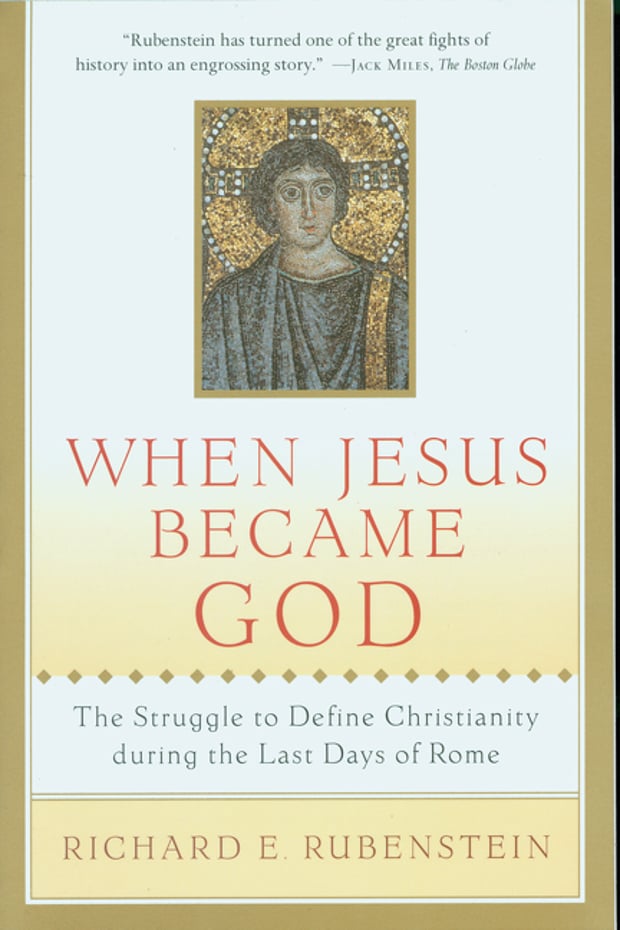
When Jesus Became God
The Struggle to Define Christianity During the Last Days of Rome
By Richard E Rubenstein
This book is about the disunity of Christian orthodoxy in the 3rd and 4th centuries, particularly as it relates to the nature of Jesus' divinity. Was he a human that acheived Godliness, or was he one-and-the-same with the 'Father' God? Scripture is not clear on this, and extremly passionate sects fought violently during this time to support their own interpretations; the Arians believed him to be a man that became God, and the Athansians believed him to be God that became man. (And don't even get started with the Holy Spirit). I actually really liked the Arian interpretation:
The heart of Arianism was the idea that radical improvements in human behavior need not await the apocalypse or be limited in this world to a cadre of religious specialists. With its popular base among city artisans and workers, sailors and merchants, monks, sodalities of virgins, and young people, it represented a radical impulse in Christianity: the drive to infuse worldly existence with the spirit of Christ, and so renew human society.
Arius’s Jesus: a beacon of moral progress sent not so much to rescue helpless humans as to inspire them to develop their own potential for divinity
What I really love about this book is the clarity it brings to the fact that orthodoxy is a very human and political process, and like everything else, it is shaped by the winners of that human process. The Jesus that is worshipped today by billions was very much defined by a small group of men in the 3rd and 4th centuries, and the driving decision maker was the emperor Constantine (and later Theodosius), who needed to create stability in a religion to keep his empire united and maintain power. While he certainly was a Christian, he was... conflicted... in his role as arbitor in this battle.
Was the Arian controversy resolved? Roman Catholic and Orthodox Christians who today recite the Nicene Creed (as amended at Constantinople) would doubtless answer, “Of course.” With the adoption of the Cappadocian Fathers’ theology, the Catholic Church recognized Jesus as God incarnate, the Second Person of the Holy Trinity. Arianism in its original form disappeared rapidly as a living force within the Roman Empire, and by the seventh century the last of the Arian tribes in Western Europe had been converted to Catholicism. About one thousand years later, Arian beliefs would be espoused by a number of well-known English Protestants, some of whom would go on to create Unitarianism. But for most Christians the question of Jesus Christ’s divinity was settled at Constantinople in 381
Tags:
religion trinity anthropology of religion anthropology288 pages
Published Aug 9, 2000 by HarperOne
Religion - Christianity - History
Religion - History
Religion - Christian Church - History
Religion - Christian Theology - Christology
Religion - Faith
Religion - Inspirational
Religion - Christian Living - Inspirational
Religion - Christianity - Protestant
Religion - Christianity - Quaker