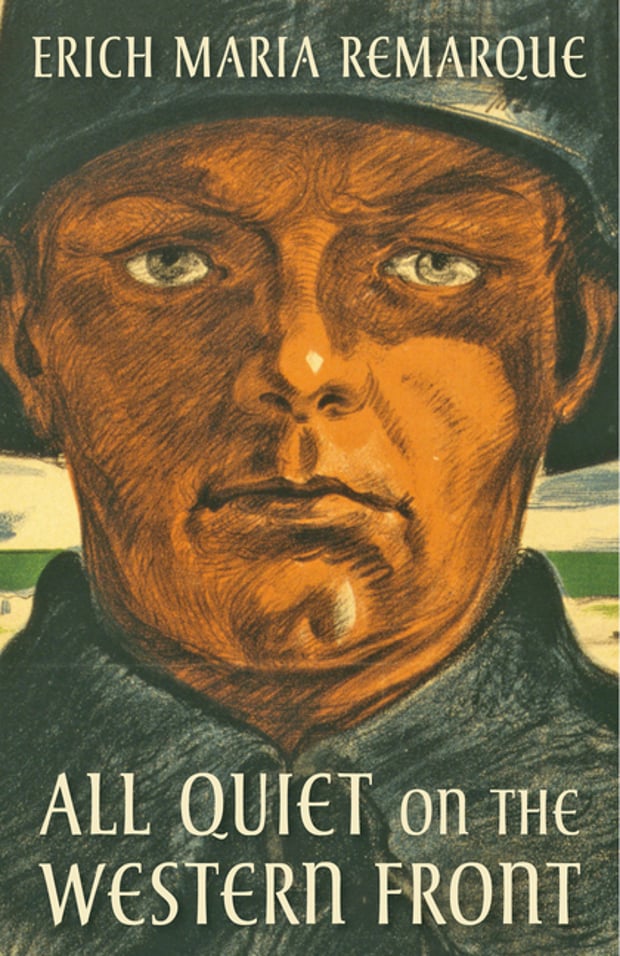
All Quiet on the Western Front
From the Vintage Classics series
Book 1 of the All Quiet on the Western Front series
Notes
Book club chose this for November since the month includes Veterans' Day in the U.S. Seemed appropriate.
Oh my. This book is devastating; possibly the best anti-war novel ever written. I can't remember the last time my emotions were so hammered in different directions over the course of less than 300 pages. It's not an easy read. Amend that: It's easy to read - accessible, not dense or confusing. But it's hard on the emotions of any reader who approaches it honestly.
I wish I'd read it 50 years ago. I might have understood some things a lot better, things that I misunderstood at the time.
Anyway. Notes from as I was reading. ...
The horses. I almost stopped reading after that horrible scene with the horses, early in the book. Then I start chastising myself for getting upset over the cruel, unnecessary deaths of horses when humans are being cruelly and unnecessarily killed on every page.
It's bothersome.
This is a harrowing read, but oddly, after reading accounts of the brutal unrelenting horror of war, the chapter that tore me up the most was in the middle of the book, when Paul goes home on leave. And he's just... not there any more. It's heartbreaking.
Chapter 9: This book is killing me. I can barely read through my tears.
"[Kropp] is a thinker. He proposes that a declaration of war should be a kind of popular festival with entrance-tickets and bands, like a bull fight. Then in the arena the ministers and generals of the two countries, dressed in bathing-drawers and armed with clubs, can have it out among themselves. Whoever survives, his country wins. That would be much simpler and more just than this arrangement, where the wrong people do the fighting." -- chapter 3
"We are forlorn like children and experienced like old men, we are crude and sorrowful and superficial -- I believe we are lost." - chapter 6
"He [Paul's father] wants me to tell him about the front; he is curious in a way that I find stupid and distressing; I no longer have any real contact with him. There is nothing he likes more than just hearing about it. I realize he does not know that a man cannot talk of such things; I would do it willingly, but it is too dangerous for me to put these things into words. I am afraid they might then become gigantic and I be no longer able to master them. What would become of us if everything that happens out there were quite clear to us?" - Chapter 7
"It's queer, when one thinks about it," goes on Kropp, "we are here to protect our fatherland. And the French are over there to protect their fatherland. Now who's in the right?"
"Perhaps both," say I without believing it.
"Yes, well now," pursues Albert, and I see that he means to drive me into a corner, "but our professors and parsons and newspapers say that we are the only ones that are right, and let's hope so; -- but the French professors and parsons and newspapers say that the right is on their side, now what about that?"
"That I don't know," I say, "but whichever way it is there's war all the same..." - Chapter 9
"I am young. I am twenty years old; yet I know nothing of life but despair, death, fear, and fatuous superficiality cast over an abyss of sorrow. I see how people are set against one another, and in silence, unknowingly, foolishly, obediently, innocently slay one another. I see that the keenest brains of the world invent weapons and words to make it yet more refined and enduring. And all men of my age, here and over there, throughout the whole world see these things; all my generation is experiencing these things with me. What would our fathers do if we suddenly stood up and came before them and proffered our account? What do they expect of us if a time ever coms when the war is over? Through the years our business has been killing; -- it was our first calling in life. Our knowledge of life is limited to death. What will happen afterwards? And what shall come out of us?" - Chapter 10
"We have almost grown accustomed to it; war is the cause of death like cancer and tuberculosis, like influenza and dysentery. The deaths are merely more frequent, more varied and terrible." .... "The factory owners in Germany have grown wealthy..." ... "What use is it to him now that he was such a good mathematician at school?" - Chapter 11
"Had we returned home in 1916, out of the suffering and the strength of our experience we might have unleashed a storm. Now if we go back we will be weary, broken, burnt out, rootless, and without hope. We will not be able to find our way any more.
And men will not understand us - for the generation that grew up before us, though it has passed these years with us already had a home and a calling; now it will return to its old occupations, and the war will be forgotten - and the generation that has grown up after us will be strange to us and push us aside. We will be superfluous even to ourselves, we will grow older, a few will adapt themselves, some others will merely submit, and most will be bewildered; -- the years will pass by and in the end we shall fall into ruin." - Chapter 12
I'm part of the Vietnam generation, and this book is so very very applicable. It hurts.